
Walk through a long metro corridor at Châtelet and you may hear a cellist, a West African kora player, or a Peruvian panpipe trio before you see them — and every one of them has, in all likelihood, passed a formal audition to be there. Paris treats its underground musicians as a managed institution, not a free-for-all, which is why the sound in the tunnels is often startlingly good. This is Guide № 007 in The Love Paris Guide series.
Get the Full Collectible Guide (Free PDF)
Parisian Street Music & Buskers — in a beautifully designed, printable booklet. The Love Paris Guide № 007.
The Metro Audition Nobody Talks About
Since 1997, the musicians you hear in Paris Métro corridors have been part of an official accreditation scheme run by RATP, the city’s transport operator, through a body long known as Espace Métro Accords. Performers apply, play a short live audition before a panel, and — if selected — receive a badge that lets them play in designated spots across the network. The accreditation is free and typically runs for about six months before it must be renewed, which keeps the roster rotating.
Competition is real: each audition season draws well over a thousand hopefuls, and only a few hundred are accredited at any given time. The badge comes with rules — play only at marked locations, not on platform edges or inside trains, and keep amplification within limits. The buskers who ignore all this and perform on carriages between stations are, strictly speaking, operating outside the official system.
Above Ground: Bridges, Squares and Permits
Street performance on the surface is governed by the Ville de Paris rather than the transport authority, and the rules vary by district and by whether a performer is amplified or passing a hat. Certain locations have become unofficial institutions anyway. The Pont Saint-Louis, the small pedestrian bridge linking Île de la Cité to Île Saint-Louis, has hosted jazz bands and chansonniers for decades, its stone parapets acting as a natural amphitheatre behind Notre-Dame.
Up in Montmartre, the Place du Tertre and the steps below the Sacré-Cœur basilica draw a steady stream of guitarists and accordionists; the area’s tourism information is coordinated through the city’s official visitor bureau, Paris je t’aime. As a rule, the best pitches are claimed early, and performers generally respect an informal first-come order rather than fighting over a corner.
Why the Accordion Became the Sound of Paris
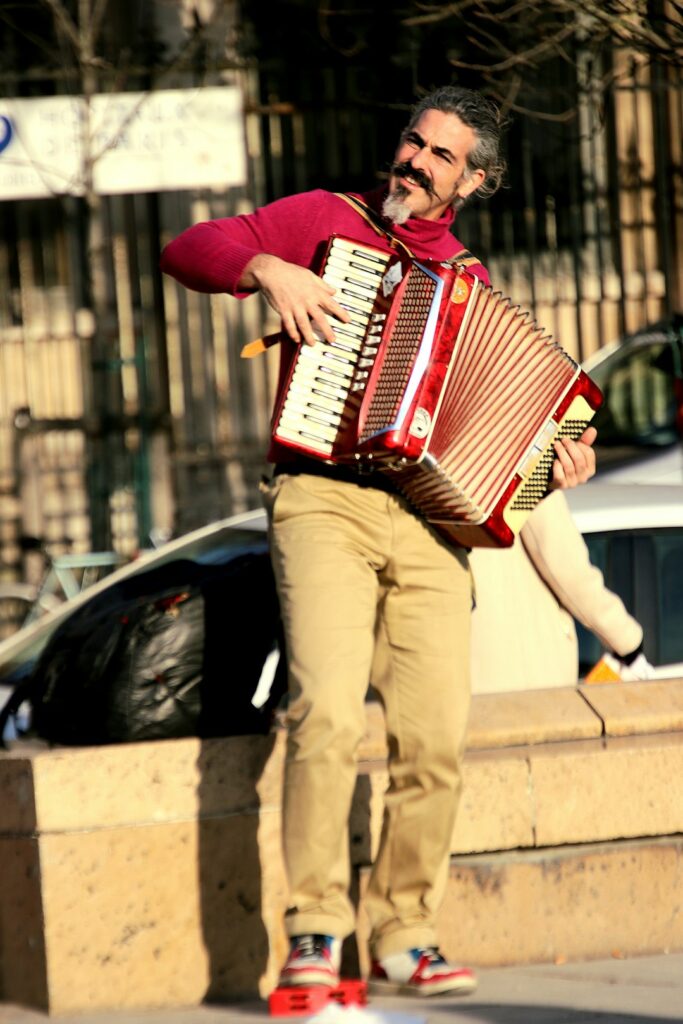
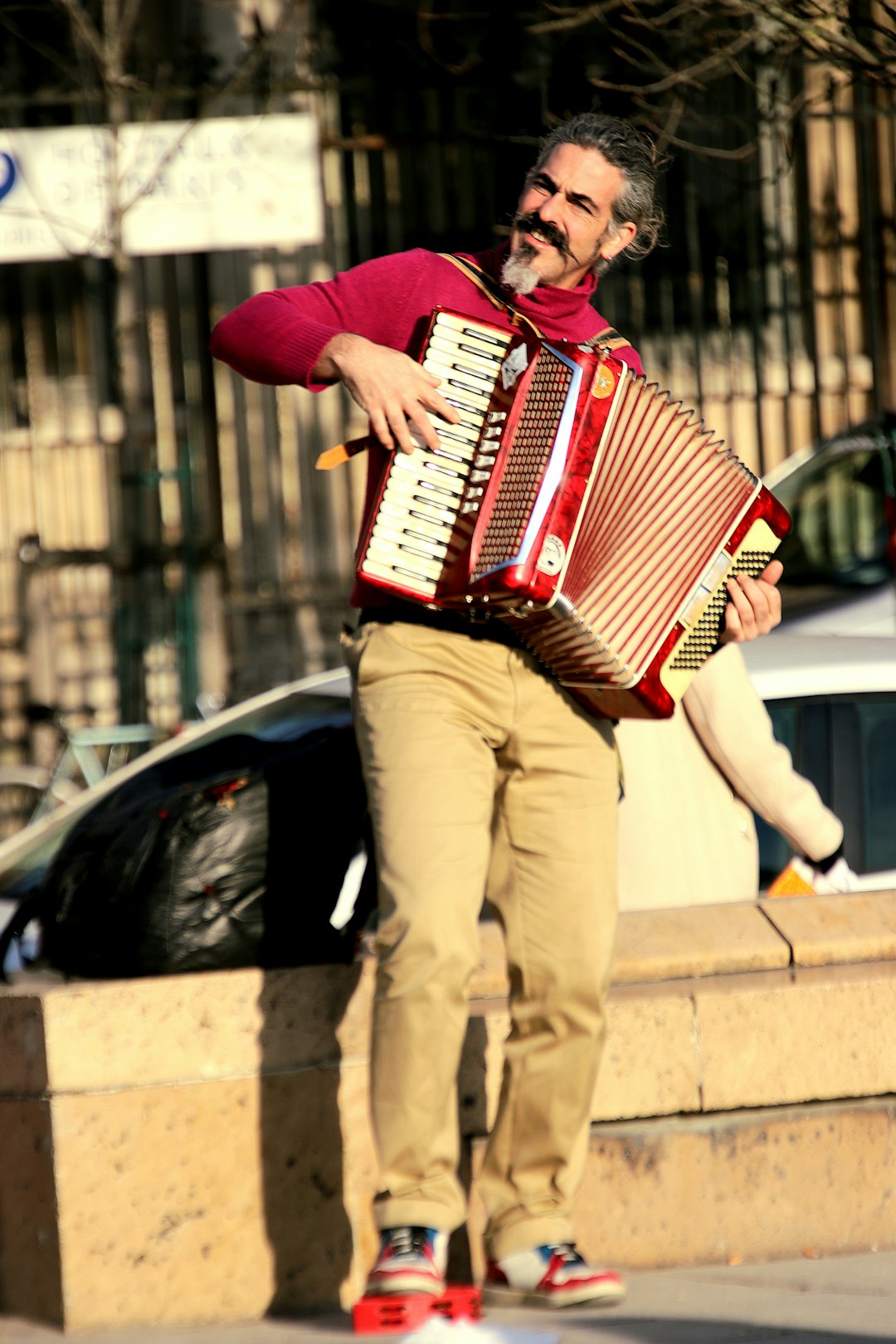
The wheezing accordion that film soundtracks reach for the instant a scene lands in Paris is not a cliché invented by Hollywood — it grew out of the bal-musette, the working-class dance halls that flourished in the city from the late 19th century into the mid-20th. Italian and Auvergnat immigrant communities pushed the accordion to the centre of that scene, and the style seeped into café culture and, eventually, the streets.
A separate tradition, the orgue de Barbarie or hand-cranked barrel organ, is still worked by a handful of dedicated players in Montmartre and along the quays. It is genuinely old technology — a pinned cylinder or perforated card triggers the pipes — and the people who maintain and perform on these machines treat them as living heritage rather than novelty.
From the Pavement to the Record Deal
Paris busking has a long habit of producing stars. Édith Piaf sang on street corners in Belleville and Pigalle as a teenager in the 1930s before a nightclub owner discovered her. More recently, the metro and street scene has been a proving ground for musicians who go on to tour, and RATP has leaned into this by staging competitions and showcases for its accredited players. The underground, in other words, functions partly as an open-air conservatory.
The One Day the Whole City Plays
Every 21 June, Paris and the rest of France turn over to the Fête de la Musique, the free music festival launched in 1982 by the Ministère de la Culture under then-minister Jack Lang. For one evening, amateurs and professionals play on pavements, in doorways and squares across the city with far looser restrictions than usual. It is the single best day to hear Parisian street music at full volume, and the model has since spread to well over a hundred countries.
Myths Worth Retiring
Myth: Anyone can just set up and play in the metro. In practice, the official corridor spots require an RATP audition and badge; the performers slipping between train cars are the exception, not the system.
Myth: Buskers and tipping are illegal in Paris. Accredited and permitted street performance is entirely legal, and passing a hat is expected — it is unlicensed amplified pitching in restricted zones that gets moved on.
Myth: The accordion stereotype is a modern invention. It descends directly from the real bal-musette dance halls of immigrant Paris, not from film shorthand.
Frequently Asked Questions
Are you supposed to tip street musicians in Paris?
Yes. There is no fixed amount, but dropping a coin or two into an open case is the normal courtesy if you stop to listen, and a euro or more is welcome for a full song.
Where can we reliably hear good street music?
The Pont Saint-Louis behind Notre-Dame, the busier Métro interchanges such as Châtelet and Saint-Michel, and the slopes of Montmartre are dependable. For the widest range, come on 21 June for the Fête de la Musique.
How do musicians get the official Métro badge?
They apply to RATP’s accreditation programme and perform a live audition before a selection panel. Successful applicants receive a time-limited, renewable badge that permits them to play at designated spots in the network.
More The Love Paris Guides
The Love Paris Guide is a numbered series — one tightly focused subject at a time, each with its own downloadable collectible edition. Guide № 001 is The Baguette, Guide № 002 is Bastille Day in Paris, Guide № 003 is The Eiffel Tower, Guide № 004 is Parisian Café Wine Culture, Guide № 005 is Parisian Café Etiquette, Guide № 006 is Parisian Cocktail Culture, This is Guide № 007. More editions are on the way.
🇫🇷 Join Love Paris
Every week, get hidden stories, local secrets, and travel inspiration from people who live and love it.
Tours & experiences in Paris


Powered by Viator. Some links are affiliate links — we may earn a small commission at no extra cost to you.