
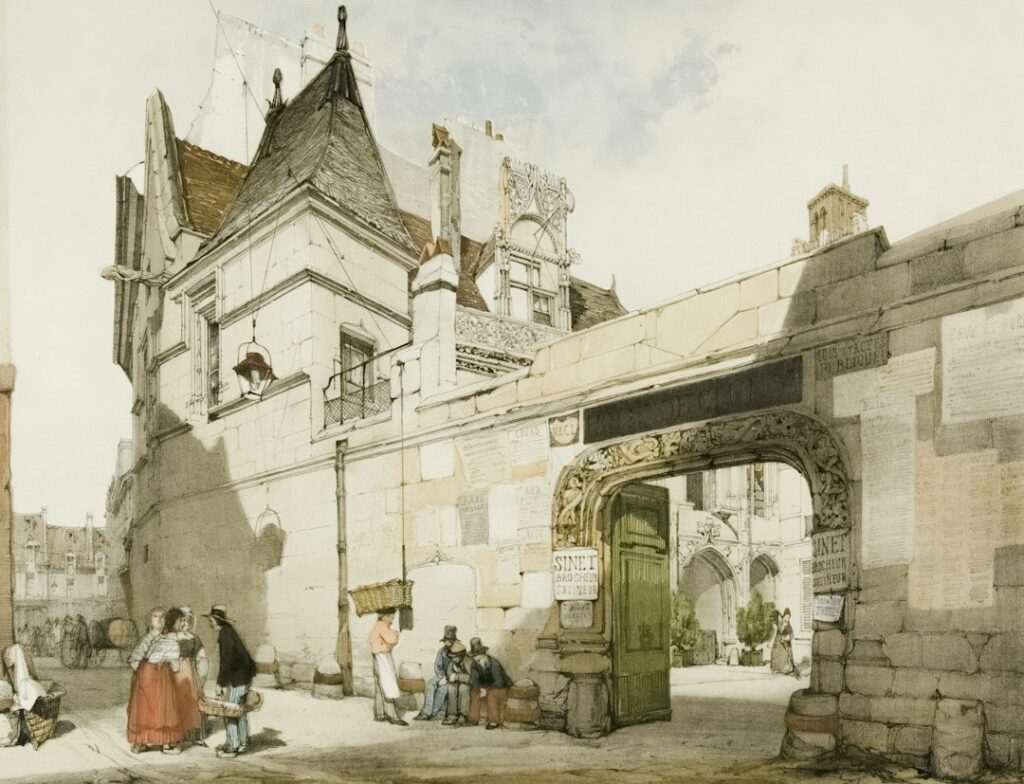
Most visitors to Paris chase Impressionism at the Orsay or Renaissance masterpieces at the Louvre. Meanwhile, the Musée de Cluny sits quietly at the corner of Boulevard Saint-Michel and Boulevard Saint-Germain, holding one of the world’s finest collections of medieval art inside a fifteenth-century townhouse built over Roman ruins. If you want to understand Paris before Haussmann reshaped it, before the Revolution tore it down, this is where you come.
The museum itself is two monuments in one: the Hôtel de Cluny, a Gothic mansion completed around 1500 for the abbots of Cluny, and the Thermes de Cluny, second-century Roman baths that predate the city’s medieval incarnation by a thousand years. You walk through both on a single visit, moving from cold stone vaults where Romans once bathed to timber-beamed chambers filled with illuminated manuscripts, carved choir stalls, and stained glass salvaged from Sainte-Chapelle.
The Lady and the Unicorn
The museum’s crown jewel hangs in a circular room designed specifically to display it: La Dame à la Licorne, a set of six tapestries woven in Flanders around 1500. Five represent the senses—taste, hearing, sight, smell, touch—while the sixth, inscribed “À mon seul désir” (To my sole desire), depicts the lady returning her jewels to a casket, an allegory scholars still debate.
The tapestries unfold in deep reds and blues against a background dense with flowers, rabbits, and a thousand tiny details. A lion and a unicorn flank the lady in each panel. Stand close enough and you’ll see individual threads, the slight fading where light has touched the fabric over five centuries. The room is kept dim to preserve them, which only adds to the intimacy. You’re not looking at museum pieces; you’re standing in someone’s medieval chamber.
Visit early—the museum opens at 9:30 a.m. Tuesday through Sunday—and you might have the tapestries to yourself for ten minutes before the tour groups arrive.
The Roman Baths and Gothic Fragments
Downstairs, the frigidarium (cold bath) of the Roman baths survives almost intact, its vaulted ceiling soaring nearly fifteen meters high. The stonework is rough, massive, built to last—and it has, for eighteen centuries. The space now houses fragments of medieval Paris: column capitals from Notre-Dame, heads of the kings of Judah smashed from the cathedral’s facade during the Revolution, pieces of the Sainte-Chapelle.
These aren’t minor relics. The twenty-one stone heads from Notre-Dame were rediscovered in 1977, buried in a basement on Rue de la Chaussée-d’Antin. They’d been hidden there since 1793, when revolutionaries mistook the biblical kings for French monarchs and tore them down. Now they line the frigidarium wall, silent witnesses to the violence that reshaped Paris.
Don’t miss the pillar of the Boatmen, a first-century monument carved by the Parisian guild of river merchants when the city was still called Lutetia. It’s the oldest sculpture created in Paris, mixing Roman gods with Celtic deities—a snapshot of a culture caught between two worlds.
Practical Details
The Musée de Cluny is at 28 Rue du Sommerard in the 5th arrondissement. The closest metro stops are Cluny-La Sorbonne (line 10) and Saint-Michel (lines 4 and 10). It’s a five-minute walk from the Seine, tucked behind the Sorbonne in a quiet pocket of the Latin Quarter that still feels medieval once you step off the main boulevards.
Admission is €12, free for EU residents under 26, and free for everyone on the first Sunday of each month. The museum is closed Mondays. Audio guides are available in English and worth the extra few euros—the collection spans a thousand years and dozens of artistic traditions, and context helps.
Budget two hours if you want to read the labels and linger over details. The museum isn’t large, but it’s dense. You’ll find medieval playing cards, Books of Hours illuminated by hand, ivory caskets carved with courtly love scenes, and entire altarpieces rescued from demolished churches. Every object has survived wars, revolutions, and centuries of neglect to end up here.
After your visit, walk east along Rue de la Harpe into the tangle of narrow streets that make up the oldest part of the Latin Quarter. Rue de la Huchette and Rue de la Parcheminerie still follow their medieval routes. The buildings are newer, but the street plan is the same one monks and students walked in the thirteenth century.
The Musée de Cluny isn’t on most first-time itineraries, which is exactly why it belongs on yours. It’s quiet, specific, and utterly Parisian in the way it layers centuries on top of each other without fuss. You walk in through Roman ruins, climb medieval stairs, and stand in front of tapestries that were already antiques when Leonardo da Vinci died. That’s Paris in three rooms.
Want one story like this in your inbox each morning? Subscribe to the Love Paris newsletter and start your day with the city beyond the guidebooks.
Tours & experiences in Paris


Powered by Viator. Some links are affiliate links — we may earn a small commission at no extra cost to you.