
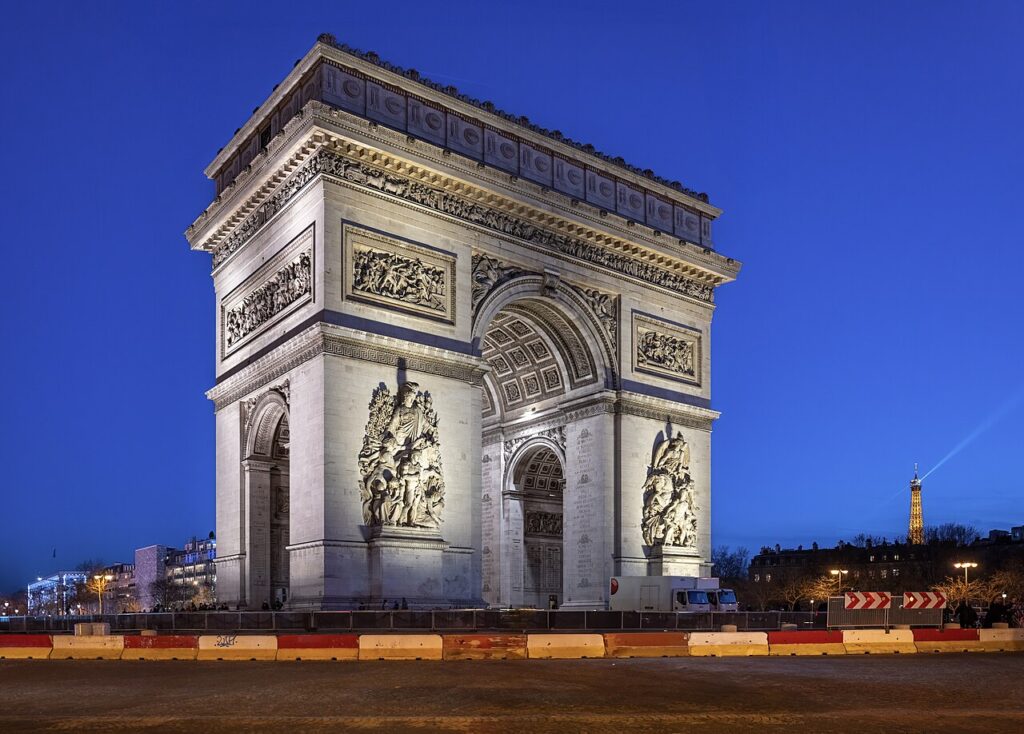
The Arc de Triomphe stands at the center of the Place Charles de Gaulle, where twelve avenues radiate outward like the spokes of a wheel. Napoleon commissioned it in 1806 to honor his Grande Armée, but he never saw it finished. The arch was completed in 1836, fifteen years after his death. Today, it’s one of Paris’s most recognizable monuments and home to France’s Tomb of the Unknown Soldier.
This isn’t just a monument to look at from the street. Climb to the top, and you’ll understand why Haussmann designed Paris the way he did.
Getting There and Getting In
The Arc sits at the western end of the Champs-Élysées. Take Metro line 1, 2, or 6 to Charles de Gaulle–Étoile. When you exit the station, follow signs for the Arc de Triomphe—do not attempt to cross the traffic circle at street level. The roundabout is one of the most chaotic intersections in Europe, with no lanes and no rules beyond survival. Use the underground pedestrian tunnel that leads directly to the monument.
The entrance to the Arc de Triomphe is at the base, inside the tunnel. You can purchase tickets on-site or skip the line with advance booking. The monument is included in the Paris Museum Pass. Admission is free for visitors under 18 and EU residents under 26.
The climb to the top is 284 steps up a narrow spiral staircase. There is no elevator for visitors. If you have mobility concerns, you can still visit the ground level to see the Tomb of the Unknown Soldier and the interior sculptures.
What You’ll See at Ground Level
Four massive relief sculptures adorn the arch’s pillars. The most famous is François Rude’s La Marseillaise (officially titled Departure of the Volunteers of 1792), which faces the Champs-Élysées on the right pillar. The winged figure of Liberty rallies soldiers to battle, her mouth open in a call to arms. It’s one of the most dynamic pieces of public sculpture in Paris.
The interior walls are engraved with the names of 558 French generals who served during the Revolution and the Empire. The names of major battles—Austerlitz, Jena, Friedland—are carved into the upper surfaces. Underneath, the Tomb of the Unknown Soldier from World War I has burned with an eternal flame since 1921. Every evening at 6:30 p.m., veterans’ associations rekindle the flame in a brief ceremony open to the public.
The View from the Top
The platform at the top of the Arc offers a 360-degree panorama of Paris. To the east, the Champs-Élysées stretches in a perfectly straight line toward the Place de la Concorde, the Tuileries Garden, and the Louvre. On a clear day, you can see all the way to the glass pyramid.
To the west, the Grande Arche de la Défense continues the axis Napoleon began. The modern arch, completed in 1989, aligns with the Arc de Triomphe and the Louvre in what’s called the Axe Historique, or Historical Axis—a six-kilometer sight line through the heart of Paris.
Look down at the traffic circle, and you’ll see how the twelve avenues converge: Avenue Foch, Avenue de la Grande Armée, Avenue Hoche, Avenue Marceau. Haussmann’s urban design becomes clear from this height. The boulevards weren’t just for beauty—they were engineered for movement, sight lines, and military control.
The best light for photography is late afternoon, when the sun illuminates the Champs-Élysées and the distant glass towers of La Défense catch the golden hour. Sunset from the platform is spectacular, but arrive early—the monument closes at 10:30 p.m. in summer and 10 p.m. the rest of the year.
Practical Tips
The Arc de Triomphe is open daily except for major holidays (May 1, July 14 morning for the military parade, and December 25). Hours are 10 a.m. to 10:30 p.m. from April through September, and 10 a.m. to 10 p.m. from October through March. Last admission is 45 minutes before closing.
Security screening at the entrance can create lines during peak season, especially mid-morning and early afternoon. Visit early (right at opening) or late (after 5 p.m.) to avoid crowds. Wednesday and Friday afternoons are typically quieter than weekends.
If you’re combining this with other major sites, consider the Paris Museum Pass. It covers the Arc de Triomphe, the Louvre, Sainte-Chapelle, Versailles, and dozens of other monuments, with skip-the-line access at most.
After your visit, walk east down the Champs-Élysées toward the Grand Palais, or head south on Avenue Marceau to the Trocadéro for the classic Eiffel Tower view. If you’re hungry, avoid the overpriced cafés on the Champs—walk north into the residential streets of the 17th arrondissement for neighborhood bistros and bakeries where Parisians actually eat.
Want one short, well-researched story about Paris in your inbox every day? Subscribe to the Love Paris newsletter and discover the city beyond the guidebooks—one perfect story at a time.
Tours & experiences in Paris


Powered by Viator. Some links are affiliate links — we may earn a small commission at no extra cost to you.