
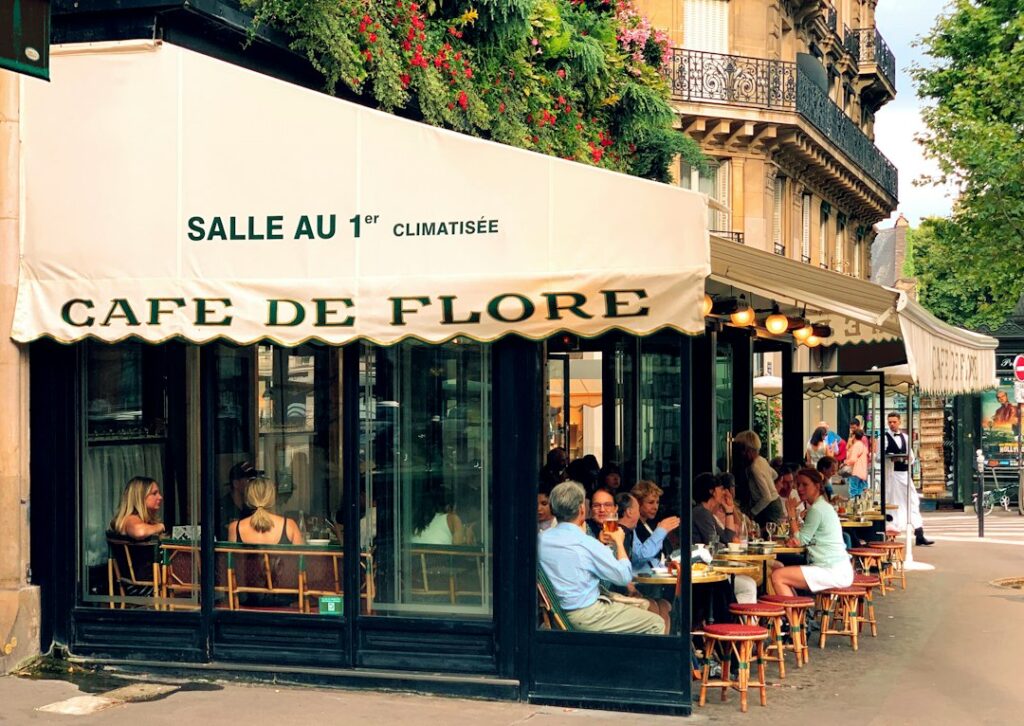
At the corner of Boulevard Saint-Germain and Rue Saint-Benoît, Café de Flore has served coffee, philosophy, and people-watching since 1887. This isn’t just another pretty Parisian café—it’s where existentialism was born over espresso, where Simone de Beauvoir held court every afternoon, and where the intellectual life of the Left Bank still unfolds beneath red banquettes and Art Deco mirrors.
Understanding Flore means understanding a particular strain of Parisian café culture: serious, literary, unapologetically intellectual, yet never pretentious about a perfectly made croque-monsieur.
The Literary History That Still Lives
Jean-Paul Sartre and Simone de Beauvoir made Flore their office during the Occupation, writing here because their apartments were unheated. Sartre penned Being and Nothingness at his regular table upstairs. Camus held debates here. Picasso sketched on napkins. Boris Vian played trumpet in the basement.
That history isn’t preserved behind velvet ropes—it’s alive in the DNA of the place. The same marble-topped tables remain. The same mirrors reflect the same kind of intense conversations. Publishers still meet writers here. Editors still mark up manuscripts over café crème.
The café awards its own literary prize, the Prix de Flore, every November. Winners receive a glass of Pouilly-Fumé daily for a year—paid at Flore, naturally. Past laureates include Patrick Modiano and Christine Angot.
What to Order and When to Visit
Breakfast at Flore is perfect: strong coffee, warm croissants, fresh orange juice, and the morning light streaming through tall windows. Arrive before 9 a.m. and you’ll find writers with notebooks, neighborhood regulars with their papers, and the quiet hum of a café waking up.
The hot chocolate here is legendary—served thick and dark in white porcelain, the way Parisians have taken it for generations. The croque-monsieur, grilled to order with proper Gruyère and butter, defines the genre.
For a meal, the Welsh rarebit is excellent, as is the club sandwich—simple bistro cooking done exactly right. The prix-fixe lunch offers good value for the location, though you’re really paying for the table, the atmosphere, and the permission to linger.
Avoid the prime afternoon hours (3 to 5 p.m.) when tour groups arrive. Early morning or after 9 p.m. belong to locals and regulars.
The Art Deco Interior and Where to Sit
The ground floor, with its red banquettes, mahogany trim, and large windows facing the boulevard, is where most visitors want to sit. It’s also the most expensive and often the most crowded. But the upstairs room—quieter, just as beautiful—is where Sartre preferred to work, and where you can actually hear yourself think.
The corner banquettes offer the best people-watching. The small tables by the window get the morning light. If you’re planning to write or read for a few hours, ask for a table upstairs.
Service is professional and brisk—these waiters have seen everything and aren’t easily impressed. Order clearly, respect their pace, and you’ll be treated well. Remember that in Parisian café culture, once you’re seated with a drink, the table is yours for as long as you like.
The Saint-Germain Context
Flore sits in the heart of literary Saint-Germain, surrounded by bookshops, publishing houses, and other legendary cafés. Les Deux Magots is directly across the square—the two cafés have been friendly rivals for over a century. Brasserie Lipp stands just down the boulevard.
After your visit, walk down Rue de l’Abbaye to the quiet Place de Furstenberg, one of Paris’s most beautiful small squares. The Saint-Germain-des-Prés church, just steps away, is the oldest in Paris. Shakespeare and Company’s Left Bank location is a fifteen-minute walk along the Seine.
The Métro stop is Saint-Germain-des-Prés (Line 4). From the Louvre or Notre-Dame, you can walk here in twenty minutes along the river, crossing at Pont des Arts or Pont Neuf.
What Makes It Worth Visiting
Yes, Café de Flore is famous. Yes, it’s more expensive than the café around the corner. But some places earn their reputation honestly, and this is one of them.
The coffee is excellent. The food is reliable. The interior is beautiful without being precious. And there’s something powerful about sitting where generations of writers and artists sat, doing the same thing you’re doing—watching Paris pass by, thinking, writing, or simply being present in one of the world’s great cities.
That continuity matters. Flore isn’t a museum of café culture; it’s a living example of it, still serving its original purpose after nearly 140 years.
Want more insider perspectives on Paris’s legendary cafés, hidden markets, and neighborhood secrets? Subscribe to the Love Paris newsletter and receive one short story about the city every day.
Tours & experiences in Paris


Powered by Viator. Some links are affiliate links — we may earn a small commission at no extra cost to you.