
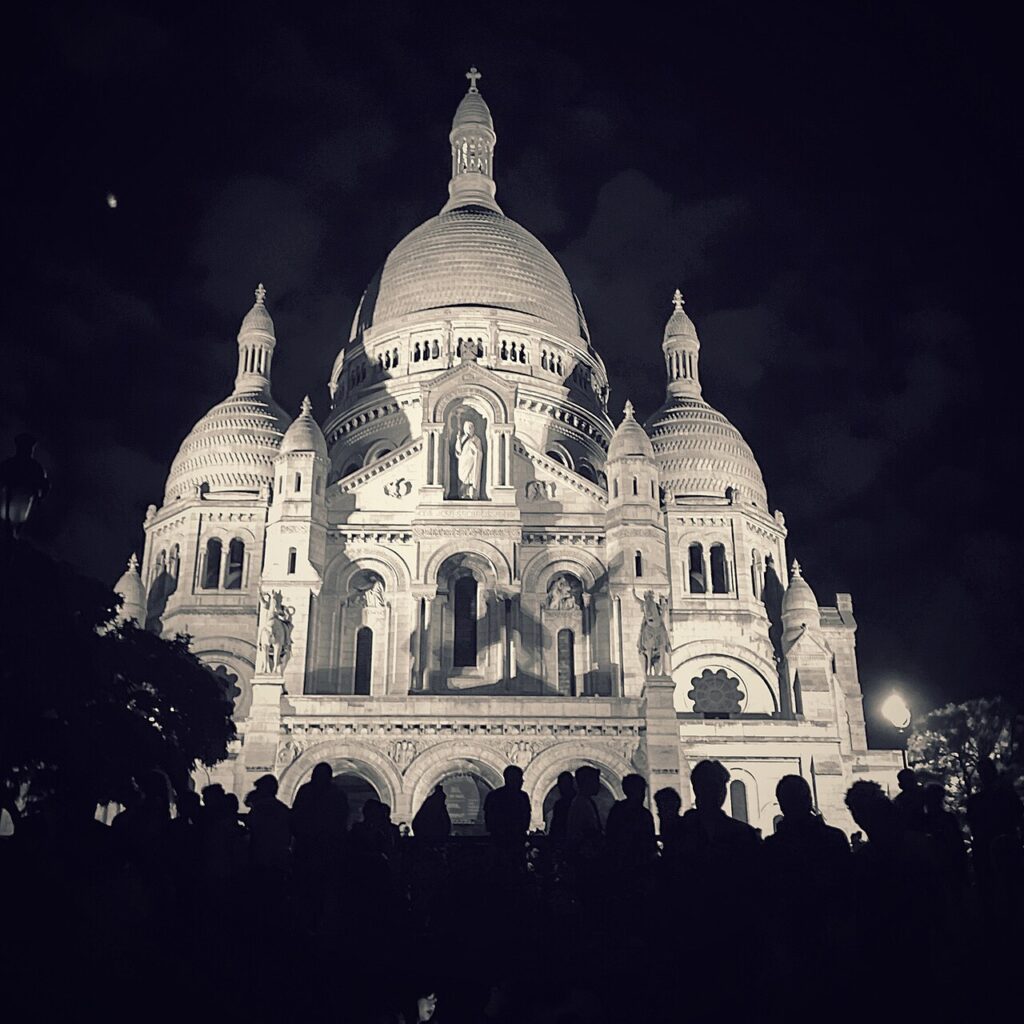
The white domes of Sacré-Cœur dominate the Parisian skyline from nearly every angle, but standing at its base—looking out over the rooftops of Paris—is an entirely different experience. Built on the summit of Montmartre at 130 meters above sea level, the Basilica of the Sacred Heart is both a spiritual landmark and one of the city’s most breathtaking viewpoints.
While it lacks the medieval gravitas of Notre-Dame or the Gothic intricacy of Sainte-Chapelle, Sacré-Cœur charms visitors with its Romano-Byzantine architecture, its luminous travertine stone that seems to glow even on gray days, and its sweeping panorama of the city below.
The Basilica: What to See Inside
Sacré-Cœur’s interior is vast, quiet, and unexpectedly serene given the crowds that gather on the steps outside. The basilica is free to enter, and once inside, your eyes will immediately be drawn upward to the massive mosaic of Christ in Majesty, one of the largest in the world at 480 square meters. Completed in 1922, the golden apse mosaic depicts Christ with outstretched arms, flanked by the Virgin Mary and Joan of Arc.
The nave is bathed in soft light filtered through stained glass windows, many of which were replaced after World War II. Unlike the ornate interiors of older Parisian churches, Sacré-Cœur feels more restrained, almost meditative. Photography is not permitted inside, so take a moment to simply absorb the atmosphere.
Perpetual adoration has been maintained here since 1885, meaning at any hour of the day or night, someone is praying before the exposed Blessed Sacrament. This devotional continuity gives the basilica a palpable sense of reverence that sets it apart from more tourist-heavy landmarks.
Climbing the Dome: Paris from Above
For one of the best views in Paris, buy a ticket to climb the dome. The entrance is outside to the left of the basilica’s main facade, and the ascent involves 300 narrow spiral steps—not for the claustrophobic or faint of heart, but absolutely worth the effort.
From the top, on a clear day, you can see up to 50 kilometers in every direction. The Eiffel Tower, the Tour Montparnasse, the golden dome of Les Invalides, and the Seine winding through the city all spread out below you. Early morning or late afternoon offers the best light and thinner crowds. The dome is open daily, and tickets cost around €8.
The Steps and the Square
The cascade of steps leading up to Sacré-Cœur is a gathering place in its own right. Street musicians, artists, and picnickers sprawl across the stone, especially on warm evenings when the city below begins to twinkle with lights. It’s a prime spot for watching the sunset over Paris, though be mindful of your belongings—pickpockets are active here.
At the base of the hill, Square Louise Michel offers a gentler vantage point with benches and greenery, perfect if you want the view without the climb. The funicular railway runs from here to the top, covered by a standard metro ticket, and is a godsend if you’re traveling with young children or have mobility concerns.
When to Visit and How to Get There
Sacré-Cœur is open daily from 6 a.m. to 10:30 p.m., and admission to the basilica itself is free. The dome and crypt require separate tickets. Arrive early—before 9 a.m.—to experience the basilica in relative peace before tour groups arrive. Sunset is popular but crowded; mid-afternoon on weekdays strikes a good balance.
The nearest metro station is Anvers (line 2), from which it’s a steep but scenic walk up through Place Saint-Pierre and Rue de Steinkerque. Alternatively, take the funicular from the base of the hill. Abbesses (line 12) is another option, though it involves more walking through Montmartre’s winding streets—charming, but tiring if you’re short on time.
Dress modestly if you plan to enter the basilica; shoulders and knees should be covered. The area can be touristy, so skip the overpriced cafés immediately surrounding the basilica and wander down into the quieter streets of Montmartre for a more authentic meal or coffee.
Combining Sacré-Cœur with Montmartre
Sacré-Cœur anchors the top of Montmartre, so it pairs naturally with a morning or afternoon exploring the neighborhood. After visiting the basilica, stroll west along Rue du Chevalier de la Barre to Place du Tertre, the artists’ square, or meander down Rue Lepic past the Café des Deux Moulins (of Amélie fame) and the last remaining windmills.
For a guided introduction to the area, consider joining a walking tour that includes both Sacré-Cœur and Montmartre’s hidden corners—it’s an efficient way to uncover stories and details you’d otherwise miss.
Whether you come for the views, the architecture, or a moment of quiet reflection, Sacré-Cœur delivers an experience that’s uniquely Parisian—grand yet intimate, sacred yet accessible to all.
Want more stories like this in your inbox? Subscribe to the Love Paris newsletter and get one short story about Paris delivered to your inbox every day.
Tours & experiences in Paris


Powered by Viator. Some links are affiliate links — we may earn a small commission at no extra cost to you.