
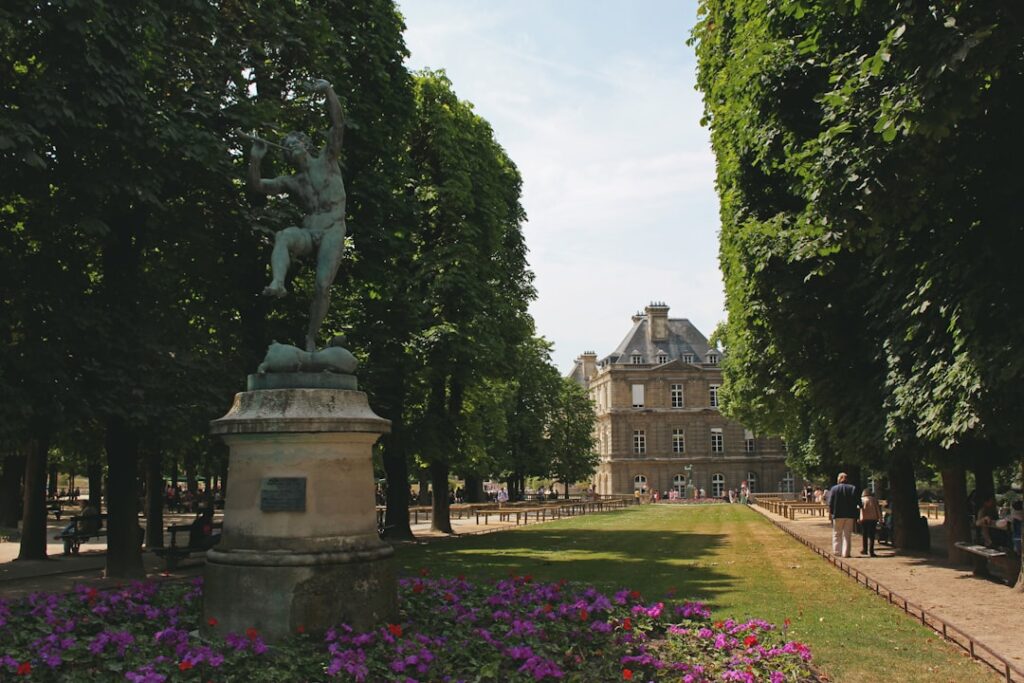
The Luxembourg Gardens may be Paris’s most beloved park, but most visitors never venture beyond the central lawn and the famous green chairs surrounding the octagonal pond. Behind the postcard scenes, this 25-hectare royal garden conceals apple orchards, beehives, puppet theaters, and meditative groves where you can sit for an hour without seeing another tourist.
I’ve been coming here for years, and I still discover new corners. Here’s where to find the Luxembourg Gardens that guidebooks miss.
The English Garden and the Medici Fountain
Walk to the northeast corner of the park, away from the palace, and you’ll enter a completely different world. The English Garden feels like a secret forest transplanted into the 6th arrondissement. Unlike the formal French parterre with its geometric precision, this section features winding paths, towering plane trees, and wild undergrowth.
The Medici Fountain sits at the far end of a long, narrow pool covered in algae and lily pads. Marie de Medici commissioned it in 1630 as a reminder of her Florentine childhood. Most visitors snap a photo from the front, but walk around to the back to find the Fontaine de Léda, a quiet Renaissance relief that almost no one sees.
Come early morning—before 8 a.m. in summer—and you’ll have this corner entirely to yourself. The light filters through the leaves, and the only sound is water trickling and birds calling from the chestnuts overhead.
The Orchards and Beehives
On the western side of the garden, near the Rue Guynemer gate, the Luxembourg maintains working fruit orchards and apiary that date back to the 19th century. You can’t enter the fenced areas, but you can peer through to see espaliered apple and pear trees trained against stone walls, exactly as they would have been tended in a monastery garden.
The beehives—more than a dozen of them—produce honey sold each September at the park’s annual honey harvest festival. Free beekeeping courses are offered here through the Société Centrale d’Apiculture, and you’ll often see beekeepers in full suits tending the hives on weekday afternoons.
Just south of the orchards, you’ll find the nursery greenhouses where all the park’s seasonal flowers are propagated. Through the glass, you can watch gardeners potting geraniums and begonias that will later fill the hundreds of pots placed throughout the garden. It’s a working garden, not just a pretty one.
The Statues You’ve Never Noticed
Everyone photographs the Statue of Liberty replica near the west gate, but the Luxembourg contains more than 100 other sculptures, most of them portraits of French queens and notable women. The long terrace flanking the palace features 20 queens of France, from Bertha of Burgundy to Anne of Austria, each standing in an alcove among the horse chestnuts.
My favorite is tucked away in the southwest corner: George Sand, the novelist and feminist, sitting with a book open on her lap. Sculpted by François Sicard in 1904, it captures her looking thoughtful and slightly defiant—exactly as she must have been when she scandalized Paris by wearing trousers and smoking cigars in public.
Near the tennis courts on the south side, look for Paul Verlaine, the symbolist poet, reclining as if he’s just collapsed after a night of absinthe. It’s wonderfully decadent and often has fresh flowers left by admirers.
Where Parisians Actually Sit
Forget the crowded central lawn. Real regulars know the quiet spots. The philosophy garden near Rue Auguste-Comte has benches beneath linden trees where students from the nearby Sorbonne come to read. The raised terrace on the east side, overlooking the Panthéon, catches the late afternoon sun and is nearly empty even in July.
My own favorite spot: the chairs tucked behind the puppet theater (Théâtre du Luxembourg), facing the playground but set back among the trees. You can hear children laughing, but you’re removed enough to feel wonderfully removed from the world. Bring a book, a coffee from Strada Café on Rue Monsieur le Prince, and settle in for the afternoon.
The southwest corner near the Orangerie offers another sanctuary. Stone benches sit in a semicircle beneath pollarded lindens, and there’s almost never anyone there except for the occasional art student sketching.
Practical Tips for Your Visit
The Luxembourg Gardens open at 7:30 a.m. in summer and 8:15 a.m. in winter, closing at sunset. Enter from the Rue de Vaugirar gate on the north side to reach the English Garden most directly, or use the Rue Auguste-Comte entrance on the south for quickest access to the orchards.
The park is free, and the nearest métro stops are Odéon (lines 4 and 10), Saint-Sulpice (line 4), or RER Luxembourg (line B). Bring your own chairs if you can—the famous green metal chairs are free to move anywhere, and locals arrive early on sunny days to claim the best spots.
If you’re visiting with children, the playground requires a small fee (around €2), but the pond where kids sail wooden boats is free. You can rent the boats for about €5 per half-hour from the kiosk on the north side of the octagonal basin.
The gardens are beautiful year-round, but May and June bring the horse chestnuts into bloom, and October turns the English Garden into a carpet of gold and russet leaves.
Want more Paris secrets in your inbox? Subscribe to the Love Paris newsletter and get one short story about Paris every day—the corners, the history, and the details that make this city unforgettable.
Tours & experiences in Paris


Powered by Viator. Some links are affiliate links — we may earn a small commission at no extra cost to you.