
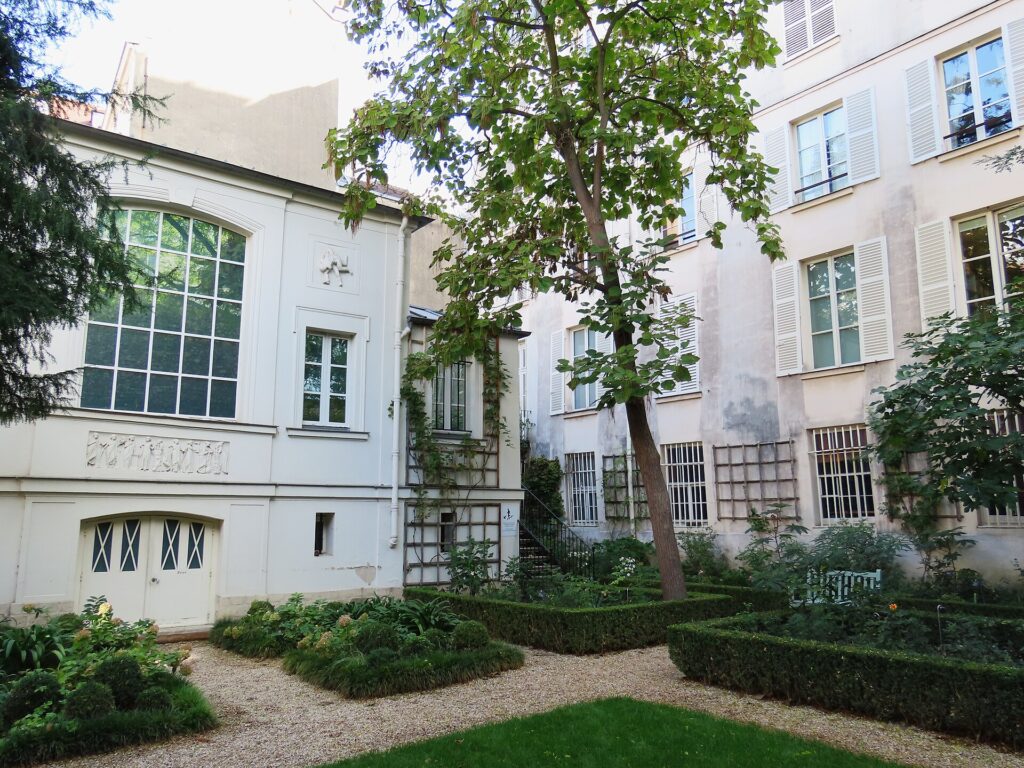
Tucked behind a courtyard on Place de Furstenberg, one of Paris’s most intimate squares, the Musée national Eugène Delacroix occupies the apartment and studio where the painter lived from 1857 until his death in 1863. Unlike the grand museums of Paris, this is an artist’s home frozen in time—three rooms of living quarters, a garden studio flooded with north light, and the walled garden he looked out on while he finished his last great commission, the murals in the church of Saint-Sulpice.
The museum sits in the heart of Saint-Germain-des-Prés, a neighborhood Delacroix chose deliberately. At 59, already suffering from chronic throat infections, he moved here to be closer to the church where he was painting murals. The apartment gave him what he needed: high ceilings, large windows, and most crucially, a separate studio he could build in the garden, away from the noise of the street.
The Apartment and Garden Studio
Delacroix’s living quarters occupy the second floor of 6 rue de Furstenberg. The rooms are modest—a bedroom, a library, a salon—but they reveal the painter’s dual life as both society figure and working artist. He was a great reader of Shakespeare and Byron, and the friend of George Sand, Chopin and, in his last years, Baudelaire.
The Paris most visitors miss
Our free 8-page PDF guide: 25 places, from Galerie Vivienne's 1880 mosaic floor to Canal Saint-Martin's locks, each linked to its official site.
The real heart of the museum is the garden studio, which Delacroix designed himself. He wanted uninterrupted light and built a tall, simple room with a wall of windows facing north. This is where he worked out his studies for the Saint-Sulpice murals, which he then painted straight onto the chapel walls.
The garden itself, walled and planted with catalpa trees, has been restored to something like its 19th-century character. In spring and summer it is a quiet place to sit and look up at the studio windows.
What You’ll See Inside
The museum’s collection is small but personal. You won’t find Delacroix’s most famous works here—Liberty Leading the People and The Death of Sardanapalus both hang in the Louvre—but you will see oil sketches, watercolors, drawings, and letters that show how he worked. The sketches for the Saint-Sulpice murals are particularly revealing: quick, loose studies where you can watch him thinking through composition and color.
There are paintings from his travels to Morocco in 1832, which transformed his use of light and color. Small portraits. Preparatory drawings for larger works. Objects from his life and studio. The collection rotates periodically, drawing on works held by the Louvre, which administers the museum.
The museum also runs temporary exhibitions, often exploring Delacroix’s influence on later artists—the Impressionists, Van Gogh, Cézanne—or his friendships with writers and musicians. The scale is intimate; you’re never more than a few steps from a painting.
Visiting the Museum
The Musée national Eugène Delacroix is at 6 rue de Furstenberg in the 6th arrondissement. The nearest Métro station is Saint-Germain-des-Prés (line 4) or Mabillon (line 10); both are a five-minute walk. You can also reach it easily from the Louvre or the Musée d’Orsay on foot, making it a natural stop on a day of museum-going.
The museum is small and rarely crowded, even in high summer. An hour is enough to see everything, though you may want to linger in the garden. Go in late morning when the studio light is strongest, or late afternoon when the garden is quiet. Check the official Musée Delacroix site before you visit for current hours, tickets and any temporary closures.
After Your Visit
Place de Furstenberg itself is worth a few minutes. It’s one of the smallest public squares in Paris, planted with white-globe streetlamps and paulownia trees. In the 18th century, this was the courtyard of the Abbaye de Saint-Germain-des-Prés; the cobblestones and scale remain unchanged.
The church of Saint-Sulpice is about a ten-minute walk away. Delacroix’s murals occupy the first chapel on the right as you enter: Jacob Wrestling with the Angel, Heliodorus Driven from the Temple, and a ceiling painting of Saint Michael Vanquishing the Demon. They are his last major work and many consider them his greatest. Entry to the church is free; bring binoculars if you want to study the ceiling.
The neighborhood is dense with galleries, antiquarian bookshops, and the cafés where Delacroix and his circle gathered. Rue de Seine and rue Jacob, a couple of minutes away, are lined with art galleries, and the Jardin du Luxembourg is about fifteen minutes on foot if you want more green space after the museum’s small garden.
Tours & experiences in Paris


Powered by Viator. Some links are affiliate links — we may earn a small commission at no extra cost to you.