
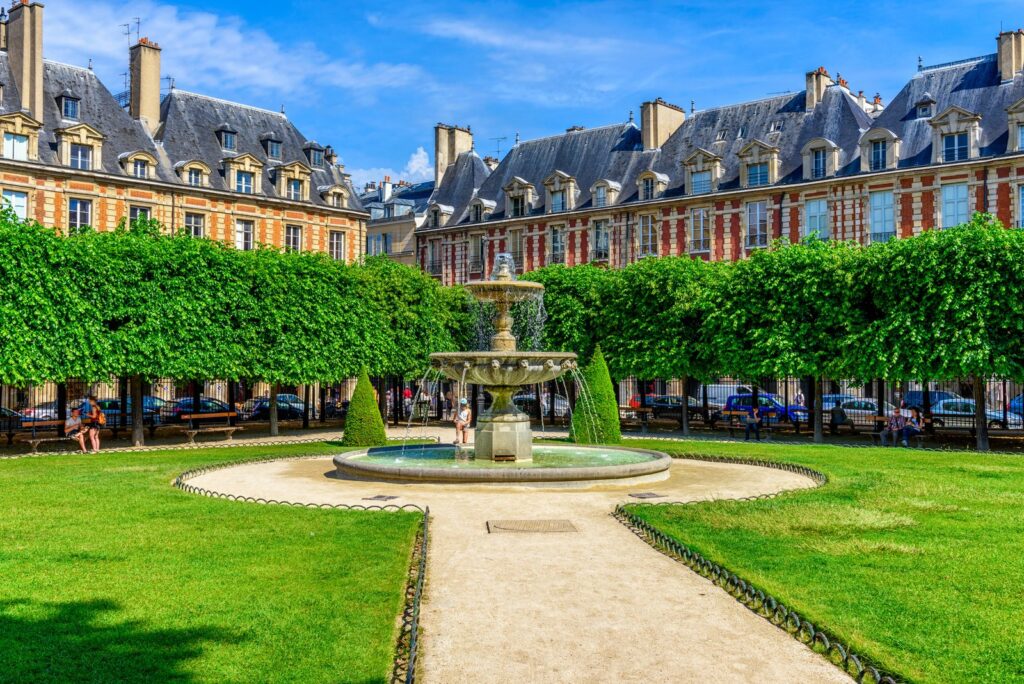
Place des Vosges sits like a perfectly preserved jewel box in the Marais, its red brick facades and steep slate roofs framing a square of linden trees and gravel paths. Built between 1605 and 1612 under Henri IV, it was Paris’s first planned public square—a radical idea at the time—and remains one of the city’s most beautiful.
The symmetry is the point. Thirty-six identical pavilions surround the central garden, each with ground-floor arcades of pale stone supporting two stories of rose-colored brick trimmed in white. The effect is both grand and intimate, a royal vision executed at human scale. Henri IV never saw it completed; he was assassinated in 1610, two years before the square opened as Place Royale. It took its current name in 1800 to honor the Vosges department, the first region to pay its taxes to the revolutionary government.
Walking the Arcades
The arcaded walkways are where Place des Vosges reveals its secrets. These covered galleries once sheltered silk merchants and royal courtiers; today they house art galleries, antiquarian bookshops, and a handful of quiet spaces where Parisians escape the rush of the surrounding streets.
The Paris most visitors miss
Our free 8-page PDF guide: 25 places, from Galerie Vivienne's 1880 mosaic floor to Canal Saint-Martin's locks, each linked to its official site.
Start at the Pavillon du Roi, the taller pavilion in the middle of the south side where Rue de Birague comes in, and walk all the way round. The rhythm of the arches creates a meditative pace—each column frames a new view into the square or out toward the Marais streets. On rainy days, the arcades offer shelter; on summer afternoons, their shade is a refuge.
The Maison de Victor Hugo occupies the southeast corner at number 6. The writer lived here from 1832 to 1848, and began Les Misérables in the second-floor apartment. The museum is free and worth visiting for the period rooms and the view back across the square. Check the official Maison de Victor Hugo site before you go.
The Garden at the Center
The central garden is a study in restraint. Four symmetrical lawns, graveled paths, and rows of linden trees clipped into perfect cubes. Parisians bring books, children, and picnic lunches. The benches along the perimeter fill quickly on weekends, but midweek mornings in spring or fall you can claim a seat in near-solitude.
The equestrian statue of Louis XIII in the center is a 19th-century replacement; the original bronze was melted down during the Revolution. The fountains at each corner are simple basins, not grand affairs—this is a square built for strolling and sitting, not spectacle.
In summer, musicians sometimes play under the arcades. Winter brings a quieter beauty: bare trees against brick, frost on the gravel, and the square to yourself before the city wakes.
Getting There and When to Visit
The closest métro stations are Saint-Paul (line 1), Bastille (lines 1, 5, and 8), and Chemin Vert (line 8). From Saint-Paul, walk along Rue Saint-Antoine to Rue de Birague, which delivers you through a vaulted passageway directly into the square—the best entrance for a first visit.
Early mornings are ideal, especially in spring when the lindens leaf out and the light slants low through the arcades. Late afternoons in autumn bring a golden glow to the brick and long shadows across the gravel. Avoid midday in July and August unless you enjoy crowds; the square is popular with tour groups in high summer.
The garden is open year-round, and the arcades are always accessible. Place des Vosges is a public square, not a ticketed site, which makes it one of Paris’s great free pleasures. Bring a book, claim a bench, and watch the city pass by at a 17th-century pace.
Tours & experiences in Paris


Powered by Viator. Some links are affiliate links — we may earn a small commission at no extra cost to you.