
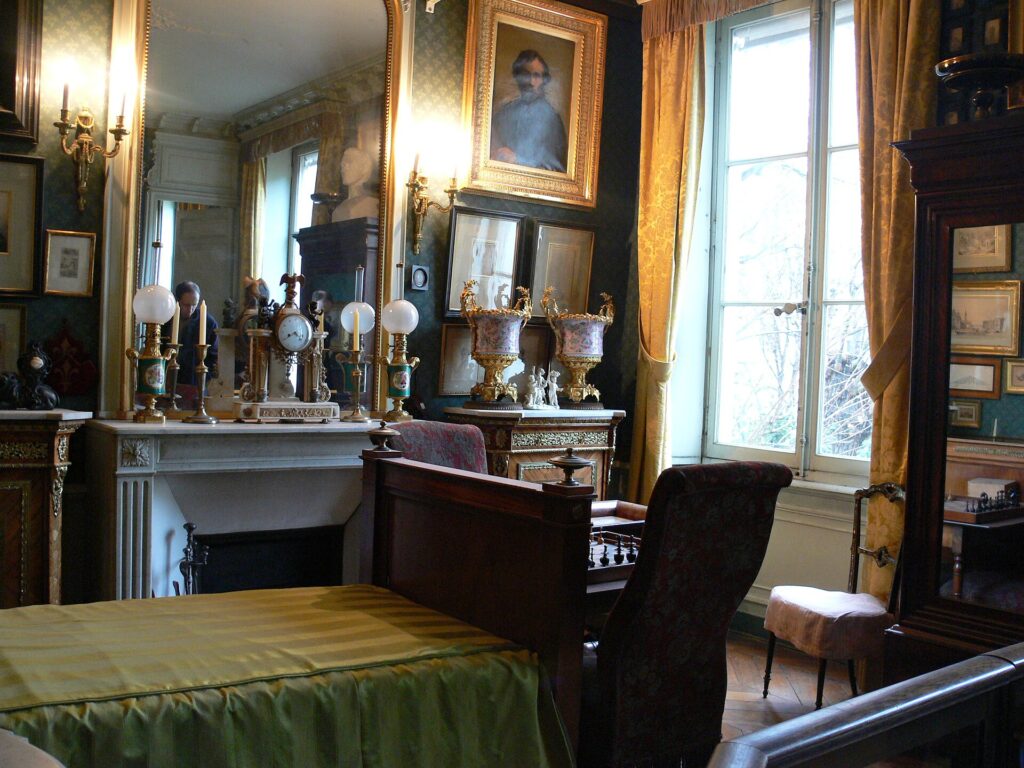
In a quiet residential street in the 9th arrondissement, the Musée Gustave Moreau offers one of Paris’s most unusual museum experiences. This is not a collection moved into a grand building—it’s the actual home and studio of Symbolist painter Gustave Moreau, preserved almost exactly as he left it when he died in 1898. He spent the last years of his life transforming his family house into a museum, installing spiral staircases, galleries, and display systems to show thousands of his paintings, watercolors, and drawings to future visitors.
The result is a time capsule of 19th-century artistic life, where you can see not just finished masterpieces but also sketches, studies, and experimental works stacked floor to ceiling in the very rooms where Moreau created them.
The Artist’s Private Apartments
The visit begins in Moreau’s private apartments on the first floor, kept as they were during his lifetime. These intimate rooms—bedroom, dining room, and small reception spaces—are filled with family furniture, personal objects, and paintings by other artists Moreau admired. The atmosphere is domestic and slightly faded, with velvet curtains, dark wood paneling, and the accumulated possessions of a comfortable bourgeois life.
The Paris most visitors miss
Our free 8-page PDF guide: 25 places, from Galerie Vivienne's 1880 mosaic floor to Canal Saint-Martin's locks, each linked to its official site.
This floor gives you a sense of the man before you encounter the overwhelming artistic production upstairs. His parents bought the house in 1852, and Moreau lived and worked here for the rest of his life, in the end giving the whole building over to his art.
The Studio Galleries
Go up to the studios and you enter a completely different world. The second and third floors are vast studio spaces with soaring ceilings, enormous windows, and walls covered floor to ceiling with paintings. The paintings hang edge to edge, and a spiral staircase links the two studio floors.
The density is extraordinary. Large mythological canvases depicting Salome, Orpheus, and Jupiter share space with smaller studies. Moreau’s Symbolist style—elaborate, dreamlike, filled with jewel-like detail and mysterious figures—creates an almost hallucinatory effect when you’re surrounded by dozens of works at once.
Don’t miss the cabinets of pivoting display panels, where Moreau stored hundreds of watercolors and drawings. You can flip through them like pages in a giant book, discovering layer after layer of preparatory sketches, alternative compositions, and experimental techniques.
The Unfinished Works
One of the museum’s revelations is seeing Moreau’s unfinished paintings and preparatory studies alongside completed works. Many canvases show only partial figures or roughly sketched backgrounds, revealing his working method. He would often complete faces and central figures in exquisite detail while leaving other areas as loose underpainting or even bare canvas.
The museum also preserves Moreau’s vast collection of reference materials—photographs, prints, and copies of works by Renaissance and Baroque masters he studied. You can trace how he absorbed influences from Mantegna, Leonardo, and Indian miniatures, transforming them into his distinctive Symbolist vision.
Planning Your Visit
The Musée Gustave Moreau is located at 14 rue Catherine de La Rochefoucauld in the 9th arrondissement, a short walk from the Trinité–d’Estienne d’Orves or Saint-Georges metro stations. The neighborhood itself is worth exploring—it’s the area known as the Nouvelle Athènes, where Romantic artists and writers lived in the 19th century, and many of their townhouses survive.
The museum is small and never crowded. Weekday mornings are particularly quiet, and you may have entire galleries to yourself. There’s no café and limited seating, but the visit takes about an hour to ninety minutes—longer if you examine the rotating watercolor panels in detail.
Check the official Musée Gustave Moreau site before you go for current visiting information. The house keeps its original staircases, so check access on the official site if stairs are hard for you.
After your visit, Square d’Orléans, the courtyard where George Sand and Chopin once lived, is a short walk away, and the Musée de la Vie Romantique is a few streets off on rue Chaptal. This corner of the 9th arrondissement preserves the atmosphere of artistic Paris in a way few other neighborhoods can.
Tours & experiences in Paris


Powered by Viator. Some links are affiliate links — we may earn a small commission at no extra cost to you.