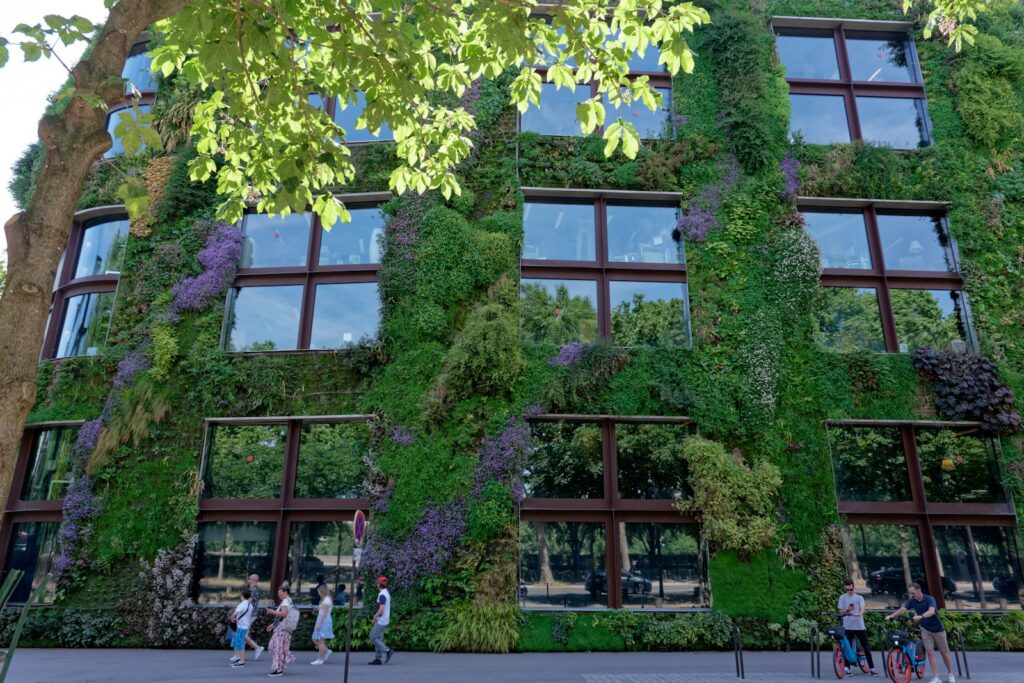
The Musée du quai Branly sits on a narrow strip of land between the Seine and the shadow of the Eiffel Tower, its rust-colored pillars and vertical garden visible from across the river. Architect Jean Nouvel designed the building to feel like a bridge between cultures, with ramps that spiral through galleries holding 3,500 objects from Africa, Asia, Oceania, and the Americas. This is Paris’s museum of indigenous and non-European art, opened in 2006 to give equal footing to traditions that were once relegated to ethnographic collections.
The building itself disrupts the usual museum experience. Instead of grand staircases and marble halls, you enter through a winding path beneath the structure, passing Patrick Blanc’s living wall of 15,000 plants. The main gallery is a single 200-meter-long space, dim and theatrical, with objects displayed in backlit cases that seem to float in the darkness. It’s a controversial design—some find it reverential, others think it obscures context—but it forces you to look at masks, textiles, and sculptures as art first, artifacts second.
The Collections: Four Continents Under One Roof
The museum divides its collection by geography. Africa occupies the largest section, with masks from the Dogon people of Mali, royal thrones from Cameroon, and beaded regalia from southern Africa. The Oceania galleries hold towering ancestral figures from Papua New Guinea, feathered cloaks from Hawaii, and Maori meeting-house panels carved with intricate patterns. Asia’s collection includes shadow puppets from Indonesia, shamanic costumes from Siberia, and embroidered robes from Central Asia. The Americas section spans pre-Columbian pottery, Inuit carvings, and feather headdresses from Amazonian tribes.
The Paris most visitors miss
Our free 8-page PDF guide: 25 places, from Galerie Vivienne's 1880 mosaic floor to Canal Saint-Martin's locks, each linked to its official site.
Temporary exhibitions occupy the ground floor and often draw on contemporary artists to reframe historical objects. Recent shows have paired ancient sculptures with modern photography, or invited indigenous communities to curate their own ancestral pieces. Check the museum’s official site before you visit to see what’s on—the temporary spaces are often more dynamic than the permanent collection.
The Garden and Views
The museum sits in a garden that wraps around the building, dotted with sculptures and thick plantings that screen the traffic on quai Branly. Paths wind through bamboo groves and past ponds, offering glimpses of the Eiffel Tower through the trees. The garden is free to enter and open during museum hours, making it a quiet retreat even if you’re not visiting the galleries.
From the museum’s terrace on the fifth floor, you look straight across to Trocadéro and down the Seine toward Pont de l’Alma. The terrace is accessible during museum hours and provides one of the best vantage points for photographing the Eiffel Tower without crowds. It’s particularly striking at dusk, when the tower’s lights come on and the river reflects the last daylight.
Getting There and Practical Tips
The museum is a five-minute walk from the Alma-Marceau métro stop on line 9, or a ten-minute walk from Bir-Hakeim on line 6. You can also arrive by RER C at Pont de l’Alma. The entrance is on quai Branly, marked by a low building with a glass facade. Tickets are sold on-site, but lines can stretch during afternoon hours—arrive when the museum opens or after 4 p.m. to avoid the rush.
Plan at least two hours to see the permanent collection. The galleries are dimly lit, which helps the objects stand out but can make reading labels difficult. Bring reading glasses if you need them, and consider downloading the museum’s audio guide app before you arrive. Photography is allowed without flash in most areas, though some temporary exhibitions prohibit it.
The museum is less crowded than the Louvre or Musée d’Orsay, but it draws school groups on weekday mornings. Afternoons and weekends are quieter. If you’re planning to visit multiple museums, check whether the Paris Museum Pass includes entry—it often does, and can save you time at the ticket desk.
Why It Matters
The Musée du quai Branly remains contentious. Critics argue that it perpetuates a colonial gaze by displaying objects stripped of their original context, while supporters say it elevates indigenous art to the same status as European masterpieces. The museum itself acknowledges these tensions in its labels and programming, increasingly working with source communities to tell more complete stories.
What’s undeniable is the quality of the objects. You’ll see Benin bronzes, Dogon granary doors, Rapa Nui moai, and Aztec turquoise mosaics—pieces that would anchor any collection. The museum asks you to see them as works of art created by sophisticated cultures, not curiosities from distant lands. Whether you think it succeeds is up to you, but the conversation is worth having.
Tours & experiences in Paris


Powered by Viator. Some links are affiliate links — we may earn a small commission at no extra cost to you.