
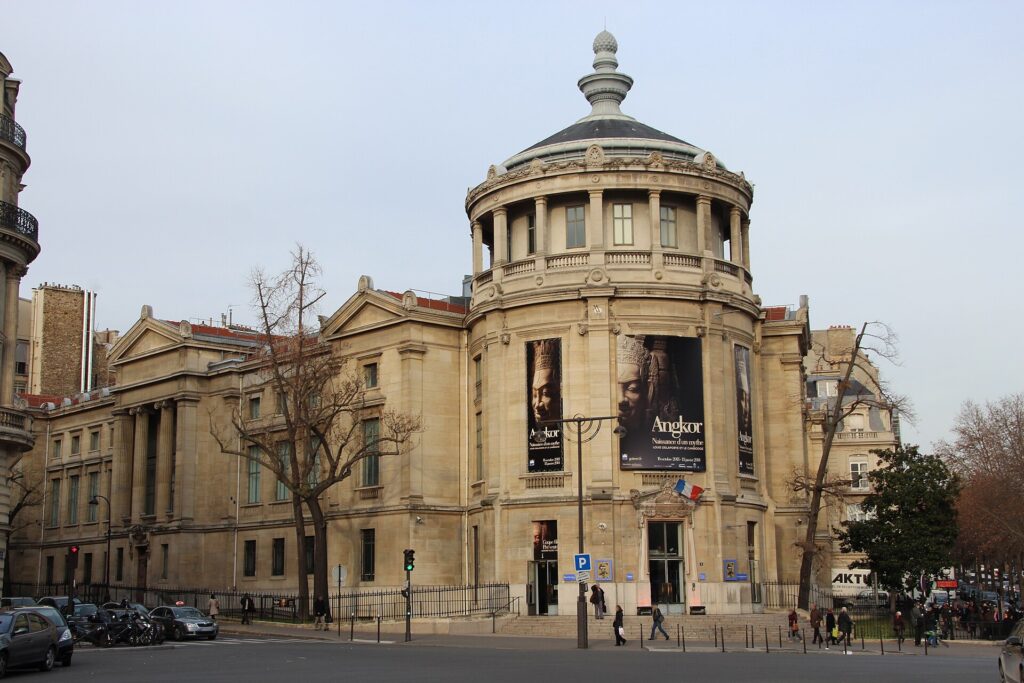
The Musée Guimet stands as one of the world’s great museums of Asian art, yet it remains refreshingly uncrowded compared to its counterparts on the Right Bank. Set in a purpose-built mansion near Place d’Iéna, this museum brings together collections from across Asia—Cambodia, China, Japan, India, Afghanistan, and beyond—in galleries that feel more like a private collector’s residence than a major institution.
Founded by industrialist Émile Guimet in 1889, the museum was conceived as a place to study world religions and cultures. Today it holds over 45,000 works spanning 5,000 years, making it the largest collection of Asian art outside Asia itself.
The Khmer Collection
The ground floor opens with the museum’s crown jewel: the Khmer galleries. These rooms showcase stone sculptures from Angkor and pre-Angkorian Cambodia, including serene Buddha heads, dancing apsaras, and monumental temple guardians. The seventh-century statue of Harihara from Prasat Andet stands nearly two meters tall, its features still crisp despite centuries of tropical weathering.
The Paris most visitors miss
Our free 8-page PDF guide: 25 places, from Galerie Vivienne's 1880 mosaic floor to Canal Saint-Martin's locks, each linked to its official site.
The collection owes much to French scholars who worked in Cambodia during the colonial period. While that history remains complicated, the care taken in presenting these works—with careful lighting and generous space around each sculpture—allows visitors to appreciate the artistry without distraction.
China and Japan Across Four Floors
Climb to the second floor for Chinese art spanning from Neolithic jades to Ming dynasty porcelain. The Han dynasty tomb figures bring ancient funeral rites to life, while the Tang dynasty ceramics show the technical mastery that made Chinese porcelain legendary across medieval trade routes.
The third floor turns to Japan, where folding screens, samurai armor, and delicate ink paintings trace Japanese aesthetic history. The collection of ukiyo-e woodblock prints rivals anything outside Tokyo, with works by Hokusai and Hiroshige displayed in rotation to protect them from light damage.
The top floor houses textiles, ritual objects, and the museum’s celebrated collection of Central Asian Buddhist art from the Silk Road—frescoes and manuscripts recovered from desert caves along ancient caravan routes.
The Panthéon Bouddhique
Don’t miss the museum’s annex, the Panthéon Bouddhique, tucked in a separate building across a small garden. This Japanese-style pavilion houses Buddhist art in an intimate setting that mimics a temple atmosphere. The garden itself, designed in Japanese style with carefully placed rocks and pruned pines, offers a moment of quiet rare in central Paris.
The Panthéon requires a separate (free) timed entry, which you can arrange at the main museum desk. It’s open fewer hours than the main building, so plan accordingly.
Practical Tips for Your Visit
The Musée Guimet sits in the 16th arrondissement between Trocadéro and Iéna metro stations, both an easy walk. Wednesday evenings the museum stays open late—a good time to visit if you want the galleries nearly to yourself.
Unlike the Louvre or Orsay, you can see the Guimet’s highlights in two hours, though serious students of Asian art will want a full afternoon. The museum is rarely crowded; even on rainy Sundays you’ll have room to contemplate the works without jostling for position.
Audio guides cover the key pieces across all collections and are worth the rental fee. The museum shop, while small, stocks excellent books on Asian art history that are hard to find elsewhere in Paris.
Check the museum’s official website before you go for current exhibitions and any temporary closures. The permanent collection rotates certain fragile works, particularly textiles and works on paper, so some pieces may be in storage during your visit.
If you’re planning a day of Asian art, consider combining the Guimet with the nearby Musée Cernuschi, which focuses on ancient Chinese art, or the Institut du Monde Arabe across the river for Islamic and Arab cultures.
Tours & experiences in Paris


Powered by Viator. Some links are affiliate links — we may earn a small commission at no extra cost to you.