
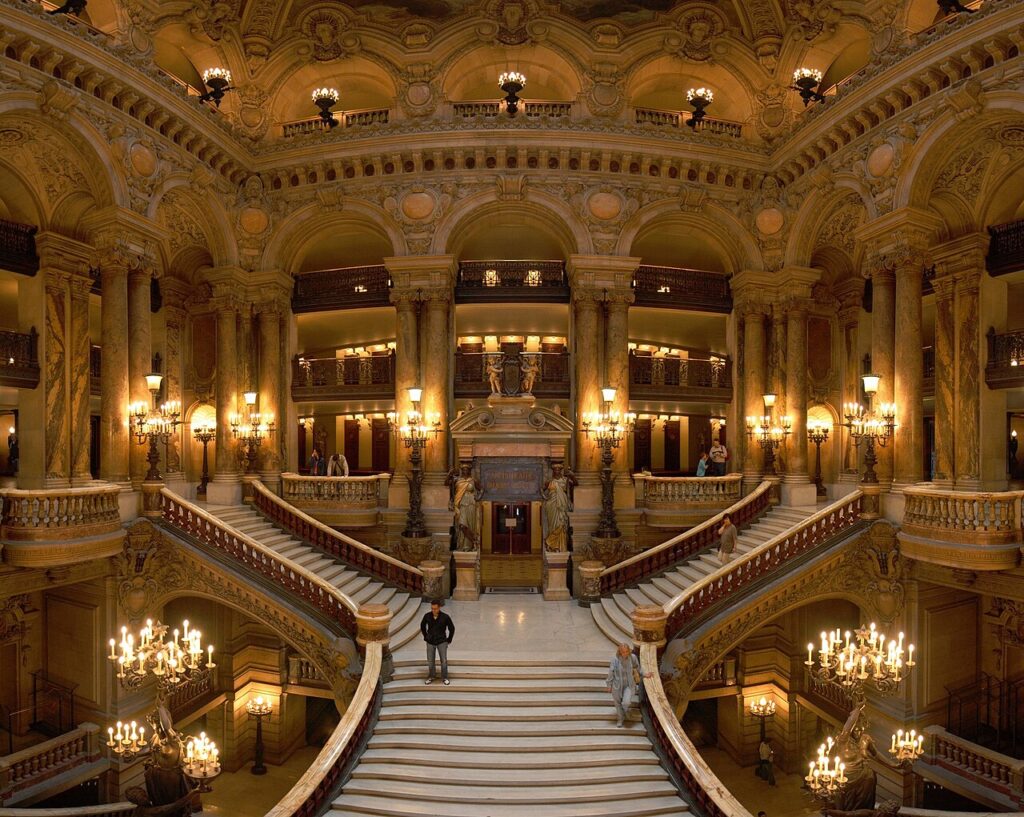
The Palais Garnier isn’t just an opera house. It’s a monument to Second Empire excess, a temple to performance art, and one of the most photographed interiors in Paris. Built between 1861 and 1875, Charles Garnier’s masterpiece dominates the Place de l’Opéra in the 9th arrondissement with 2,200 tons of marble, a six-ton chandelier, and enough gilt to make Versailles jealous.
Most visitors walk past on their way to the Galeries Lafayette. The smart ones go inside.
The Grand Staircase and Foyer
Enter through the main doors on Place de l’Opéra and you’re immediately at the bottom of the Grand Staircase, a double-revolution marvel in white marble with an onyx and algerian marble balustrade. This is where Paris society once preened before performances, and it’s still the building’s showstopper.
The staircase leads to the Grand Foyer, a 154-foot gallery lined with mirrors, mosaics, and frescoes depicting the history of music. The ceiling paintings are by Paul Baudry, and on sunny afternoons the light streaming through the arched windows turns the whole space gold. This room was designed for intermission promenades, a chance to see and be seen. It still works.
Stand at the western end and look back toward the mirrors. You’ll understand why Garnier fought so hard with Baron Haussmann over every detail.
The Auditorium and Chagall’s Ceiling
The auditorium seats 1,979 people across five levels of balconies upholstered in red velvet. Look up: that’s Marc Chagall’s 1964 ceiling, a controversial addition that replaced the original 19th-century painting. Chagall’s dreamlike panels honor composers from Mozart to Wagner, swirling around the seven-ton bronze and crystal chandelier that famously crashed during a performance in 1896, killing one person and inspiring Gaston Leroux’s Phantom of the Opera.
The stage is enormous, one of the largest in Europe, with room for up to 450 performers. Even if you’re visiting during the day without a performance ticket, the self-guided tour usually includes access to a box where you can peer down at the stage and up at Chagall’s work.
Performance tickets start around €10 for standing room, but if you want the full experience, book a box or orchestra seat for a ballet or opera. The building comes alive at night, when the chandeliers are lit and the curtain rises.
The Library-Museum and Phantom’s Lake
Most tourists miss the Library-Museum on the building’s western side. It’s a small collection of costumes, set designs, and memorabilia from past productions, but the reading room itself is worth the detour: wood-paneled, hushed, lined with 100,000 volumes of opera scores and theater history.
The famous underground lake is real. It’s actually a concrete cistern built to manage groundwater during construction, and it’s still there beneath the stage, holding about 50,000 cubic feet of water. You can’t visit it on the standard tour, but specialty behind-the-scenes tours occasionally include access. Ask at the ticket desk.
Practical Information
The Opéra Garnier is open daily from 10 a.m. to 5 p.m., with later hours during the summer. Self-guided tours cost €14 for adults; audio guides are included. On performance days, visiting hours may be shortened, so check the schedule online before you go.
The closest métro is Opéra (lines 3, 7, and 8), which deposits you directly in front of the building. If you’re coming from the Louvre, it’s a pleasant 15-minute walk up Avenue de l’Opéra.
Go early in the morning or late in the afternoon to avoid tour groups. The Grand Foyer is most beautiful between 4 and 5 p.m., when the western light hits the mirrors. If you’re visiting in December, the building is decorated for the holidays, and the staircase becomes even more theatrical.
Photography is allowed in most areas except during performances. Bring a wide-angle lens for the staircase and foyer, but your phone will work fine in the auditorium.
After your visit, walk around to the back of the building on Rue Scribe to see the Pavillon de l’Empereur, a private entrance built for Napoleon III. Across the street, Café de la Paix has been serving opera-goers since 1862. It’s touristy and expensive, but the Belle Époque dining room and terrace people-watching are part of the neighborhood’s charm.
The Opéra Garnier isn’t hidden or undiscovered. It’s one of the most visited monuments in Paris. But it rewards attention. Slow down on the Grand Staircase. Look up at the ceiling. Sit in one of the boxes for a few minutes. This is the Paris that built monuments to beauty for its own sake, and 150 years later, it still works.
Want more stories from Paris, delivered daily? Subscribe to the Love Paris newsletter and get one short story about the city each day, straight to your inbox.
Tours & experiences in Paris


Powered by Viator. Some links are affiliate links — we may earn a small commission at no extra cost to you.