
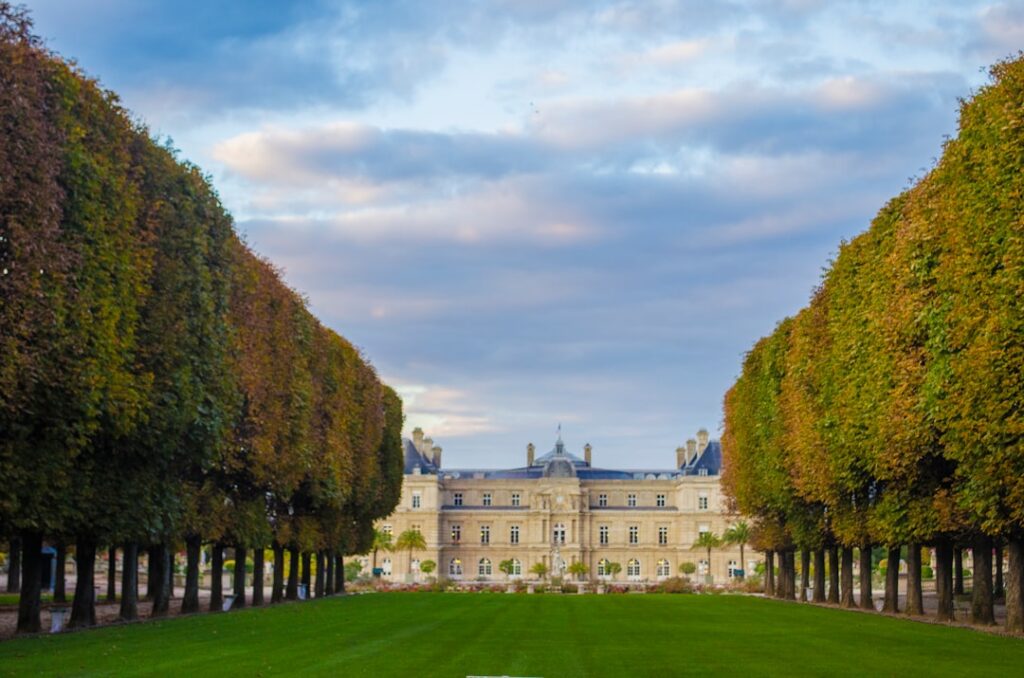
The Luxembourg Gardens stretch across 25 hectares in the 6th arrondissement, offering one of Paris‘s most elegant green spaces. Created in 1612 for Marie de’ Medici, the widow of Henri IV, these formal gardens blend French geometric precision with unexpected pockets of intimacy. On any given afternoon, you’ll find children sailing toy boats, students sprawled on metal chairs with books, and retirees engaged in serious games of chess.
Unlike the wilder expanses of parks like Buttes-Chaumont, the Luxembourg Gardens embody a distinctly French approach to nature: controlled, beautiful, and designed for lingering.
The Grand Basin and the Palace
The octagonal Grand Bassin forms the heart of the gardens. Children have been sailing miniature wooden boats here since the 1920s, and you can rent one from the kiosk on the north side for a few euros. The boats glide across the water while kids race along the edge with wooden sticks, pushing them back when they drift too close to the rim.
Behind the basin stands the Luxembourg Palace, built for Marie de’ Medici in the Florentine style to remind her of her childhood home, the Pitti Palace. Today it houses the French Senate, so you can’t wander inside, but the symmetrical façade provides a perfect backdrop for the geometric flower beds and gravel paths that fan out before it.
The Medici Fountain, tucked away on the eastern edge near rue de Médicis, offers a cool retreat on hot days. This long, shaded grotto features a sculpture of Polyphemus discovering the lovers Acis and Galatea. It’s one of the park‘s most romantic corners, often overlooked by first-time visitors who stick to the main lawns.
Gardens Within the Garden
The Luxembourg Gardens contain several distinct sections, each with its own character. The English Garden, on the western side, takes a more informal approach with winding paths and open lawns where picnicking is actually permitted. This area also contains an apiary where beekeepers tend hives and offer occasional workshops on urban beekeeping.
The orchards along rue Auguste Comte showcase heritage apple and pear varieties, a remnant of the gardens’ original purpose as a productive estate. In spring, the fruit trees explode with blossoms; in fall, the gardeners harvest the fruit for local community programs.
Near the northwest corner, you’ll find the rose garden, replanted according to historical plans. June brings peak bloom, when the formal beds overflow with old-fashioned varieties in deep crimsons and soft pinks.
Statues, Chairs, and Culture
More than 100 statues populate the gardens, ranging from French queens lining the terraces to writers and artists scattered throughout. The Statue of Liberty—a small-scale model by Bartholdi, creator of New York’s version—stands near the western exit. George Sand, Baudelaire, and Verlaine all have their bronze tributes here.
The iconic green metal chairs deserve special mention. Unlike fixed park benches, these chairs can be dragged into sun or shade, positioned for conversation or solitude. Parisians treat them as essential equipment for proper garden enjoyment, rearranging them without hesitation to catch the last rays of afternoon light or create impromptu social circles.
Cultural programming fills the gardens year-round. The Luxembourg Theatre presents concerts and performances, while photography exhibitions line the garden railings along Boulevard Saint-Michel. In summer, free concerts take place at the ornate bandstand, and the puppet theater near the playground has been entertaining children since 1933.
Practical Tips for Your Visit
The gardens open at 7:30 a.m. or 8:15 a.m. depending on season, closing at dusk. The closest metro stations are Odéon (lines 4, 10), Saint-Sulpice (line 4), and RER Luxembourg (line B). Each entrance offers a different perspective—arrive via rue de Vaugirard for the palace view, or through the gate near Odéon to discover the Medici Fountain first.
Morning visits before 10 a.m. offer the quietest experience, when you’ll share the paths mainly with joggers and tai chi practitioners. Late afternoon brings the golden hour light that makes the honey-colored stone of the palace glow, plus students and office workers settling in for after-work relaxation.
The gardens have clear rules posted at entrances: stay off the lawns (except in designated areas), no ball games on the main grounds, and proper attire required (yes, they still enforce this). Playgrounds cluster near the southwest corner, with separate areas for different age groups, sand pits, and vintage carousels.
For refreshments, the kiosk by the tennis courts serves decent coffee and snacks, but locals often bring their own provisions. Small bags are permitted for picnics in designated zones, though you’ll need to carry out what you carry in.
The Luxembourg Gardens prove that parks can be both manicured and magical. Whether you’re sailing a boat, reading in a chair, or simply watching Parisian life unfold around the fountain, these gardens offer a masterclass in the art of taking your time.
Want more stories from Paris’s most beautiful corners? Subscribe to the Love Paris newsletter—one short story a day, straight to your inbox.
Tours & experiences in Paris


Powered by Viator. Some links are affiliate links — we may earn a small commission at no extra cost to you.