
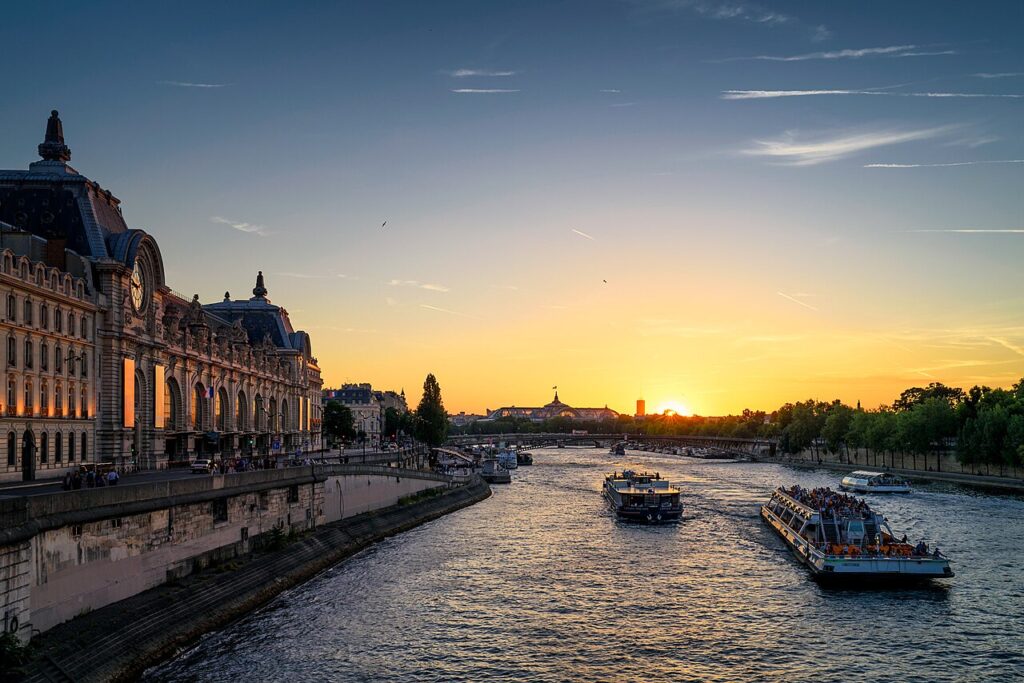
The Musée d’Orsay sits along the Seine in a grand Beaux-Arts railway station, its massive clock face overlooking the river. Inside, beneath the arched glass roof, you’ll find the world’s greatest collection of Impressionist and Post-Impressionist paintings—works by Monet, Renoir, Degas, Van Gogh, Cézanne, and dozens of others who changed how we see light, color, and modern life.
This isn’t the overwhelming maze of the Louvre. The Musée d’Orsay is manageable, focused, and utterly spectacular. Here’s how to visit wisely.
Planning Your Visit
The museum occupies the old Gare d’Orsay at 1 rue de la Légion d’Honneur in the 7th arrondissement. Take the RER C to Musée d’Orsay, or métro line 12 to Solférino. You can also walk from Saint-Germain-des-Prés in about ten minutes.
Book your ticket online and arrive early—the museum opens at 9:30 a.m. Tuesday through Sunday (closed Monday). Thursday evening extends to 9:45 p.m., when the galleries are quieter and the light through the great clock is magical. Avoid weekends if you can; Wednesday and Thursday mornings are your best bet for smaller crowds.
The museum spans five levels, but most visitors focus on the ground floor (sculpture and early 19th-century painting), the middle level (decorative arts and smaller galleries), and the top floor—where the Impressionists live.
The Top Floor: Where You Want to Be
Head straight to the fifth floor. Take the elevator or the escalators to the far end of the ground floor, then ride up. You’ll emerge into a series of light-filled galleries devoted to Impressionism and Post-Impressionism, the museum’s crown jewels.
Start with the Impressionists in rooms 29 through 36. Here you’ll find Monet’s Impression, Sunrise (which gave the movement its name), his shimmering Rouen Cathedral series, and the poppy fields that glow like stained glass. Renoir’s Bal du moulin de la Galette captures dappled sunlight on a Montmartre afternoon. Degas’s ballet dancers stretch and rehearse in soft pastels.
Move through to the Post-Impressionists: Van Gogh’s swirling Starry Night Over the Rhône and his intense Bedroom in Arles, Cézanne’s geometric landscapes of Mont Sainte-Victoire, Gauguin’s vivid Tahitian canvases. Room 35 holds Van Gogh’s Portrait of Dr. Gachet, painted just weeks before his death—one of the most moving works in the collection.
Don’t rush. Sit on the benches. Notice how Monet dissolves form into color, how Degas captures motion in stillness, how Van Gogh makes paint itself feel urgent and alive.
The Ground Floor and Sculpture Galleries
After the Impressionists, descend to the ground floor. The central nave holds massive sculptures from the Third Republic—allegorical figures, public monuments, and Carpeaux’s exuberant The Dance. The side galleries display earlier 19th-century paintings: Ingres, Delacroix, Courbet, and the Realists who paved the way for the Impressionists.
Look for Courbet’s controversial The Origin of the World in room 20, and Manet’s scandalous Olympia and Luncheon on the Grass in room 14—paintings that shocked Paris in the 1860s and cracked open the door for modernism.
Practical Tips and Hidden Gems
The museum café, behind one of the station’s original giant clocks on the middle level, offers excellent espresso and a stunning view across the Seine to the Tuileries and the Right Bank. It’s worth a break just for the clock alone.
If you have time, explore the middle level’s Art Nouveau rooms—furniture by Guimard, jewelry by Lalique, and the reconstruction of a Belle Époque apartment. Room 51 holds Toulouse-Lautrec’s posters and paintings of Montmartre nightlife, vibrant and raw.
Audio guides are worthwhile here—the commentary is concise and adds context without overwhelming. Photography is permitted (no flash), so bring your phone or camera.
Combination tickets with the Musée Rodin or the Musée de l’Orangerie can save money if you’re planning multiple visits, but the Musée d’Orsay alone deserves at least three hours.
On your way out, glance up at the great glass vault and the clock overlooking the Seine. This railway station, nearly demolished in the 1970s, became one of the world’s most beautiful museums. The Impressionists, rejected by the establishment in their time, now draw millions to see how they painted light itself.
Want more insider tips like these delivered to your inbox? Subscribe to the Love Paris newsletter—one short story about the city each day, full of the details that turn a good trip into an unforgettable one.
Tours & experiences in Paris


Powered by Viator. Some links are affiliate links — we may earn a small commission at no extra cost to you.