
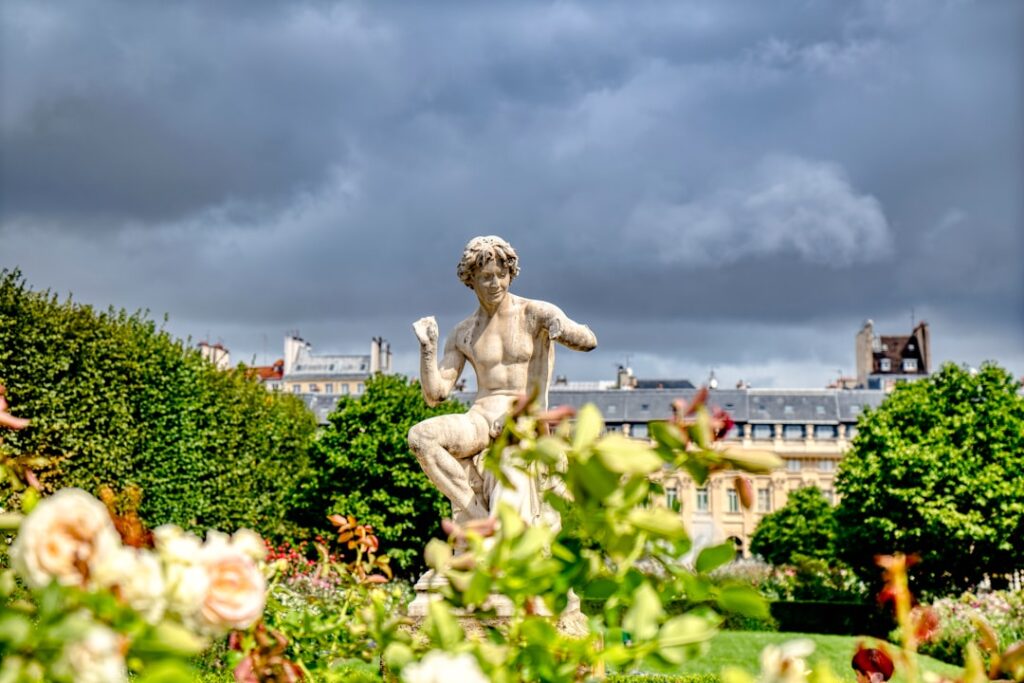
While tourists queue for hours at the Louvre and the Musée d’Orsay, the Musée Rodin remains one of Paris’s best-kept secrets. Tucked behind ivy-covered walls at 77 rue de Varenne in the 7th arrondissement, this museum pairs Auguste Rodin’s most famous sculptures with three hectares of gardens that feel like a private estate.
The museum occupies the elegant Hôtel Biron, an 18th-century mansion where Rodin lived and worked from 1908 until his death in 1917. He donated his entire collection to the French state on one condition: that they preserve the building and gardens exactly as he knew them. Walking through today, you’ll understand why he fought so hard for this place.
The Garden: Where Sculpture Meets Nature
Start outside, not in. The garden is the museum’s soul, and it’s where Rodin himself preferred to display his work. The Thinker sits on his pedestal near the entrance, exactly where Rodin placed him. Further along the gravel paths, you’ll find The Gates of Hell, the massive bronze portal commissioned for a museum that was never built but which occupied Rodin for 37 years.
The rose garden behind the mansion blooms from May through October, framing The Burghers of Calais in a cascade of pink and white. In summer, arrive at opening time—10:00 on Tuesdays through Sundays—to have the garden nearly to yourself. The light is softer, the air cooler, and you can actually sit on the iron chairs scattered throughout without competing for space.
Don’t miss the far corner near rue de Varenne, where a small café serves excellent coffee and pastries. The outdoor tables overlook a quieter section of the garden where couples picnic on the lawn and locals read newspapers under the chestnut trees.
Inside the Mansion: Intimacy with the Work
The Hôtel Biron’s interior rooms feel like visiting Rodin’s actual home, because they were. The ground floor holds his most celebrated marbles: The Kiss occupies an entire room, the couple frozen mid-embrace in Carrara marble so smooth it seems to glow. Stand close and you’ll see Rodin’s fingerprints still visible in the rougher passages where he worked the stone himself.
Upstairs, the collection expands to include Rodin’s personal art acquisitions—works by Van Gogh, Monet, and Renoir that he bought directly from the artists. The third floor displays his thousands of drawings, rotated seasonally, and his collection of ancient sculpture that influenced his own approach to the human form.
The basement—often overlooked—houses plaster casts and clay studies that show Rodin’s working process. Here you can see how he built The Gates of Hell figure by figure, rearranging and recombining forms across decades.
Camille Claudel: The Other Genius
Four rooms on the ground floor belong to Camille Claudel, Rodin’s student, collaborator, and lover. Her work—The Waltz, The Age of Maturity—stands equal to his, though she died poor and forgotten in an asylum while Rodin enjoyed international fame.
The museum has recently expanded its Claudel collection, acknowledging both her talent and the complicated relationship between the two artists. Her sculptures possess an emotional rawness that Rodin’s sometimes lack, and seeing them side by side reveals how much they learned from each other.
Practical Information
The Musée Rodin sits a ten-minute walk from Invalides metro station (line 8 or RER C) or fifteen minutes from Varenne (line 13). Entry costs €14 for the full museum and garden, or €6 for garden-only access—one of Paris’s best bargains if you want a beautiful outdoor space to spend an afternoon.
Visit on the first Sunday of each month for free admission, though the garden will be crowded. Otherwise, Tuesday and Wednesday mornings remain the quietest times. The museum closes Mondays.
Allow two hours minimum—one for the mansion, one for the garden. If you’re traveling with children, they can run on the lawns (unlike most Paris museums) while you contemplate the sculptures. The museum provides English audio guides, but the garden is best experienced without narration, just the sound of gravel underfoot and bronze glinting through the leaves.
From here, you’re a short walk from the Bon Marché department store and its famous food hall, or south toward the quiet streets around the Institut Catholique. The neighborhood—the 7th arrondissement’s residential heart—offers a glimpse of Paris as wealthy Parisians actually live it: elegant, unhurried, and remarkably green.
Want more stories about Paris’s hidden museums, secret gardens, and the neighborhoods where locals actually spend their time? Subscribe to the Love Paris newsletter and get one short story delivered to your inbox each day.
Tours & experiences in Paris


Powered by Viator. Some links are affiliate links — we may earn a small commission at no extra cost to you.