
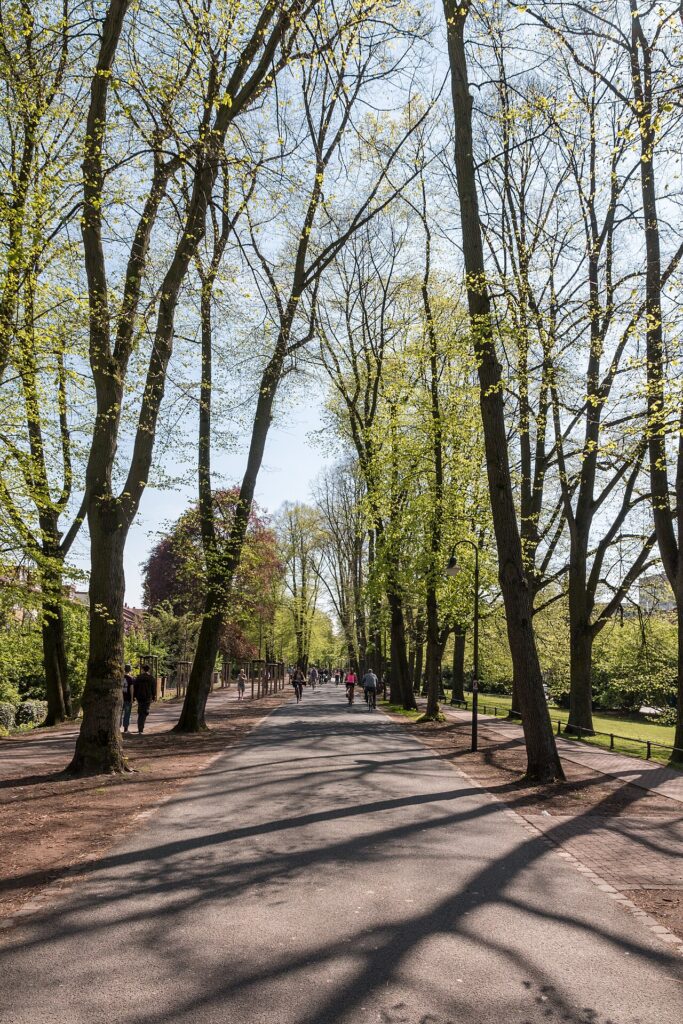
While tourists crowd the Eiffel Tower and the Luxembourg Gardens, a remarkable elevated park stretches nearly three miles through the 12th arrondissement, virtually unknown to most visitors. The Promenade Plantée—also called the Coulée Verte René-Dumont—opened in 1993, transforming an abandoned 19th-century railway viaduct into the world’s first elevated park, inspiring New York’s High Line two decades later.
This linear garden begins at the Opéra Bastille and winds eastward to the Bois de Vincennes, offering a completely different perspective on Paris. You’ll walk above street level through residential neighborhoods, peer into apartment windows, pass through tunnel sections draped with wisteria, and emerge into open sections with roses, bamboo groves, and wildflower meadows.
Starting at the Bastille End
The most dramatic entrance sits near the Opéra Bastille at Avenue Daumesnil. Climb the stairs at number 1, and you’ll emerge onto the red-brick viaduct, where the first section runs above the Viaduc des Arts—a series of renovated railway arches now housing artisan workshops, furniture makers, and specialty boutiques.
From this elevated perspective, you’re walking through what was once the railway line connecting the Bastille to the suburbs. Built in 1859 and abandoned in 1969, the viaduct sat derelict until architect Philippe Mathieux and landscape designer Jacques Vergely reimagined it as a park. Today, plane trees shade the walkway, roses climb the railings, and benches offer views over the 12th arrondissement’s rooftops.
The first kilometer is the most architecturally striking. The brick arches create a rhythm as you walk, and the contrast between the industrial structure and the lush plantings—lavender, ornamental grasses, climbing hydrangeas—shows exactly what thoughtful urban renewal can accomplish.
The Middle Sections: Tunnels and Gardens
After the viaduct section, the Promenade descends to ground level near Rue de Rambouillet. Here it transforms into a more traditional linear park, winding through the neighborhood with tunnel sections cutting under buildings. These tunnels stay cool even in summer and feel almost secret, with ivy and ferns growing along the walls.
The garden sections between Rue de Rambouillet and Boulevard de la Guyane are the wildest parts of the walk. Bamboo groves create natural screens, and in spring, the wisteria and laburnum create purple and yellow canopies overhead. You’ll pass community gardens where locals tend vegetable plots, and small play areas where neighborhood children climb on wooden structures.
This stretch feels less like central Paris and more like a countryside path that happens to run through an urban neighborhood. The traffic noise fades, replaced by birdsong and the rustle of leaves. On weekday mornings, you might have entire sections to yourself.
The Eastern End and Jardin de Reuilly
Around the halfway point, the Promenade opens into the Jardin de Reuilly, a larger park with lawns, a modern footbridge, and more open space. This is where local families come for picnics, and where the walking path widens enough for joggers and cyclists to pass comfortably.
Beyond Reuilly, the park continues toward Porte Dorée and eventually connects to the Bois de Vincennes. The eastern sections are less manicured, with more naturalistic plantings and a wilder feel. If you walk the entire length—about 4.5 kilometers—you’ll end near the Porte Dorée metro station, where you can explore the Bois de Vincennes or head to the nearby Palais de la Porte Dorée.
Practical Information
The Promenade Plantée is open from 8 a.m. until sunset year-round, with exact closing times varying by season. Access is free, and there are multiple entry points along its length, making it easy to walk just a section or the entire route.
Start at Bastille (lines 1, 5, 8) if you want the most dramatic architectural section, or enter at Gare de Lyon (lines 1, 14, RER A, D) for a quieter start. Daumesnil station (line 6) sits roughly in the middle. The walkway is flat and paved, suitable for wheelchairs and strollers, though some access points require stairs.
The best time to visit is early morning in spring or late spring through early summer, when the wisteria, roses, and perennials are blooming. Weekday mornings are quietest. Bring water—there are no cafés along the route, though you’ll find plenty in the neighborhoods at either end. The Viaduc des Arts underneath the western section has several cafés and restaurants.
For a perfect half-day, walk the Promenade from Bastille to Jardin de Reuilly (about 2.5 kilometers, taking an hour with stops for photos), then descend to explore the Viaduc des Arts shops before having lunch in the Bastille neighborhood.
Want more hidden corners of Paris delivered to your inbox? Subscribe to the Love Paris newsletter and get one short story about the city every day—the Paris beyond the guidebooks, straight to you each morning.
Tours & experiences in Paris


Powered by Viator. Some links are affiliate links — we may earn a small commission at no extra cost to you.