
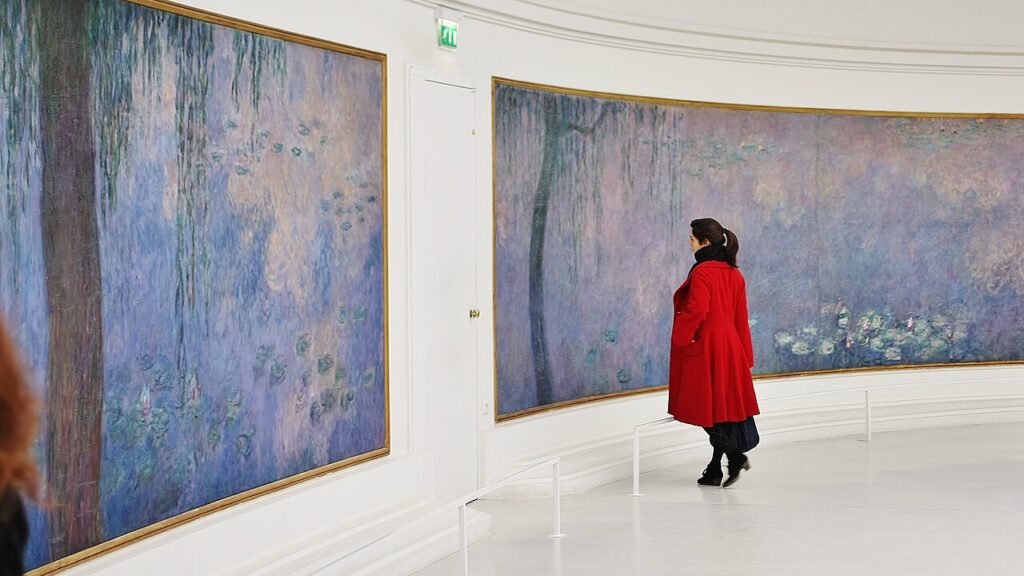
While crowds flock to the Musée d’Orsay and the Louvre, one of Paris’s most transcendent art experiences waits quietly in the Tuileries Garden. The Musée de l’Orangerie, housed in a former royal greenhouse at the western end of the garden, is home to Claude Monet‘s monumental Water Lilies—eight massive panels that wrap around two oval rooms, creating an immersive meditation on light, color, and reflection.
This is intimate museum-going at its finest. You won’t need four hours or a complicated strategy. An hour or two is plenty to absorb Monet’s vision and explore the excellent collection downstairs. But what you’ll take away stays with you far longer.
The Water Lilies Rooms
Monet painted these enormous murals—some nearly 17 meters long—at his home in Giverny specifically for the Orangerie. He donated them to the French state the day after the World War I armistice in 1918, and they were installed here in 1927, shortly after his death. Each panel captures his lily pond at different times of day and in different seasons, rendered in the loose, almost abstract style of his final years.
The two oval rooms on the ground floor were designed by Monet himself to create a sense of total immersion. Natural light filters in from above, just as he intended. The effect is hypnotic—you’re not just looking at water lilies, you’re surrounded by them. Willows droop, clouds drift across reflected skies, and lilies float in pools of green, blue, and violet.
Go slowly. Sit on the benches in the center of each room. Watch how the light shifts, how the paint strokes dissolve into pure color when you step back. Early morning on weekdays offers the quietest experience, though even at busier times, the rooms maintain a contemplative atmosphere.
The Walter-Guillaume Collection
Most visitors come for Monet and discover a bonus downstairs: the Walter-Guillaume collection, one of the finest private collections of early 20th-century art ever assembled. Paul Guillaume and his widow Domenica Walter built this collection with impeccable taste, and it passed to the French state in 1977.
Here you’ll find Cézanne’s still lifes and portraits, Renoir’s bathers glowing with peachy light, and Modigliani’s elongated faces. There’s Matisse, Picasso, Rousseau’s dreamlike jungle scenes, and Soutine’s intense, emotional landscapes. Utrillo’s pale Paris streets. Derain’s vivid Fauve experiments. It’s a compact collection, beautifully displayed, that traces the path from Impressionism through Cubism and beyond.
The intimacy here is the point. Unlike the vast halls of the Orsay, you can spend real time with each painting without feeling rushed or overwhelmed.
Visiting the Orangerie
The museum sits at Place de la Concorde, right where the Tuileries Garden meets the square. The entrance is on the Seine side of the garden. Take Métro line 1, 8, or 12 to Concorde, or line 12 to Assemblée Nationale. It’s also an easy walk from the Louvre or along the Seine from the Eiffel Tower.
The museum opens at 9:00 a.m. every day except Tuesday (closed) and stays open until 6:00 p.m. Last entry is at 5:15 p.m. If you have the Paris Museum Pass, you’ll skip the ticket line—the pass covers entry and it’s worth it if you’re visiting several museums during your stay.
Arrive early, especially on Wednesday and Friday evenings in summer when the museum stays open until 9:00 p.m. and draws larger crowds. Monday and Thursday mornings are typically the quietest times. In winter, afternoon light in the Water Lilies rooms has a particularly soft, contemplative quality.
There’s no café on site, but you’re steps from the Tuileries Garden with its cafés and chairs around the fountains. Combine your visit with a walk through the garden, perhaps continuing to the Louvre or crossing to the Left Bank via Pont de la Concorde.
What Makes It Special
The Orangerie offers something increasingly rare in Paris: space to breathe with art. There’s no audio assault, no selfie chaos in front of the Water Lilies. People speak in hushed voices. Many just sit.
Monet wanted these panels to offer “an asylum of peaceful meditation.” Nearly a century later, they still do exactly that. In a city where major museums can overwhelm, the Orangerie reminds you why you came to Paris in the first place—not to check boxes, but to be moved.
After you’ve spent time with the Water Lilies, walk out into the Tuileries. Monet painted light on water; here it plays across the fountains and pools, filtered through plane trees, shifting every hour. The conversation between art and life continues right outside the door.
Want more insider guides to Paris’s museums, neighborhoods, and hidden corners? Subscribe to the Love Paris newsletter—one short story a day, straight to your inbox.
Tours & experiences in Paris


Powered by Viator. Some links are affiliate links — we may earn a small commission at no extra cost to you.