
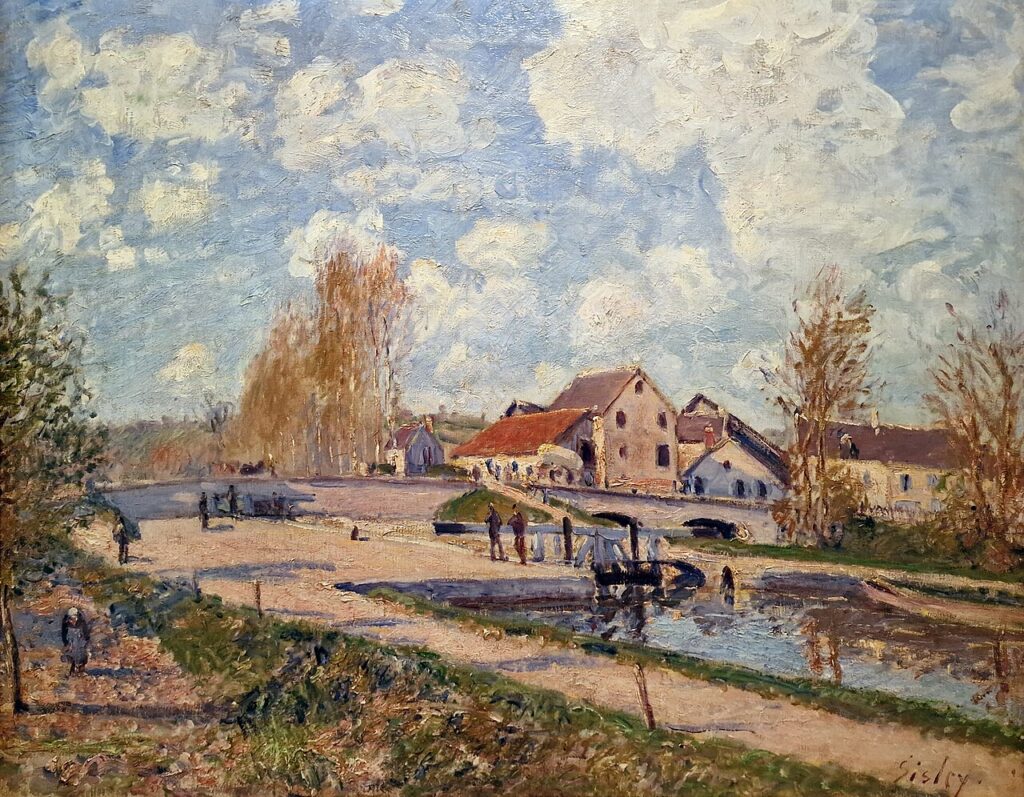
While tourists line up at the Louvre, savvy Paris visitors head to the Musée d’Orsay on the Left Bank. Housed in a magnificent former railway station, this museum holds the world’s finest collection of Impressionist and Post-Impressionist art—Monet’s water lilies, Renoir’s dancers, Van Gogh’s self-portraits, and Degas’s ballerinas all under one soaring glass roof.
The Gare d’Orsay opened in 1900 for the Universal Exhibition, its Beaux-Arts façade hiding modern platforms that served southwest France. When longer trains made it obsolete in 1939, the station nearly became a hotel or was slated for demolition. Instead, it reopened as a museum in 1986, its iron-and-glass architecture providing the perfect backdrop for the revolutionary art that shocked 19th-century Paris.
The Fifth Floor: Where Impressionism Lives
Skip the ground floor on your first visit and take the escalators straight to the fifth floor. This is where the magic happens. The galleries overlooking the main hall hold the museum’s crown jewels: Monet’s Impression, Sunrise (the painting that gave the movement its name), Renoir’s Bal du moulin de la Galette, and Caillebotte’s Paris Street; Rainy Day.
Start in Room 29 with early Monet and Renoir, when they were still finding their light. Move through Room 30 to see how Pissarro and Sisley captured the changing seasons in the Île-de-France countryside. Room 32 holds Monet’s series paintings—haystacks, Rouen Cathedral, and the parliament buildings in London, each showing how light transforms the same subject hour by hour.
The café on this level, the Café de l’Horloge, sits behind the museum’s giant clock face. Through the transparent glass numbers, you get a perfect view across the Seine to Montmartre. Come here mid-visit, not at the end when you’re exhausted.
Van Gogh and the Post-Impressionists
The smaller galleries on the fifth floor’s opposite side hold the Post-Impressionist collection. Room 35 is devoted entirely to Van Gogh, including his self-portrait, The Bedroom, and The Church at Auvers—one of the last paintings he completed before his death in 1890.
Rooms 43 and 44 showcase Cézanne’s revolutionary approach to form and color that paved the way for Cubism. His still lifes of apples look simple until you realize he’s showing you multiple viewpoints simultaneously, breaking every rule of traditional perspective.
Don’t miss Seurat’s pointillist masterpiece The Circus in Room 45, or Gauguin’s Tahitian paintings in Room 46, with their flat planes of intense color that rejected European realism entirely.
The Middle Level: Sculpture and Decorative Arts
The museum’s middle level holds an often-overlooked treasure: the sculpture terraces with their glass roofs. These galleries feature works by Rodin, Camille Claudel, and other 19th-century sculptors displayed in natural light, just as they were meant to be seen.
The Art Nouveau rooms (Rooms 61-66) show furniture, jewelry, and decorative objects from the turn of the century—Guimard’s sinuous metro entrances, Lalique’s dragonfly jewelry, and Gallé’s iridescent glassware. This is the Paris of the Belle Époque in three dimensions.
Practical Tips for Your Visit
The museum opens at 9:30 a.m. Tuesday through Sunday (closed Mondays). Arrive at opening or after 4 p.m. to avoid crowds—most tour groups hit the museum between 11 a.m. and 3 p.m. Thursday evening hours (until 9:45 p.m.) offer the quietest experience.
Enter through the Entrance C if you’ve pre-booked tickets online (which you should). The main entrance on Rue de la Légion d’Honneur has the longest lines. If you have a Museum Pass, use Entrance A.
The museum sits at 1 Rue de la Légion d’Honneur in the 7th arrondissement. Take the RER C to Musée d’Orsay, or métro line 12 to Solférino. From Saint-Germain-des-Prés, it’s a ten-minute walk along the Seine.
Allow three hours minimum—two if you focus only on the Impressionist galleries. The museum’s collection spans 1848 to 1914, so you’re covering more than six decades of art history. Audio guides are excellent and worth the extra few euros.
After your visit, walk east along the Seine toward the Louvre, or cross Pont Royal to the Tuileries Garden. The Musée de l’Orangerie, with Monet’s massive Water Lilies murals, sits at the Tuileries’ far end—a perfect pairing if you’re not museum-ed out.
Want more insider guides to Paris’s museums, neighborhoods, and hidden corners? Subscribe to the Love Paris newsletter and get one short story a day in your inbox—the Paris you won’t find in guidebooks.
Tours & experiences in Paris


Powered by Viator. Some links are affiliate links — we may earn a small commission at no extra cost to you.