
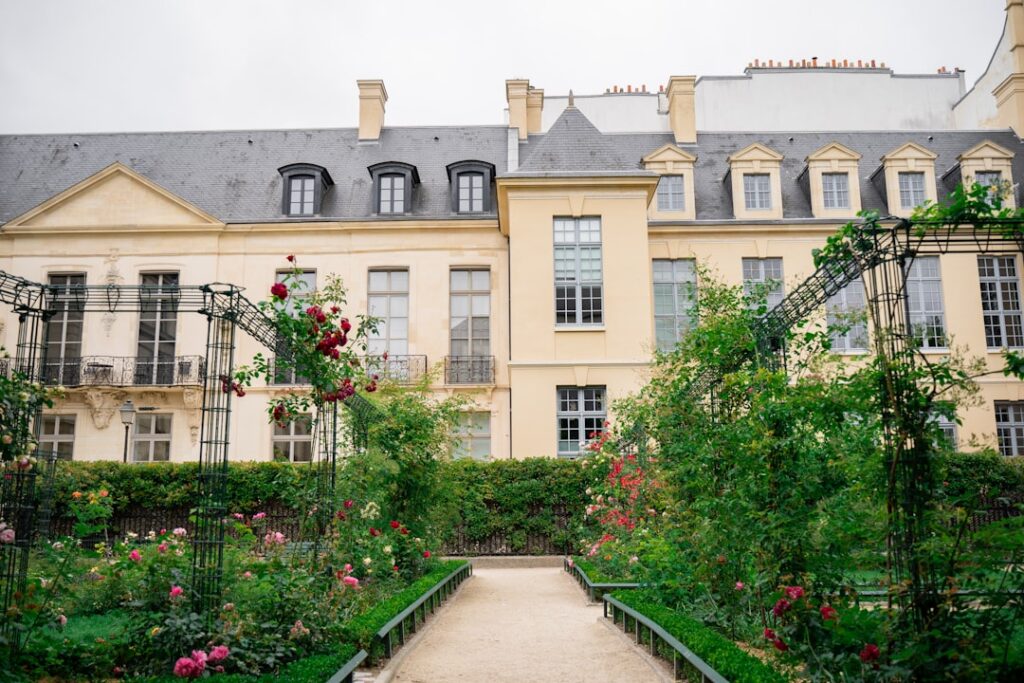
The Marais—literally “the marsh”—sits on what was once swampy land on the Right Bank, transformed in the 17th century into Paris‘s most fashionable aristocratic district. Today, the 3rd and 4th arrondissements preserve more medieval and Renaissance architecture than anywhere else in the city, with narrow streets that follow their original paths and hôtels particuliers (private mansions) that have survived Haussmann’s 19th-century renovations.
This is a neighborhood built for walking. The streets are too narrow and winding for grand vistas—you discover the Marais one courtyard, one carved doorway, one hidden garden at a time.
The Historic Heart: Place des Vosges and Rue des Francs-Bourgeois
Start at Place des Vosges, Paris’s oldest planned square and still its most beautiful. Built by Henri IV in 1612, the symmetrical arcaded buildings in red brick and stone create a space that feels both grand and intimate. Victor Hugo lived at number 6—his apartment is now a free museum worth visiting for the view over the square alone.
Walk under the arcades (the northwest corner puts you on Rue des Francs-Bourgeois, the Marais’s main artery) and you’ll find antique shops, contemporary art galleries, and the occasional perfect café. This street connects the major sights—the Musée Carnavalet, the Musée Picasso, the Jewish quarter—but the real pleasure is stepping off it into side streets like Rue Elzévir or Rue de Sévigné.
The Hôtel de Sully at 62 Rue Saint-Antoine offers one of the neighborhood’s finest courtyards, open to the public. Walk through the gateway into the first courtyard, then through to the second, and you’ll find yourself in a formal garden that opens directly onto Place des Vosges—a secret passage locals use to skip the crowds.
The Jewish Quarter: Rue des Rosiers and Pletzl
The Marais has been home to Paris’s Jewish community since the 13th century, and the streets around Rue des Rosiers—the Pletzl, or “little square” in Yiddish—remain its heart. L’As du Fallafel at number 34 draws lines down the block for its legendary falafel sandwiches, but arrive before noon or after 2 p.m. to avoid the worst crowds.
The neighborhood blends Ashkenazi and Sephardic traditions. You’ll find Eastern European delis like Sacha Finkelsztajn at 27 Rue des Rosiers (their poppy seed strudel is exceptional) alongside North African couscous restaurants. The Mémorial de la Shoah at 17 Rue Geoffroy-l’Asnier is Paris’s Holocaust memorial and museum, a somber and essential stop.
Sunday morning is the best time to experience this area’s particular energy, when families emerge from synagogue services and the bakeries put out fresh challah.
Hidden Courtyards and Private Gardens
The Marais’s hôtels particuliers were built around interior courtyards, and many remain accessible during business hours. The Hôtel de Soubise at 60 Rue des Francs-Bourgeois (now the National Archives) has a magnificent horseshoe-shaped courtyard. The Hôtel de Sens at 1 Rue du Figuier, one of Paris’s few surviving medieval residences, houses the Forney Library and a small garden.
For the neighborhood’s most secret green space, find the entrance to the Village Saint-Paul between Rue Saint-Paul and Rue Charlemagne. This cluster of interconnected courtyards fills with antique dealers and vintage shops, and the cobbled passages feel removed from the 21st century entirely.
The Square Georges-Cain at 8 Rue Payenne sits behind the Musée Carnavalet and collects architectural fragments from demolished Paris buildings—carved doorways, statuary, fountains—arranged in a peaceful garden that few visitors discover.
Practical Details for Your Walk
The Marais is compact enough to walk in a morning, but rich enough to occupy a full day. Start at Saint-Paul (line 1) or Rambuteau (line 11) métro stations. Wear comfortable shoes—the cobblestones are authentic and unforgiving.
Most museums close Mondays (some close Tuesdays instead), but the streets and courtyards remain accessible every day. Sunday is particularly atmospheric, with fewer cars and families out for weekend walks, though many shops close. Thursday through Saturday brings out the neighborhood’s younger energy, with boutiques open late and café terraces full.
The Marais rewards aimless wandering, but bring a detailed map—phone GPS can be unreliable in the narrow streets, and part of the pleasure is finding your own route through the medieval tangle. Many of the finest courtyards have no signs; you simply push open a heavy wooden door and discover what’s inside.
Want more insider walks and hidden corners of Paris delivered to your inbox? Subscribe to the Love Paris newsletter—one short story about the city every day, written for people who want to know Paris beyond the obvious.
Tours & experiences in Paris


Powered by Viator. Some links are affiliate links — we may earn a small commission at no extra cost to you.