
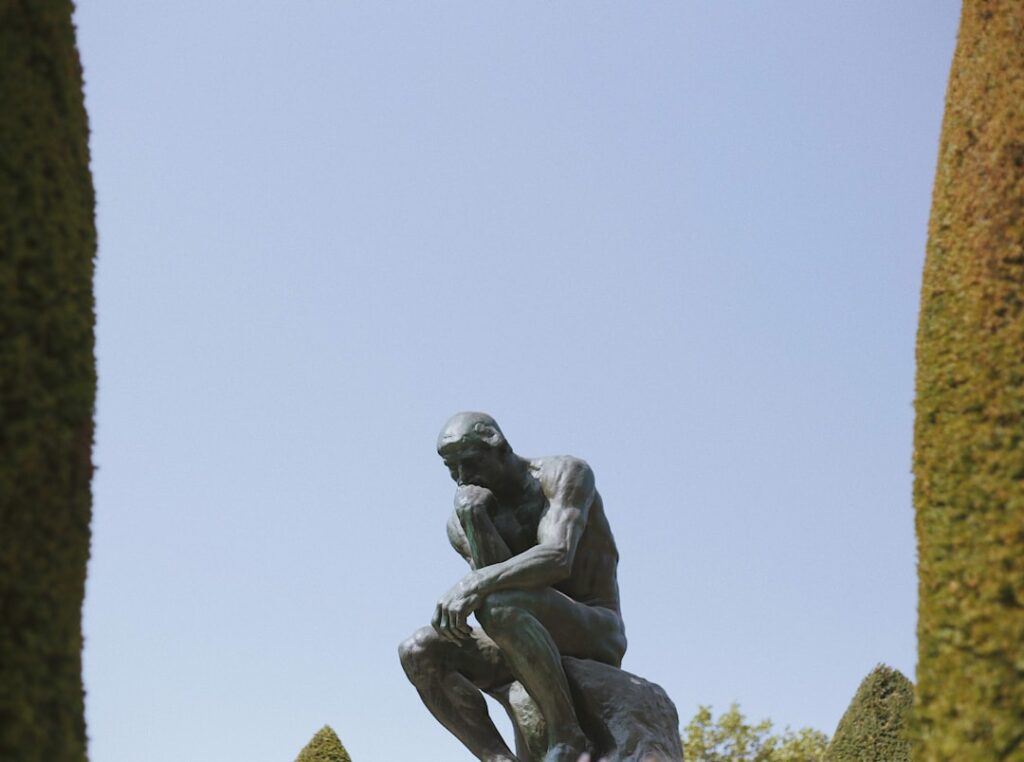
Tucked behind a high wall on rue de Varenne in the 7th arrondissement, the Musée Rodin offers something rare in Paris: a world-class museum where the garden is as compelling as the galleries. While crowds rush toward the Louvre and Orsay, this elegant 18th-century mansion and its three-hectare garden provide an intimate encounter with Auguste Rodin’s most celebrated works.
The museum occupies the Hôtel Biron, where Rodin himself lived and worked from 1908 until his death in 1917. He donated his entire collection to the French state in exchange for the promise that his work would be preserved here. Today, it remains one of Paris’s most rewarding museums—and one of its most undervisited.
The Mansion Galleries
Start inside the Hôtel Biron, where the ground floor galleries display Rodin’s most famous marble and bronze works. The rooms unfold chronologically, tracing his evolution from academic sculptor to the artist who revolutionized modern sculpture.
You’ll find The Kiss in the first gallery—smaller than you might expect, but mesmerizing in its detail. The marble seems to soften where the lovers’ bodies meet. Nearby, The Cathedral shows just two right hands reaching toward each other, a fragment that somehow conveys more emotion than many complete figures.
Don’t rush through the upper floor. The attic rooms display Rodin’s personal collection—works by Renoir, Monet, and Van Gogh that he bought or received as gifts. The light here is beautiful in the afternoon, streaming through the mansard windows.
The Garden and Major Bronzes
The real revelation is the garden. At three hectares, it’s large enough to feel like a genuine park, with roses, reflecting pools, and gravel paths lined with linden trees. The bronzes placed throughout give the sculptures an entirely different character than their indoor counterparts—weathered by rain, shadowed by trees, monumental against the sky.
The Thinker sits on a pedestal near the entrance, his familiar pose somehow more powerful outdoors. Walk past him toward the back of the garden to find The Gates of Hell, Rodin’s enormous commission inspired by Dante’s Inferno. He worked on it for 37 years and never completed it. Stand close and you’ll spot The Thinker again, this time as a small figure at the top—the original version before Rodin enlarged it into the famous sculpture.
The garden café, behind the main building, serves proper coffee and excellent quiche. Tables scatter across a terrace overlooking the rose garden. It’s one of the best museum cafés in Paris, and you don’t need a ticket to visit—the café has its own entrance from the garden.
Visiting Details and Insider Tips
The museum sits at 77 rue de Varenne, easily reached by metro (Varenne on line 13, or Invalides on lines 8 and 13). It’s open Tuesday through Sunday, 10 a.m. to 6:30 p.m., closed Mondays.
Buy your ticket online to skip the line, though crowds here are manageable even in summer. A full ticket costs €14 and includes both the mansion and garden. If you only want to see the garden and outdoor sculptures, you can buy a garden-only ticket for €6—an exceptional deal.
First Sunday of the month? The museum is free, but expect bigger crowds. Otherwise, come on a weekday morning or late afternoon for the quietest visit. Tuesday and Wednesday mornings between 10 and 11:30 are particularly peaceful.
The garden is worth visiting in any season, but May and June are peak rose season. In autumn, the lime trees turn golden and scatter leaves across the paths. Even winter has its charm—the bronzes look dramatic against bare branches and occasional snow.
Combining Your Visit
The Musée Rodin makes a natural pairing with other 7th arrondissement sights. The Invalides and Napoleon’s tomb are a five-minute walk north. The Eiffel Tower is fifteen minutes west on foot. For a quieter combination, walk ten minutes south to the Bon Marché department store and its exceptional food hall, La Grande Épicerie.
If you’re interested in more sculpture, the Musée Maillol is a fifteen-minute walk across the boulevard Saint-Germain. For gardens, the Jardin Catherine-Labouré—a hidden community garden—is around the corner on rue de Babylone.
The museum shop, just off the entrance hall, sells excellent art books and a surprisingly good selection of Rodin-inspired jewelry. The poster selection is better than most Paris museum shops.
Photography is allowed throughout the museum and garden without flash. The sculpture garden is particularly photogenic in the late afternoon when the light softens and the tour groups have left.
Want more insider guides to Paris’s museums, neighborhoods, and hidden corners? Subscribe to the Love Paris newsletter and get one short story a day about the city beyond the guidebooks.
Tours & experiences in Paris


Powered by Viator. Some links are affiliate links — we may earn a small commission at no extra cost to you.