
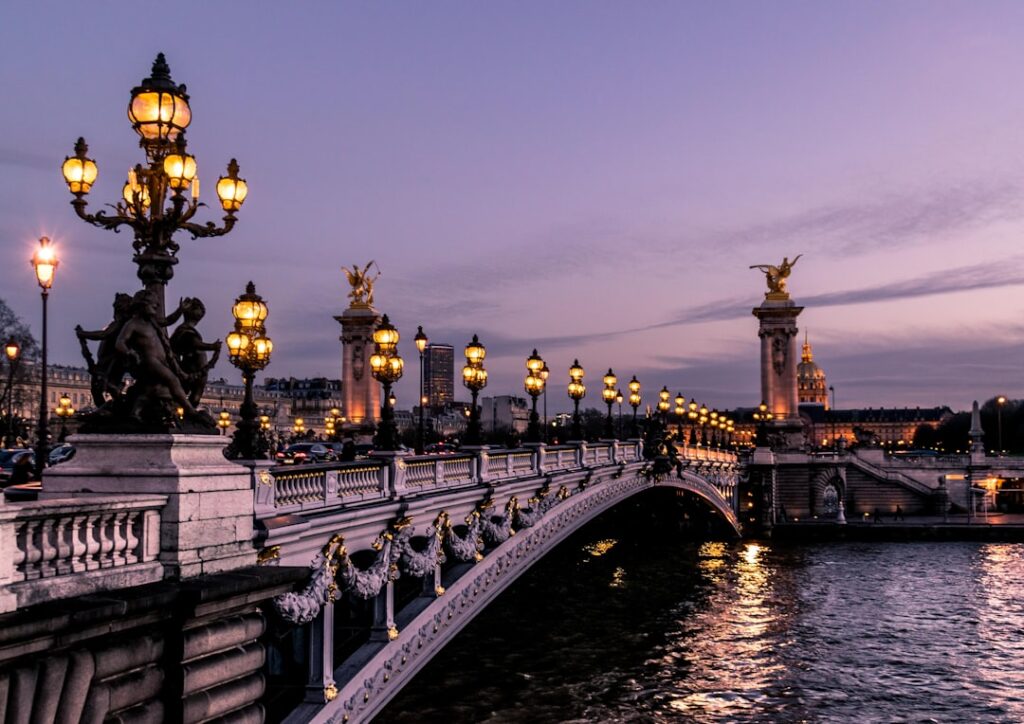
Paris wouldn’t be Paris without its bridges. The city has 37 of them spanning the Seine, each with its own character, history, and views. Some are grand monuments, others intimate passageways. Together, they form a walking route that lets you see the city from its most romantic vantage point—over the water.
Here’s a guide to the bridges you shouldn’t miss, and how to string them together into an unforgettable walk along the river.
Start at Pont Neuf: The Oldest Bridge in Paris
Despite its name—”New Bridge”—Pont Neuf is actually the oldest standing bridge in Paris, completed in 1607 under Henri IV. It connects the Left and Right Banks at the tip of Île de la Cité, and it was the first Parisian bridge built without houses on top.
Start your walk here in the early morning when the light is soft. The bridge has twelve arches and 381 stone masks decorating its sides, each one different. Walk to the center and look west toward the Eiffel Tower—it’s one of the classic Paris views. Below, the tree-lined Square du Vert-Galant offers a quiet spot to sit at river level.
Metro: Pont Neuf (Line 7). From here, head east along the Right Bank toward Notre-Dame.
Pont des Arts: The Pedestrian Classic
Cross to the Left Bank using Pont des Arts, the iron footbridge that connects the Institut de France to the Louvre. Built in 1804 and rebuilt in the 1980s, this is one of the most peaceful spots in central Paris. No cars, just pedestrians, buskers, and painters setting up their easels.
The “love locks” that once weighed down the railings have been removed, but the bridge remains a favorite for proposals and picnics. Bring a baguette and cheese from the nearby Rue de Buci market and settle in. The view upstream toward Île de la Cité and downstream toward the Eiffel Tower is hard to beat.
Continue east along the Left Bank quays—Quai de Conti and Quai des Grands Augustins—where the bouquinistes (secondhand booksellers) have been selling prints and poetry since the 16th century.
Pont Alexandre III: Paris at Its Most Extravagant
Backtrack west along the Right Bank to reach Pont Alexandre III, the most ornate bridge in Paris. Built for the 1900 World’s Fair, it’s a Belle Époque fantasy of golden statues, Art Nouveau lamps, and winged horses. The single-span steel arch was an engineering marvel at the time, designed to offer unobstructed views of the Invalides to the south and the Grand Palais to the north.
This is the bridge you’ve seen in a thousand photos and movies—Midnight in Paris, Anastasia, countless fashion shoots. Go at sunset when the gilt catches the light, or after dark when the lamps glow against the sky.
The bridge connects the Champs-Élysées quarter with the Invalides. Metro: Invalides (Line 8) or Champs-Élysées–Clemenceau (Lines 1, 13).
Pont Bir-Hakeim: The Eiffel Tower Bridge
For a more modern, cinematic experience, head southwest to Pont Bir-Hakeim, a two-level bridge carrying both the Métro (Line 6) and pedestrians. The upper deck offers one of the best views of the Eiffel Tower, and if you time it right, you’ll see a train rattling past with the Iron Lady in the background.
This is the bridge from Inception and Last Tango in Paris. Walk across in the late afternoon and pause at the center island, Île aux Cygnes, a narrow park with a quarter-scale Statue of Liberty at its western tip—a gift from the American community in Paris in 1889.
Metro: Bir-Hakeim (Line 6) or Passy (Line 6).
Practical Tips for Your Bridge Walk
The full walk from Pont Neuf to Pont Bir-Hakeim is about 5 kilometers (3 miles) and takes two to three hours at a leisurely pace, longer if you stop for coffee or photos. Wear comfortable shoes—the quays are mostly paved, but there are stairs at several points.
The best time to walk is early morning or late afternoon, when the light is warm and the crowds are thinner. Spring and fall are ideal seasons, though a winter walk has its own moody charm.
Pick up snacks at a bakery or market before you start—there are fewer food options along the quieter stretches of the quays. And don’t forget your camera. Every bridge offers a different frame of the city.
Want more stories like this delivered to your inbox? Subscribe to the Love Paris newsletter—one short story a day, taking you deeper into the Paris you love.
Tours & experiences in Paris


Powered by Viator. Some links are affiliate links — we may earn a small commission at no extra cost to you.