
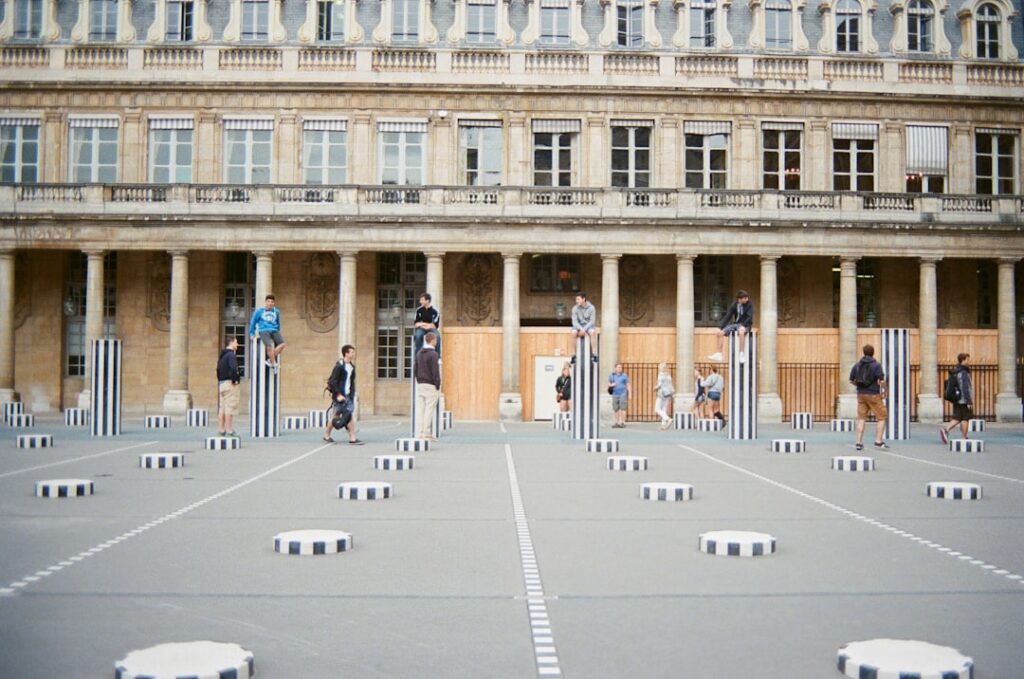
Walk through the courtyard of the Palais-Royal on any given afternoon and you’ll find Parisians reading on benches, children chasing each other around Daniel Buren’s striped columns, and visitors who’ve stumbled upon one of the city’s most elegant surprises. This former royal palace, tucked between the Louvre and the Grands Boulevards, remains surprisingly under-visited despite sitting in the heart of the 1st arrondissement.
Built for Cardinal Richelieu in the 1630s and later home to the Orléans family, the Palais-Royal today houses government offices, the Comédie-Française theater, and a public garden surrounded by arcades that feel worlds away from the tourist crowds just blocks away.
The Controversial Columns
Your first encounter with the Palais-Royal will likely be in the Cour d’Honneur, where 260 black-and-white striped columns of varying heights create an optical playground. Daniel Buren’s 1986 installation, formally titled “Les Deux Plateaux,” sparked outrage when it was unveiled—critics called it vandalism of a historic monument. Forty years later, these columns have become one of the city’s most photographed contemporary artworks.
Children climb them, photographers use them as foreground elements for countless Instagram shots, and on sunny days, the contrast of black stripes against white stone and blue sky creates a striking geometric landscape. Visit early morning or late afternoon when the light rakes across the columns at dramatic angles.
The Gardens and Arcades
Pass through the columns and enter the Jardin du Palais-Royal, a formal French garden that feels like a private estate open to the public. Rows of perfectly pruned lime trees frame gravel paths, fountains provide a gentle soundtrack, and metal chairs invite you to sit and read, nap, or simply watch Paris go by at a slower pace.
The real treasure lies in the arcades surrounding the garden on three sides. Built in the late 18th century, these covered walkways once housed gambling dens, cafes, and theaters that made the Palais-Royal the entertainment center of pre-Revolutionary Paris. Today, the Galerie de Valois, Galerie de Montpensier, and Galerie Beaujolais shelter upscale boutiques, vintage fashion shops, antique dealers, and specialty stores you won’t find anywhere else.
Stop by E. Dehillerin at 18-20 Rue Coquillière (just outside the gardens) for professional cookware that’s equipped French kitchens since 1820. Browse rare perfumes at Serge Lutens’ boutique in the Galerie de Valois. Or simply wander and window-shop—the arcades themselves, with their stone columns and vaulted ceilings, are as beautiful as anything they contain.
Le Grand Véfour: Where History Tastes Exquisite
Under the arcades at 17 Rue de Beaujolais, Le Grand Véfour has occupied the same spot since 1784. This two-Michelin-star restaurant preserves its original painted ceilings and gilded mirrors, and brass plaques mark tables where Napoleon, Victor Hugo, and Colette regularly dined. It’s Paris dining at its most theatrical and expensive, but if you’ve been saving for one splurge meal, this 18th-century jewel box delivers both culinary excellence and time-travel ambiance.
For something more accessible, Café Kitsuné in the gardens serves excellent coffee and light fare in a minimalist space that contrasts beautifully with the historic surroundings.
Practical Information
The Palais-Royal garden is open daily from 7:30 a.m. to 8:30 p.m. April through August, with shorter hours in winter. Entry is free. The nearest métro station is Palais Royal-Musée du Louvre on lines 1 and 7. You can easily combine a visit here with the Louvre, the covered passages to the north, or the Tuileries Garden just across the rue de Rivoli.
The garden is at its loveliest in late spring when wisteria drapes the arcades in purple blooms, but it’s peaceful year-round—even in high summer when the Louvre’s courtyard teems with crowds. Come with a book, claim a chair in the shade, and experience Paris as locals do: unhurried, elegant, and quietly magnificent.
Want more hidden corners and insider tips delivered to your inbox? Subscribe to the Love Paris newsletter and receive one short story about the city each day—the Paris beyond the guidebooks, straight to you.
Tours & experiences in Paris


Powered by Viator. Some links are affiliate links — we may earn a small commission at no extra cost to you.