The Grands Boulevards—that chain of wide, tree-lined avenues sweeping from the Madeleine to République—represent Baron Haussmann’s most dramatic reshaping of Paris. Built in the 1860s and 1870s atop old city ramparts, these boulevards defined modern Paris and remain one of the city’s most rewarding walks, lined with theaters, historic cafés, and elegant covered passages.
While tourists flock to the Champs-Élysées, locals know the real grand boulevard experience unfolds along this east-west arc through the 2nd, 9th, and 10th arrondissements. Here’s how to walk it like a Parisian.
Boulevard des Capucines to Boulevard des Italiens
Start at Place de l’Opéra, where the Palais Garnier anchors the western end of the circuit. Walk east along Boulevard des Capucines, pausing at number 14—the Grand Café, where the Lumière brothers first projected moving pictures in 1895. The café still serves today, and the plaque outside marks cinema’s birthplace.
Continue to Boulevard des Italiens, named for the Italian theater that once stood here. This stretch was the heart of fashionable Paris in the 19th century. Café de la Paix, opposite the Opéra, has been serving since 1862 and remains the perfect spot for a mid-morning coffee on the terrace. The interior, all gilded moldings and painted ceilings, hasn’t changed in 160 years.
Just south of the boulevard, duck into the Passage des Panoramas, opened in 1800 and Paris’s oldest covered passage. Its dim glass roof, antique storefronts, and stamp dealers evoke another era entirely. The engraving shops and old-fashioned bistros like Racines make it worth the detour.
Boulevard Montmartre to Boulevard Poissonnière
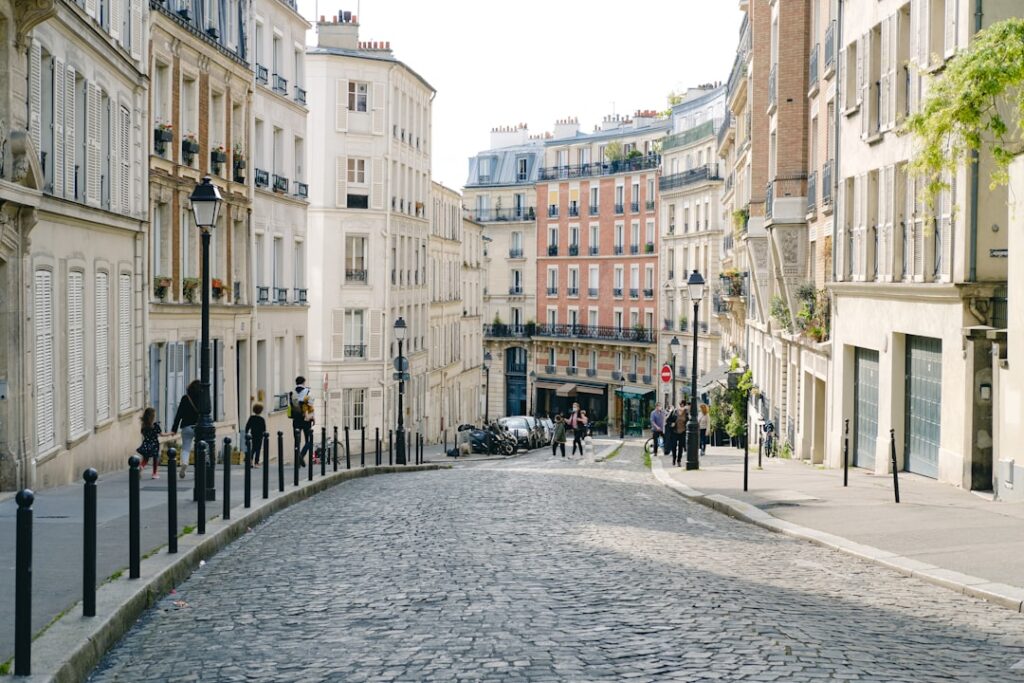
East of Rue Montmartre, the boulevards shift character. Boulevard Montmartre leads past the Musée Grévin wax museum and the Théâtre des Variétés, its Belle Époque facade still advertising operettas. This area pulses with tourists by day, but early morning reveals its architectural bones—the uniform cream stone facades, the wrought-iron balconies, the rhythm of identical windows marching block after block.
The Passage Jouffroy, across from the Grévin, is the loveliest of the covered passages. Browse old books at Librairie du Passage, admire walking canes at M&G Segas, or warm yourself with hot chocolate at Café Zephyr. The passage connects through to Passage Verdeau, quieter still, with antique print dealers and curiosity shops that see few visitors.
Boulevard Poissonnière continues the theater district. Count the marquees as you walk—this was Paris’s entertainment heart before Montparnasse claimed that title. Le Grand Rex, the Art Deco cinema palace on Boulevard Poissonnière, is Europe’s largest theater and still shows films on its vast screen.
Boulevard Bonne-Nouvelle to République
The boulevards turn grittier as you head east. Boulevard Bonne-Nouvelle and Boulevard Saint-Martin feel less polished, more lived-in. The crowds shift from tourists to office workers grabbing lunch, students heading to République, and locals doing their shopping.
Two grand theaters dominate this stretch: the Porte Saint-Martin and the Théâtre de la Renaissance. Both date to the late 18th and early 19th centuries, and both still stage plays and musicals. Their columned facades give these boulevards their theatrical grandeur.
The walk ends at Place de la République, where the grands boulevards meet the eastern arrondissements. The massive square, redesigned in 2013, has become a gathering place for Parisians—skateboarding, protesting, picnicking, or simply passing through on their way to the Marais or Canal Saint-Martin.
Practical Tips for Walking the Grands Boulevards
The entire walk from Opéra to République covers about three kilometers and takes 90 minutes at a leisurely pace, not counting stops. Start mid-morning when cafés are setting up terraces and shops are opening. The light is best before noon, when it streams down the wide avenues Haussmann designed specifically for sunlight and air.
Métro access is excellent throughout. Get off at Opéra to start, or join the walk at Richelieu-Drouot, Grands Boulevards, Bonne-Nouvelle, or Strasbourg-Saint-Denis. You can walk the entire route or tackle it in sections.
For the covered passages, visit weekdays when shops are open. Many close Sunday and Monday. Bring cash for the old-fashioned bistros and engraving shops—not all take cards.
The boulevards shine at night, too, when theater marquees light up and cafés glow from within. An evening stroll after dinner captures the Belle Époque atmosphere that made these avenues legendary.
This is Paris’s great 19th-century promenade, less famous than the Champs-Élysées but far more authentic. Walk it, and you’re walking where Parisians have walked for 150 years.
Want more Parisian walks and hidden corners delivered to your inbox? Subscribe to the Love Paris newsletter and get one short story a day about the city beyond the guidebooks.
Tours & experiences in Paris


Powered by Viator. Some links are affiliate links — we may earn a small commission at no extra cost to you.