While tourists flock to the Luxembourg Gardens and the Tuileries, Parisians in the know head to Parc Monceau, an elegant 8-hectare retreat in the 8th arrondissement that feels more like a private estate than a public park. With its Renaissance colonnade, ornamental ponds, and Belle Époque statuary, this is where Haussmann-era Paris comes to life in the most refined way possible.
Created in 1778 by the Duke of Chartres and redesigned by Baron Haussmann in the 1860s, Parc Monceau remains one of the city’s most atmospheric green spaces—a place where local families stroll beneath plane trees and art students sketch beside crumbling follies.
The Architectural Follies
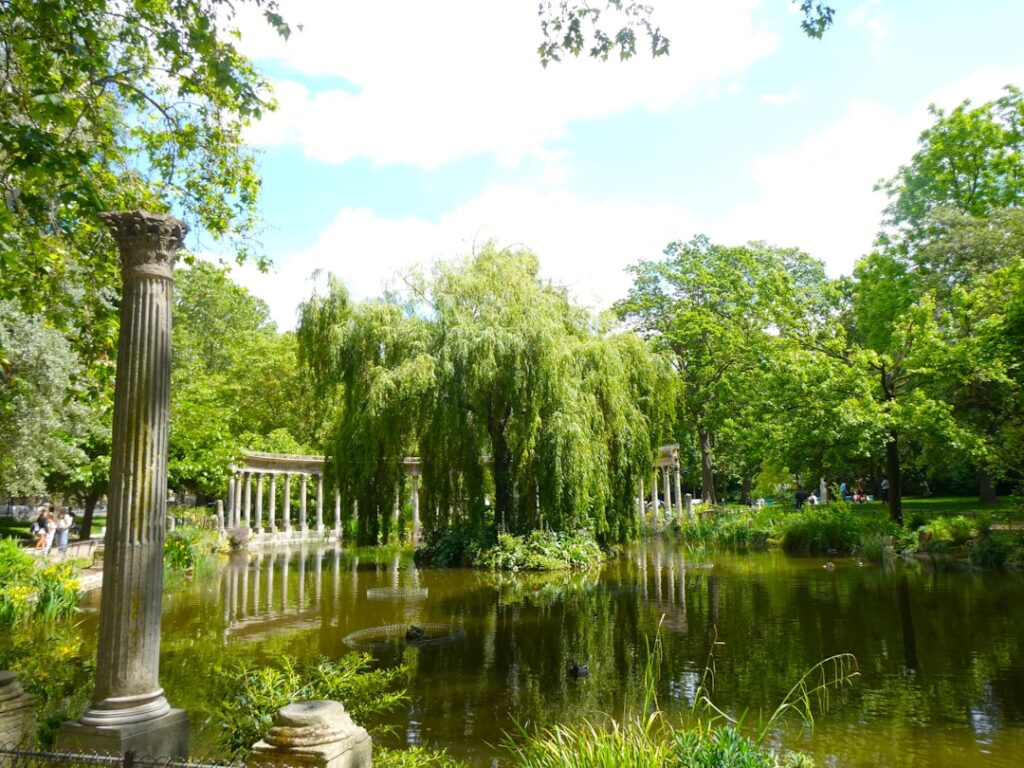
What sets Parc Monceau apart from other Parisian parks is its collection of whimsical architectural fragments scattered throughout the grounds. The star attraction is the Naumachie, a curved Renaissance colonnade surrounding a small oval pond. These Corinthian columns once belonged to a rotunda at the Hôtel de Ville, demolished during the Revolution, and they create one of the most photogenic corners in Paris.
Elsewhere you’ll find a small Egyptian pyramid, a Dutch windmill, and various stone bridges crossing winding paths. The park was designed as a fantasy landscape, an 18th-century aristocrat’s vision of exotic destinations brought to life. While some structures have disappeared over the centuries, enough remain to give Parc Monceau its distinctive fairy-tale quality.
The gold-trimmed wrought-iron gates at the main entrance on Boulevard de Courcelles are themselves worth admiring—ornate examples of Second Empire metalwork that set the tone for what lies beyond.
A Neighborhood of Mansions and Museums
The streets surrounding Parc Monceau tell the story of Gilded Age Paris. This was where banking families and industrial magnates built their hôtels particuliers in the late 19th century, and many of these mansions still line Avenue Velasquez, Avenue Van Dyck, and Avenue Ruysdael (all named after painters).
Three of these private homes now house exceptional small museums. The Musée Cernuschi, at 7 Avenue Velasquez on the park’s eastern edge, displays one of France’s finest collections of Asian art in an intimate mansion setting. The Musée Nissim de Camondo, just north of the park at 63 Rue de Monceau, preserves an exquisite collection of 18th-century decorative arts in a perfectly preserved aristocratic residence. And the Musée Jacquemart-André, a short walk south at 158 Boulevard Haussmann, showcases Renaissance and 18th-century masterpieces in opulent Second Empire interiors.
Walking from the park to any of these museums gives you a sense of how Paris’s wealthiest families lived during the Belle Époque—and how much of that grandeur survives today.
When to Visit and How to Get There
Parc Monceau is most magical early on weekday mornings, when joggers circle the paths and the light filters through the trees onto the Naumachie’s columns. Weekend afternoons bring local families and their children, who sail wooden boats in the pond near the rotunda or play in the designated playground areas.
The park is open daily from 7:00 a.m. to 8:00 p.m. in winter and until 10:00 p.m. in summer. Spring, when the cherry blossoms bloom along the central lawn, is particularly beautiful, as is autumn when the plane trees turn gold.
Take the Metro to Monceau station (Line 2) and use the exit directly into the park—one of the few Metro stations in Paris that opens into a green space. You can also reach the park from Villiers station (Lines 2 and 3) or Courcelles station (Line 2), both a short walk away.
The surrounding 8th arrondissement offers plenty of cafés for a post-visit coffee. Try Pâtisserie des Rêves at 111 Rue de Longchamp for exceptional pastries, or settle into one of the traditional cafés along Rue de Courcelles.
Insider Tips
Look for the largest tree in Paris, a 200-year-old Oriental plane tree (platane d’Orient) near the center of the park with a trunk circumference of nearly seven meters. There’s a small plaque marking it.
The benches near the Naumachie fill up quickly on sunny days, but the southeastern corner of the park, near the pyramid, usually stays quieter and offers equally lovely spots to sit and read.
If you’re visiting the Musée Nissim de Camondo, note that it’s closed Mondays and Tuesdays. The mansion and its collection offer an unforgettable glimpse into aristocratic life, and combining it with a stroll through Parc Monceau makes for a perfect half-day in this elegant corner of Paris.
Parc Monceau proves that Paris still holds secrets—quiet, beautiful places where you can escape the crowds and experience the city as Parisians do. For more stories about Paris’s hidden corners and neighborhood gems, subscribe to the Love Paris newsletter and get one short story a day in your inbox.
Tours & experiences in Paris


Powered by Viator. Some links are affiliate links — we may earn a small commission at no extra cost to you.