
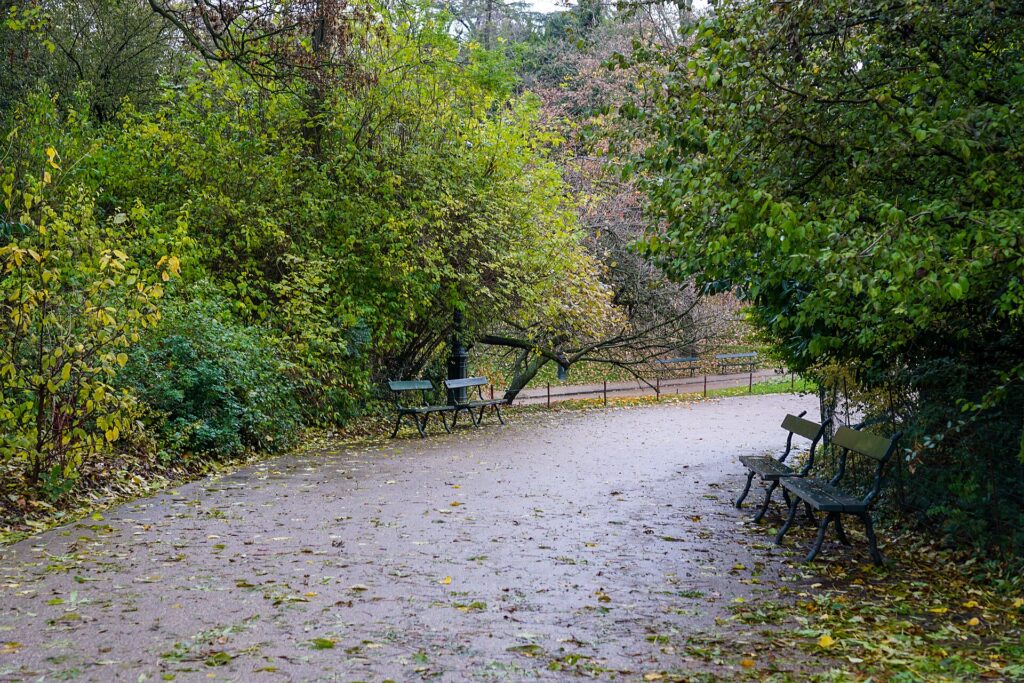
Parc des Buttes-Chaumont is Paris’s most surprising public garden. Created in the 1860s from an abandoned gypsum quarry and garbage dump, this 25-hectare park in the 19th arrondissement transforms the usual flat Parisian green space into something that feels more like the countryside than the city. Cliffs rise 30 meters above an artificial lake, waterfalls cascade down rocky outcrops, and a Roman-style temple crowns an island in the center. Napoleon III commissioned the space as part of his modernization of Paris, giving working-class northeastern neighborhoods a grand park to rival those in wealthier districts.
Unlike the formal geometry of the Tuileries or Luxembourg, Buttes-Chaumont embraces the picturesque English garden style. Winding paths climb steep hillsides, caves tunnel through artificial rock formations, and bridges span dramatic drops. The park’s topography — a direct result of decades of quarrying — creates views and vantage points impossible in flatter gardens. On weekends, Parisians from across the city make the trip here for precisely this drama, picnicking on sloping lawns and climbing to the temple for panoramic views that stretch from Montmartre to the Eiffel Tower.
The Temple de la Sibylle and Its Views
The park’s most recognizable feature stands on the Île du Belvédère, a rocky outcrop in the middle of the lake. The Temple de la Sibylle, modeled after the ancient Temple of Vesta in Tivoli, sits atop sheer cliffs that drop straight into the water below. Two bridges connect the island to the mainland: the Pont des Suicidés (Suicide Bridge), an elegant suspension bridge built in 1867, and a smaller stone bridge on the opposite side.
The Paris most visitors miss
Our free 8-page PDF guide: 25 places, from Galerie Vivienne's 1880 mosaic floor to Canal Saint-Martin's locks, each linked to its official site.
The climb to the temple rewards you with one of the best free panoramas in Paris. From this elevated position, you can see Sacré-Cœur gleaming white on the Butte Montmartre to the west, the towers of Notre-Dame to the south, and on clear days, the distant outline of the Eiffel Tower. Early morning visits offer the clearest air and the softest light, though sunset brings its own rewards as the city begins to glow. The suspension bridge itself has been reinforced multiple times over the decades but retains its original graceful lines.
Waterfalls, Caves and Hidden Grottoes
The park’s artificial waterfalls flow down from the heights above the lake, fed by water pumped from the Canal de l’Ourcq. The main cascade drops dramatically over manufactured rock faces designed to look like natural limestone formations. In the 19th century, this kind of romantic engineering was cutting-edge landscape design, meant to evoke wild nature within city limits.
Several grottoes tunnel into the cliffs, the largest being the Grotte de la Cascade near the northeastern shore. These caves stay cool even in summer and were built using the same techniques employed in the Bois de Vincennes around the same time. Stalactites and rock formations are all artificial, created with concrete and wire to mimic natural cave systems. Children love exploring these dim passages, and they provide welcome shade during July and August heat waves.
When to Visit and How to Get There
The park opens at 7 a.m. year-round and closes at dusk, with exact times shifting seasonally. Spring brings cherry blossoms to the paths near the lake, while autumn turns the park’s cedars and maples into a showcase of gold and red. Winter visits offer solitude and stark beauty, with far fewer crowds than summer weekends.
Take the Metro to Buttes Chaumont (line 7bis) or Botzaris (line 7bis) for the closest access. From Buttes Chaumont station, enter through the main gate on Rue Botzaris. From Botzaris, a short walk along Rue Botzaris or Rue de Crimée brings you to side entrances. The park sits in a primarily residential area, so you’ll pass neighborhood bakeries and cafés where locals stop for morning coffee — useful to know if you’re planning a breakfast picnic.
What to Bring and Where to Explore
Bring a blanket for the lawns that slope down to the lake on the southern side of the park. These grassy banks fill up on sunny weekends with families, students and couples who spread out for hours. The park has no food vendors inside, so pack provisions or stop at the small shops along Rue de Crimée before entering.
The paths total about 5 kilometers if you walk the full perimeter and explore the various hillside trails. Wear comfortable shoes: some sections climb steeply, and the artificial rocks can be uneven. Runners favor the outer loop early in the morning, while photographers head to the temple area in late afternoon when the western light illuminates the cliffs.
The park includes a small puppet theater (Guignol) near the main entrance that operates on Wednesday and weekend afternoons, a miniature pony ride for young children, and several playgrounds scattered throughout. The northeastern corner, near Place Armand Carrel, tends to be quieter than the lakeside areas and offers shaded benches under mature trees.
Unlike more formal Parisian parks, Buttes-Chaumont permits sitting and lying on the grass throughout most of the space, making it a genuine public living room for the 19th and 20th arrondissements. The atmosphere stays relaxed and unpretentious, a neighborhood park that happens to offer some of the most dramatic landscapes in the city.
Tours & experiences in Paris


Powered by Viator. Some links are affiliate links — we may earn a small commission at no extra cost to you.