
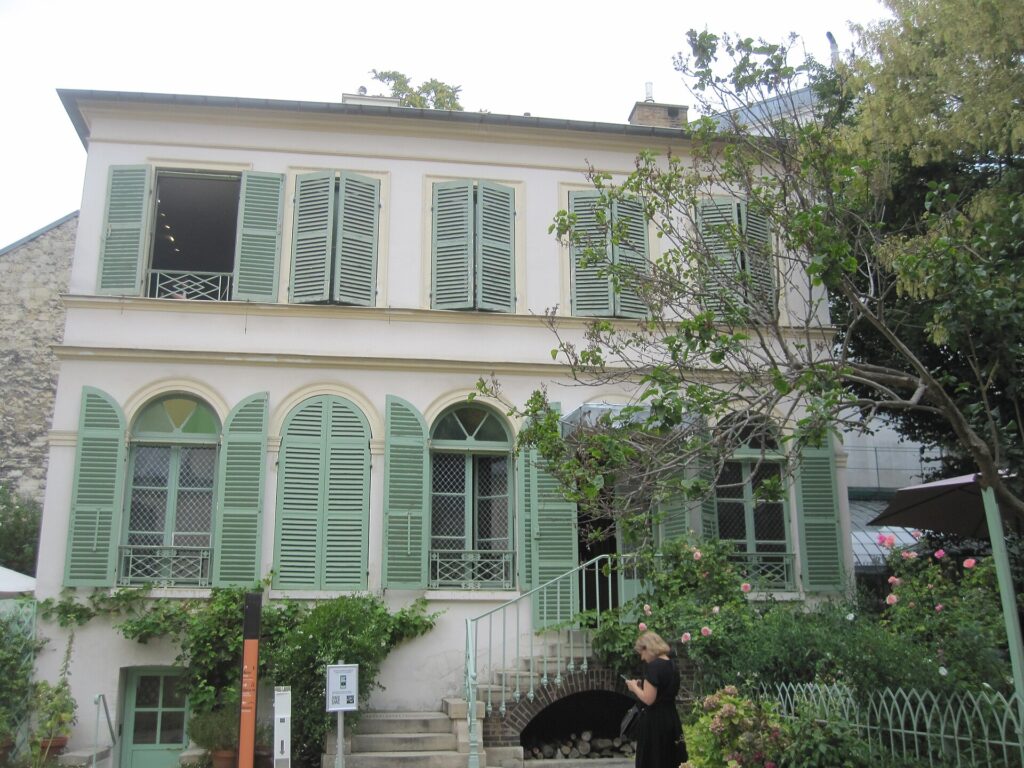
At the end of a narrow cobblestone lane in Pigalle, the Musée de la Vie Romantique feels like a secret from another century. The Italianate villa, set back behind iron gates and surrounded by a walled garden, was home to painter Ary Scheffer in the 1830s and 1840s—when this neighborhood at the foot of Montmartre was the artistic heart of Romantic Paris.
Today the museum preserves that world, with rooms devoted to George Sand, one of the 19th century’s most celebrated writers, and galleries filled with portraits, manuscripts, and personal objects from the Romantic movement. It’s one of the quietest museums in Paris, and one of the most atmospheric.
George Sand’s World
The heart of the museum is devoted to George Sand—novelist, playwright, feminist pioneer, and the woman who scandalized Paris by wearing trousers and smoking cigars in public. The collection includes her writing desk, jewelry, watercolors, and family portraits, along with first editions of her novels and letters to Chopin, Flaubert, and Balzac.
The Paris most visitors miss
Our free 8-page PDF guide: 25 places, from Galerie Vivienne's 1880 mosaic floor to Canal Saint-Martin's locks, each linked to its official site.
One room recreates the drawing room atmosphere of Sand’s country estate at Nohant, where she hosted the leading artists and intellectuals of her time. Display cases hold delicate porcelain, embroidered slippers, and the intricate jewelry she made herself—reminders that Sand was as skilled with her hands as with her pen.
The portrait gallery upstairs shows the faces of Romantic Paris: writers, musicians, and artists who gathered in this house for Friday evening salons. Scheffer’s studio, preserved as it was in the 1840s, gives a sense of how artists lived and worked during the era.
The Garden and Salon de Thé
The museum’s walled garden is one of the most peaceful spots in Paris. Roses climb the villa walls, gravel paths wind between flower beds, and iron tables sit in the shade of chestnut trees. In warm weather, the garden operates as a salon de thé, serving tea, coffee, and light refreshments.
It’s the kind of place where time slows down—a garden that feels lifted from a George Sand novel, where visitors linger over books and conversation the way Scheffer’s guests once did in the villa above.
The museum is free to enter, though donations are welcome. Check the official website before you go, as the museum occasionally closes for special exhibitions or events.
Finding the Musée de la Vie Romantique
The museum sits at the end of Rue Chaptal, a quiet cul-de-sac off Avenue Frochot in the 9th arrondissement. The nearest métro stations are Pigalle (lines 2 and 12) and Blanche (line 2), both about a five-minute walk away.
The approach is part of the experience: Rue Chaptal is lined with ivy-covered walls and private villas, and the cobblestones give way to silence as you walk toward the museum gates. It’s a pocket of old Paris that somehow survived Haussmann’s renovations.
The neighborhood around the museum rewards exploration. Avenue Frochot, just steps away, is a gated private street lined with 19th-century artist studios—you can peek through the ironwork at the lane where Toulouse-Lautrec once lived. The tree-lined Square Alex Biscarre, across from the museum entrance, offers benches and a small playground.
Visiting Tips
The museum is small and never crowded, making it ideal for a quiet morning or afternoon visit. Arrive early if you want to enjoy the garden, especially on weekends when the salon de thé draws locals. The collection changes periodically as temporary exhibitions rotate through the upstairs galleries, but the core George Sand rooms remain constant.
The museum shop sells books about George Sand and the Romantic period, along with postcards and prints. There are no audio guides, but printed room notes in English explain the major pieces.
Plan an hour to see the museum and another hour if you want to sit in the garden. The villa has no elevator, and the second floor is reached by a narrow staircase.
The Musée de la Vie Romantique proves that Paris still has secrets—small museums in hidden corners where the past feels close enough to touch. In a city of grand palaces and crowded galleries, this intimate villa offers something rarer: the chance to step into a world that has almost vanished, preserved in a garden at the end of a cobblestone lane.
Tours & experiences in Paris


Powered by Viator. Some links are affiliate links — we may earn a small commission at no extra cost to you.