
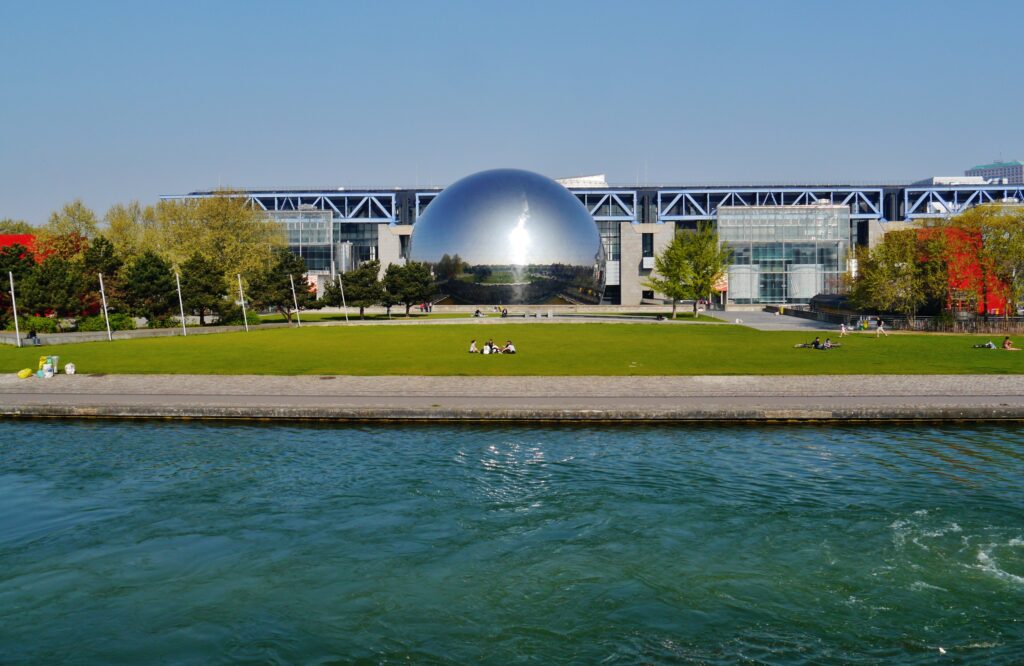
Tucked into the 19th arrondissement where the Canal de l’Ourcq meets the Canal Saint-Denis, Parc de la Villette sprawls across 55 hectares of what was once Paris’s central slaughterhouse district. Since its transformation in the 1980s, this park has become something entirely different from the manicured lawns and formal allées of traditional Parisian green spaces—a playground of red steel structures, world-class museums, and experimental gardens that draws families, students, and architecture enthusiasts in equal measure.
The Museums and Concert Halls
The Cité des Sciences et de l’Industrie anchors the northern edge of the park, housed in a striking building that preserves the steel framework of the old auction hall. Inside, interactive exhibits explore everything from oceanography to space exploration, with entire floors dedicated to children’s discovery. The Géode, the mirrored sphere visible across the park, screens IMAX films on a 1,000-square-meter hemispherical screen.
On the southern side, the Cité de la Musique and Philharmonie de Paris form a cultural complex devoted to music in all its forms. The Philharmonie’s soaring sail-like design houses one of Europe’s finest concert halls, while the Musée de la Musique displays centuries of instruments, from Renaissance lutes to electric guitars. Even if you’re not attending a performance, the building’s rooftop offers panoramic views across northeastern Paris.
The Paris most visitors miss
Our free 8-page PDF guide: 25 places, from Galerie Vivienne's 1880 mosaic floor to Canal Saint-Martin's locks, each linked to its official site.
The Folies and Thematic Gardens
Twenty-six bright red follies—small architectural structures designed by Bernard Tschumi—punctuate the park at regular intervals, serving as information points, refreshment stands, and sculptural landmarks. They’re unmissable: each is exactly ten meters cubed, painted in the same vivid shade, creating a geometric rhythm as you walk through the grounds.
Between these markers, a dozen thematic gardens offer wildly different experiences. The Jardin des Miroirs uses reflective surfaces to fragment and multiply the landscape. The Jardin des Dunes features rolling artificial hills popular with children. The Jardin du Dragon centers on a massive slide shaped like its namesake creature. These aren’t traditional flower gardens—they’re conceptual spaces that play with perception, sound, and movement.
Seasonal Events and Outdoor Cinema
From mid-July through August, the park hosts one of Paris’s most beloved summer traditions: an open-air cinema that screens classic and contemporary films on the vast lawn near the Canal de l’Ourcq. Thousands of Parisians arrive with picnic blankets and wine as the sun sets, turning movie night into a social ritual. The program changes yearly but always mixes French cinema with international favorites.
The park also serves as a venue for music festivals, contemporary dance performances, and circus arts throughout the warmer months. Check the official calendar before your visit—you might stumble onto a free concert or discover an installation by a contemporary artist using the park’s unique architecture as a canvas.
Getting There and Planning Your Visit
Metro line 5 stops at Porte de Pantin on the southern edge of the park, while line 7 serves Porte de la Villette to the north. The park itself is free and open around the clock, though the museums and concert venues keep their own schedules. Allow at least half a day to explore properly—more if you plan to visit both major museums or catch a performance.
The park works beautifully for families with children of any age, thanks to playgrounds scattered throughout and the hands-on exhibits at the Cité des Sciences. For architecture students and design enthusiasts, this is essential viewing: one of the clearest expressions of 1980s deconstructivist principles built at urban scale. The contrast with traditional Parisian parks couldn’t be sharper, and that’s precisely the point.
Bring a picnic if the weather cooperates—the lawns along the canal offer perfect spots to spread out, and you’ll find food vendors near the main entrances if you prefer to buy supplies on-site. The park sees far fewer tourists than central Paris attractions, so even on summer weekends, you’ll find room to breathe.
Tours & experiences in Paris


Powered by Viator. Some links are affiliate links — we may earn a small commission at no extra cost to you.