
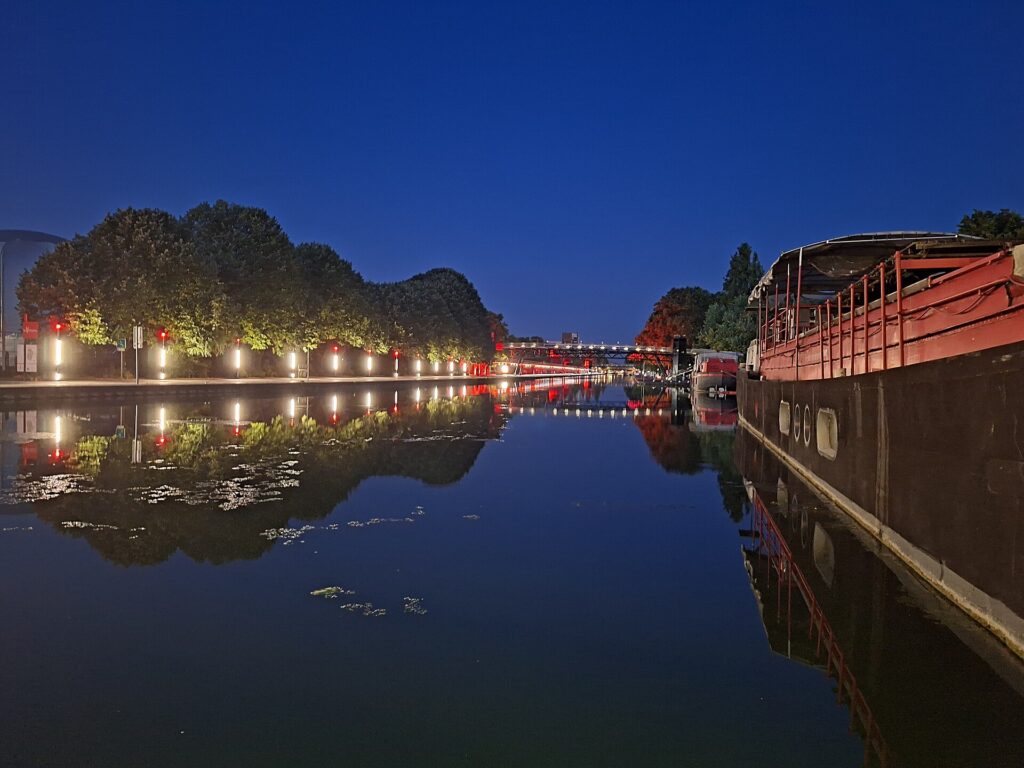
The Canal de l’Ourcq doesn’t appear in many guidebooks, but this waterway of about 108 kilometers has shaped northeastern Paris since a law of May 1802, under Napoleon as First Consul, decided to bring the water of the Ourcq river to the city. It ends in Paris at the Bassin de la Villette, and on the way it runs right through Parc de la Villette, home of the Cité des Sciences and the Philharmonie. Away from those big names, the canal is a ribbon of calm water lined with plane trees, moored barges and neighborhoods where Parisians actually live.
Unlike its famous cousin, the Canal Saint-Martin, with its iron footbridges and weekend crowds, the Ourcq feels unhurried. The towpath that once served working barges now belongs to joggers, cyclists and anyone who wants a break from monumental Paris. Walk east from La Villette and you trade tourists for anglers, and postcard views for a city going about its day.
Walking the Towpath from Parc de la Villette
Start in Parc de la Villette in the 19th arrondissement, where the Canal Saint-Denis branches off toward the north. The park rewards a wander of its own: Bernard Tschumi’s red follies, the mirrored sphere of La Géode cinema and wide lawns where Parisians picnic on summer evenings. Then follow the canal east along its tree-lined towpath.
The Paris most visitors miss
Our free 8-page PDF guide: 25 places, from Galerie Vivienne's 1880 mosaic floor to Canal Saint-Martin's locks, each linked to its official site.
The first stretch past the city limits runs through Pantin, where former industrial and office buildings have found new lives. The largest is the concrete block on the water that now houses the Centre national de la danse, France’s national dance center, with its studios and a media library.
Continue east and the cityscape softens. Small bridges cross the canal, houseboats sit at their moorings, and the path is flat all the way. There’s no single destination: the pleasure is in the walking itself, watching Paris thin out and green space take over.
Swimming in the Bassin de la Villette
At its Paris end, between Place de Stalingrad and Rue de Crimée, the water widens into the Bassin de la Villette, a long rectangular basin framed by stone quays. In recent summers it has been part of Paris Plages, the city’s summer beach festival, with supervised swimming areas set up in the basin itself. Swimming can close on some days, so search “Paris Plages” on paris.fr for this year’s dates and any closures before you pack a towel.
The basin is lined on both sides by long quays, Quai de la Seine and Quai de la Loire, with cinemas, terraces and benches facing the water. On warm evenings the quays fill with people watching the light fade, and the basin is worth a walk even when swimming season ends.
The 19th Arrondissement Along the Water
Inside Paris, the basin and the canal belong to the 19th arrondissement, one of the city’s most underrated. It mixes post-war housing blocks with converted warehouses, and it also holds Parc des Buttes-Chaumont, a short walk south of the water.
Where the basin meets the canal, Rue de Crimée crosses on a lift bridge. Built in 1885, its deck is raised by two hydraulic pistons, and the bridge, its mechanism and its control post have been listed as a historic monument since 1993. If a boat is coming through, stop and watch the whole road rise.
The streets around it show everyday Paris: bakeries, produce stalls, grocers from every corner of the world, the kinds of shops that serve residents rather than visitors. This part of the city is one of its most multicultural, and the markets show it, with vegetables, spices and whole fish laid out on ice.
Getting There and When to Go
For the basin, take the metro to Stalingrad or Jaurès. For Parc de la Villette, Porte de Pantin (line 5) and Porte de la Villette (line 7) put you at either end of the park, and Ourcq (line 5) stops close to the canal in between. Vélib’ bike-share stations are dotted around La Villette, and the towpath is ideal for cycling: flat, car-free and running far beyond the city limits if you’re feeling ambitious.
Summer brings the crowds, especially around Paris Plages, but it’s also when the canal shows its best face: plane trees in full leaf, water reflecting blue sky, the banks busy with life. Spring and fall offer quieter walks, and even winter has its appeal, with the canal stripped down to water, stone, trees and sky.
The Canal de l’Ourcq won’t knock you sideways the way the Eiffel Tower does. But if you’re tired of queues at the Louvre, it offers something increasingly rare in Paris: room to wander without a plan, neighborhoods that haven’t been arranged for visitors, and water that reflects a working city rather than a postcard.
Tours & experiences in Paris


Powered by Viator. Some links are affiliate links — we may earn a small commission at no extra cost to you.