The Panthéon rises above the Latin Quarter like a classical temple transplanted from ancient Rome. Its massive dome dominates the skyline of the 5th arrondissement, visible from dozens of vantage points across Paris. But while tourists flock to Notre-Dame and the Eiffel Tower, this neoclassical masterpiece remains surprisingly quiet—even though it holds the remains of France‘s most celebrated citizens.
Step inside and you’ll find Voltaire, Rousseau, Victor Hugo, Émile Zola, Marie Curie, and dozens of other luminaries entombed in the crypt below. Above, Foucault’s Pendulum swings beneath the soaring dome, demonstrating the Earth’s rotation in real time. This is where France honors its greatest minds, and it’s one of the most moving monuments in Paris.
From Church to Revolutionary Temple
King Louis XV commissioned the building in 1744 as the Church of Sainte-Geneviève, dedicated to Paris’s patron saint. Architect Jacques-Germain Soufflot designed a structure that would rival St. Peter’s in Rome—a Greek cross plan topped by a triple-layered dome inspired by Christopher Wren’s St. Paul’s Cathedral in London.
The church was completed in 1790, just as revolutionary fervor swept France. The National Assembly transformed it into a secular mausoleum, bricking up most of the windows to create a somber atmosphere befitting a national tomb. The building’s purpose shifted repeatedly over the next century—back to a church under Napoleon, then to a mausoleum again, then church, then mausoleum—before settling permanently into its current role in 1885 when Victor Hugo was interred here.
Today, 81 people rest in the Panthéon’s crypt. Only five are women—a stark imbalance that includes scientist Marie Curie, who was the first woman interred on her own merits in 1995, and Josephine Baker, the most recent addition in 2021.
What to See Inside
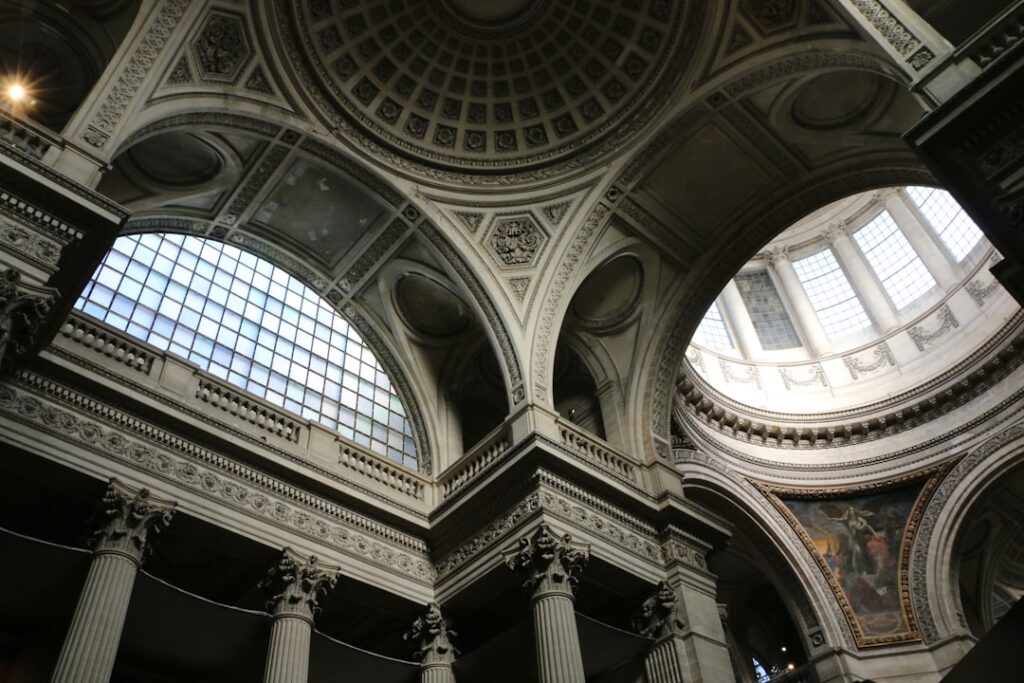
The interior stretches 110 meters long, with massive columns supporting the central dome that rises 83 meters above the floor. Natural light filters through the remaining windows, creating dramatic shadows across the marble floors and monumental paintings that line the walls.
Look for the enormous 19th-century frescoes depicting scenes from French history. The most famous shows Saint Geneviève watching over Paris and Joan of Arc’s story, painted by Jules Eugène Lenepveu. Pierre Puvis de Chavannes contributed pastoral scenes of the saint’s life that cover entire walls with soft, muted colors.
Foucault’s Pendulum hangs from the center of the dome—a 67-meter cable supporting a 28-kilogram brass sphere. Léon Foucault installed the original here in 1851 to prove the Earth rotates. Watch it swing slowly back and forth; over the course of hours, it appears to change direction, but it’s actually the floor rotating beneath it.
The crypt descends beneath the main floor in a maze of vaulted corridors. Down here, simple tombs line the walls. You’ll find Voltaire and Rousseau facing each other—the Enlightenment’s great rivals united in death. Marie Curie’s tomb sits in a far chamber, her coffin lined with lead due to her radioactive research. Victor Hugo, Alexandre Dumas, Émile Zola, André Malraux, and Resistance leader Jean Moulin all rest here too.
Visiting the Panthéon
The monument sits at the top of the Montagne Sainte-Geneviève on Place du Panthéon in the 5th arrondissement. The nearest métro stations are Cardinal Lemoine (line 10) or Maubert-Mutualité (line 10), both about a five-minute walk. The RER B stops at Luxembourg, a ten-minute walk through the Luxembourg Gardens.
Entry costs €11.50 for adults, free for EU residents under 26 and everyone under 18. The Paris Museum Pass covers admission and lets you skip the ticket line—worth it if you’re visiting multiple monuments. The Panthéon opens daily at 10 a.m., closing at 6 p.m. October through March and 6:30 p.m. April through September.
Arrive early or late to avoid tour groups. Mid-morning between 10 and 11 a.m. tends to be quietest. Give yourself at least an hour to explore the main floor and crypt. If you want to climb to the colonnade for panoramic views across Paris, book the dome tour in advance—it runs April through October only and requires an additional ticket.
Around the Panthéon
The Latin Quarter surrounds the monument with winding medieval streets, bookshops, and cafés. The Church of Saint-Étienne-du-Mont next door holds the only remaining rood screen in Paris and the shrine of Saint Geneviève. Rue Soufflot runs straight down to the Luxembourg Gardens, perfect for a post-visit stroll.
For lunch, head to Rue Mouffetard two blocks east—one of Paris’s oldest market streets, lined with food shops, produce stands, and casual restaurants. Le Pot de Terre at 22 Rue Mouffetard serves classic French cuisine in a tiny, tile-covered dining room. Place de la Contrescarpe at the top of the street fills with café terraces where locals linger over coffee.
The Panthéon rewards quiet contemplation. Stand beneath the dome, watch the pendulum swing, descend to the crypt where France’s greatest writers and scientists sleep. This is Paris at its most solemn and inspiring—a monument to ideas, achievement, and the enduring belief that some lives deserve to be remembered forever.
Want more Paris stories delivered daily? Subscribe to the Love Paris newsletter and get one short story about the city in your inbox each day.
Tours & experiences in Paris


Powered by Viator. Some links are affiliate links — we may earn a small commission at no extra cost to you.