
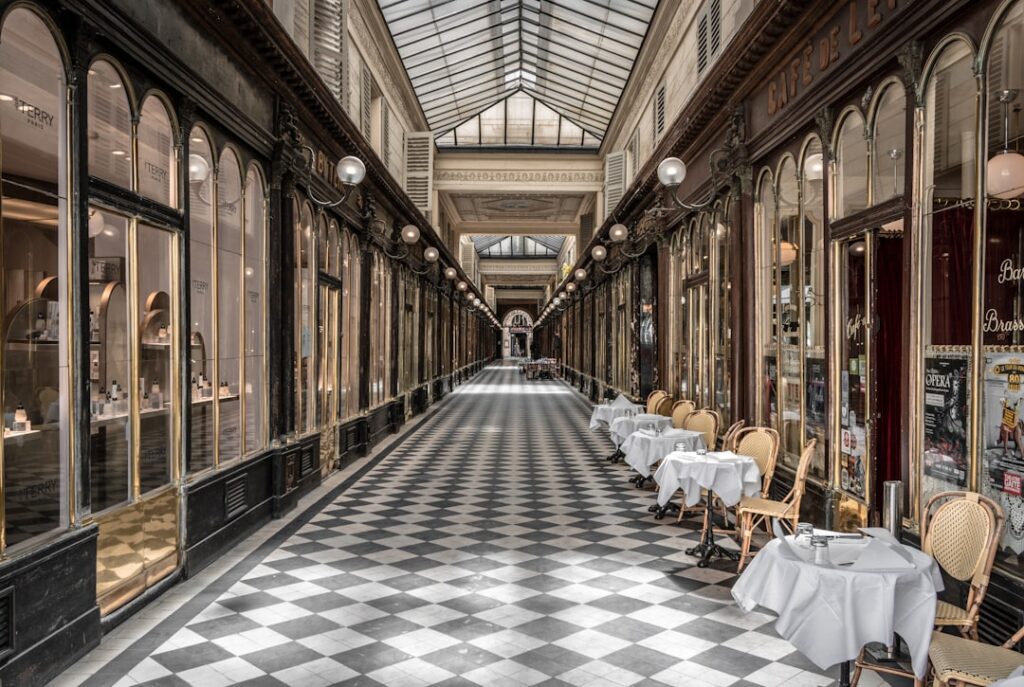
Long before department stores and shopping malls, Parisians strolled through covered passages: glass-roofed arcades lined with boutiques, cafés and theatres. Most were built in the late 1700s and early 1800s, and they offered a dry, well-lit alternative to the muddy streets outside. The City of Paris counts about thirty that survive today, tucked between the grand boulevards, and they remain some of the city’s most atmospheric corners.
Walking through these arcades feels like stepping into a time capsule. Mosaic floors gleam under iron-and-glass roofs, old shopfronts line both sides, and the sounds of the modern city fade. Here’s how to explore three of the best. (Our free Paris Covered Passages Guide adds three more, in walking order.)
Galerie Vivienne: The Most Beautiful Passage
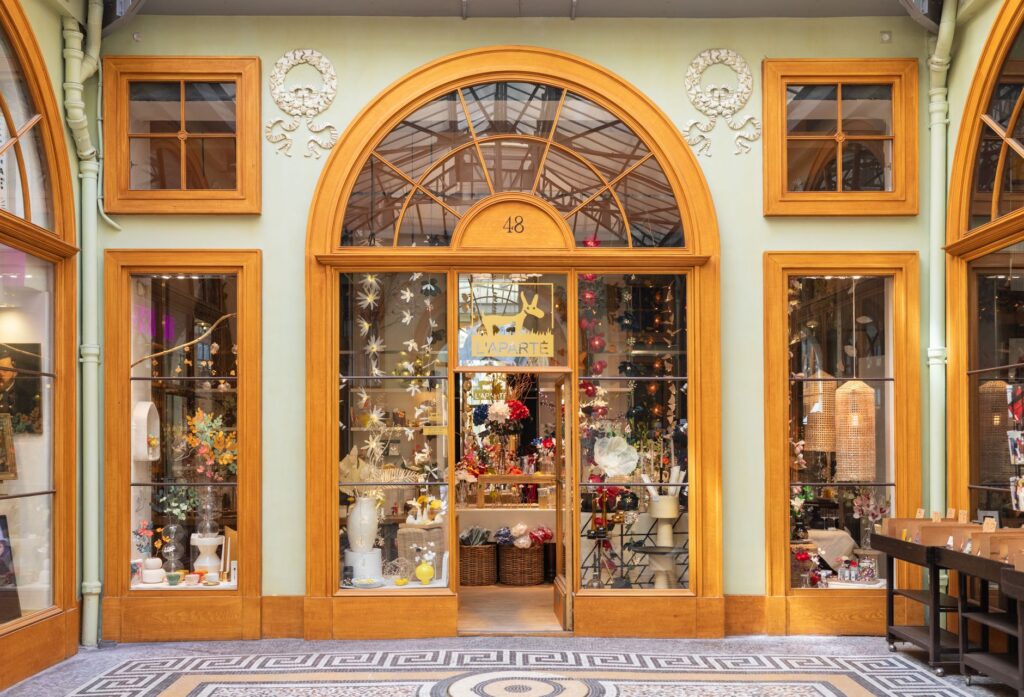
Start with Galerie Vivienne, the jewel of Paris’s covered passages. Built from 1823 to plans by the architect François Jean Delannoy and inaugurated in 1826, it runs 176 metres in the 2nd arrondissement, with entrances on Rue des Petits-Champs, Rue de la Banque and Rue Vivienne, just north of the Palais-Royal. The coloured mosaic floor is reason enough to visit, but look up at the glass roof and the dome too. It has been a listed historic monument since 1974.
Paris under glass roofs
Our free PDF guide: six covered passages in walking order, from Galerie Vivienne's mosaic floor to Passage Brady, each with a link.
You’ll find a mix of shops, tearooms and restaurants here, including Legrand Filles et Fils, a wine merchant trading since 1880.
Take the metro to Bourse (line 3) and walk a few minutes. Morning or late afternoon gives the best light through the glass roof.
Passage des Panoramas: The Oldest and Liveliest
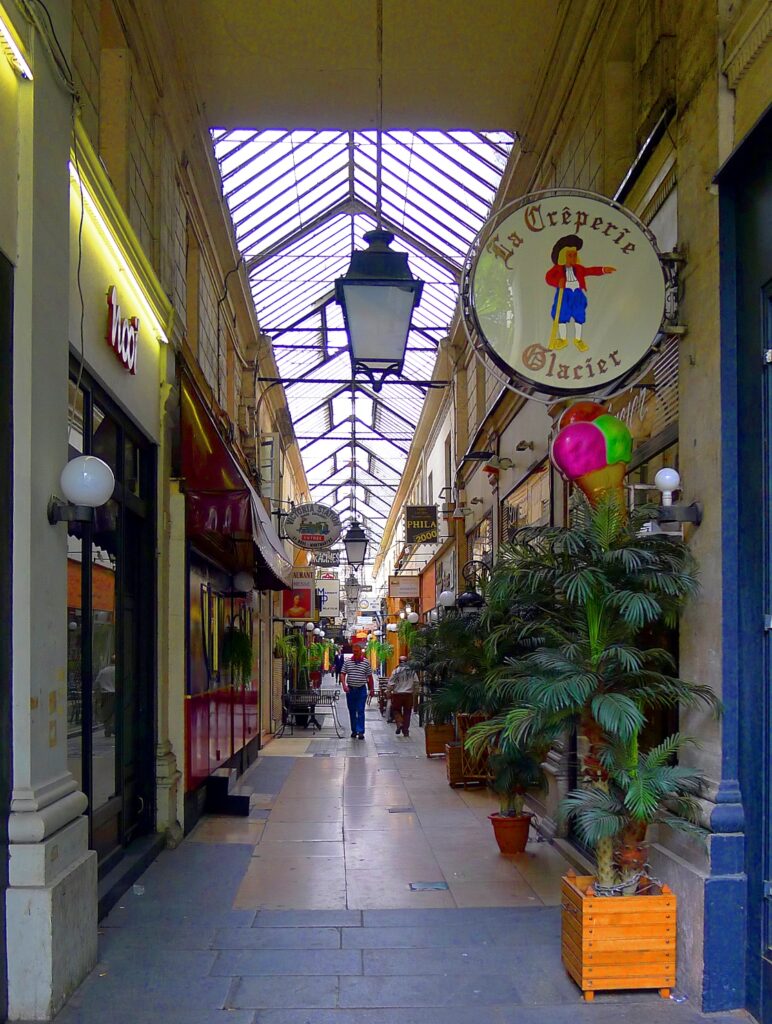
The Passage des Panoramas is the oldest of the surviving passages: in 1799 a man named Thayer built two towers on Boulevard Montmartre to show his panoramas, huge painted scenes, and opened a covered walk to bring customers in out of the rain and mud. The towers are long gone, but the name stayed. Today its galleries run between Boulevard Montmartre, Rue Vivienne and Rue Montmartre in the 2nd arrondissement.
It’s a lively mix of stamp and postcard dealers, small shops and places to eat. Across Boulevard Montmartre, the walk continues north through Passage Jouffroy, home to the wax museum Musée Grévin, and on to Passage Verdeau, both in the 9th.
Metro Grands Boulevards (lines 8 and 9) puts you near the main entrance on Boulevard Montmartre.
Passage du Grand-Cerf: High Ceilings and Artisan Workshops
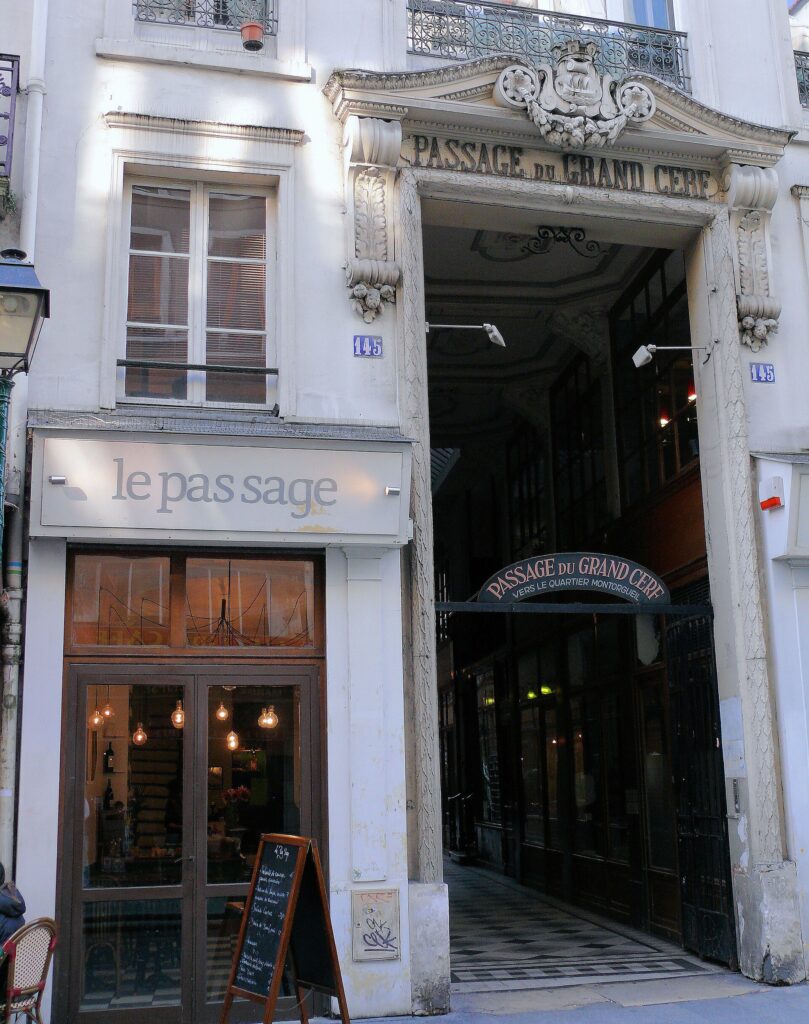
Between Rue Saint-Denis and Rue Dussoubs, the Passage du Grand-Cerf stands on the site of the Grand Cerf coaching inn, a terminus for stagecoaches that was pulled down in 1825. At nearly 12 metres, it is the tallest of all the Paris passages. Its partly metal frame allowed two storeys of glass shopfronts, with homes starting only on the third floor.
The passage was built more for workshops and craft than for luxury trade, and its plain neoclassical decoration reflects that. Left to decline for years, it was restored in 1990. It’s quieter than the Passage des Panoramas, which makes it good for browsing at a slow pace.
Combine your visit with the nearby Passage du Bourg-l’Abbé, built in 1828 and shortened when the Boulevard de Sébastopol was cut through. Metro Etienne Marcel (line 4) is closest.
Practical Tips for Passage Hopping
Each passage and shop sets its own opening times, so check before you go; the architecture is worth seeing on any day. Weekday mornings are the quietest.
The passages cluster around the Grands Boulevards (Panoramas, Jouffroy, Verdeau), near the Palais-Royal (Vivienne) and near Les Halles (Grand-Cerf, Bourg-l’Abbé). You can easily visit three or four in a single morning walk.
Bring a camera: the light through old glass, the floor mosaics and the painted shop signs are endlessly photogenic. And resist the urge to rush. These passages were made for flânerie, the art of wandering without a plan, and they still reward a slow pace.
Facts checked October 2026 against the City of Paris passages page and the Galerie Vivienne site.
Want more corners of Paris like these delivered to your inbox? Subscribe to the Love Paris newsletter and get one short story a day about the city beyond the guidebooks.
Tours & experiences in Paris


Powered by Viator. Some links are affiliate links — we may earn a small commission at no extra cost to you.