
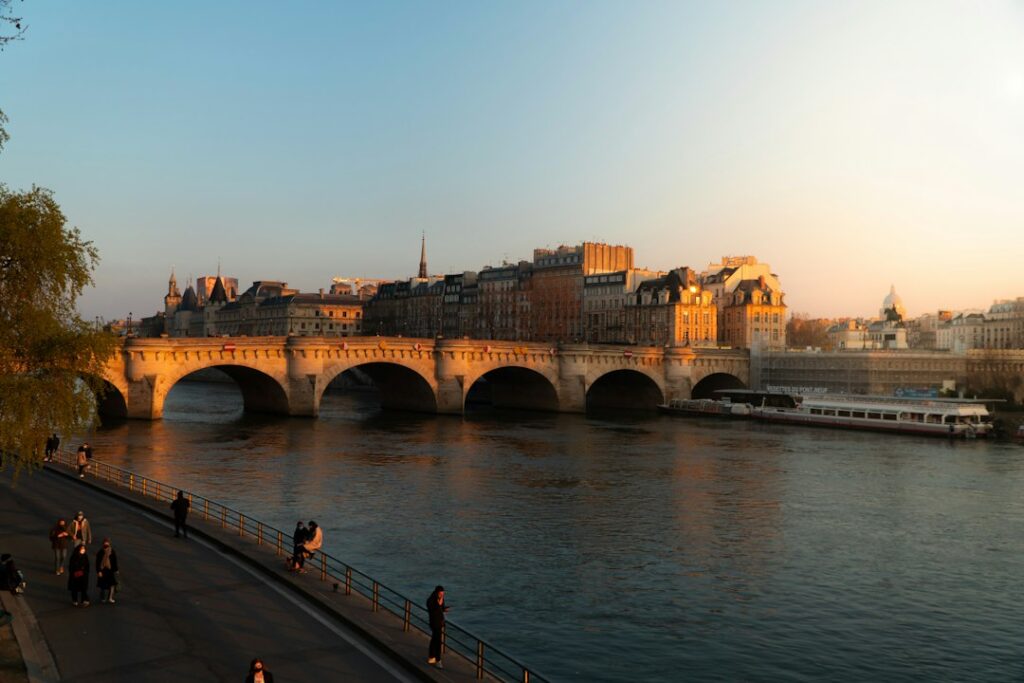
The Pont des Arts may be the most romantic pedestrian bridge in Paris—and that’s saying something in a city with thirty-seven Seine crossings. This elegant iron footbridge connects the Left Bank’s Institut de France to the Louvre’s Cour Carrée, creating a 155-meter walkway that’s become synonymous with Parisian romance, street performers, and some of the best views in the city.
Built in 1804 under Napoleon I, the original bridge was the first metal bridge in Paris and one of the first pedestrian bridges anywhere. What stands today is actually a 1984 reconstruction, faithful to the original’s nine-arch design but engineered with modern steel. Despite its relatively recent rebuild, the Pont des Arts feels timeless—probably because of the golden light that hits the Seine here around sunset and the bridge’s perfect position between two of Paris’s most beautiful buildings.
The Love Lock Story
For years, the Pont des Arts was famous for the thousands of padlocks couples attached to its railings, tossing the keys into the Seine as symbols of eternal love. By 2014, more than 700,000 locks weighed down the bridge—nearly 45 tons of metal threatening the structure’s integrity. Paris removed them all in 2015 and replaced the railings with glass panels.
The love lock tradition hasn’t entirely disappeared—couples still attach small locks to nearby bridges—but the Pont des Arts today is cleaner and actually more usable. The glass panels offer unobstructed views up and down the Seine, and the bridge can finally accommodate the crowds it attracts on warm evenings without structural concern.
What remains is the romantic spirit. Couples still come here to watch the sunset. Street musicians set up near the center arches. Artists sell watercolors and sketches. On Friday and Saturday nights in summer, you’ll find Parisians sitting on the wooden planks with wine and cheese, treating the bridge like an outdoor living room.
What to See From the Bridge
The views from the Pont des Arts are exceptional in both directions. Looking east, you’ll see the Île de la Cité with its elegant buildings and the towers of Notre-Dame rising behind them. The Pont Neuf, Paris’s oldest standing bridge despite its name, spans to your right.
To the west, the Seine opens up toward the Eiffel Tower, visible in the distance on clear days. The golden dome of Les Invalides catches the afternoon sun on the Left Bank. Directly across, the Louvre’s classical facades create one of those postcard-perfect Parisian backdrops.
The bridge itself sits low to the water, giving you an intimate perspective on the Seine. In summer, you’ll watch bateaux-mouches glide underneath, their passengers photographing you as you photograph them. Fishermen occasionally cast lines from the quais below. Joggers pass on both banks.
Best Times and How to Visit
The Pont des Arts is at its most magical around sunset, roughly 6 to 8 p.m. in summer, when the light turns golden and the bridge fills with locals and travelers alike. If you prefer it quieter, come early morning—before 9 a.m.—when mist often rises from the Seine and you’ll have the bridge nearly to yourself.
The bridge connects two different Paris neighborhoods worth exploring. On the Left Bank (south side), you’re in Saint-Germain-des-Prés territory: the Institut de France with its distinctive dome is right at the bridge’s entrance, and rue de Seine runs south into gallery-filled streets. On the Right Bank, you step into the Louvre’s orbit, with the museum’s courtyards and the Palais Royal gardens minutes away.
Getting here is simple: take the metro to Louvre-Rivoli (Line 1) or Pont Neuf (Line 7) and walk toward the river. The bridge is free and open 24 hours, though it’s best visited during daylight or early evening when it’s populated and well-lit.
Pack light if you’re planning to linger—there’s nowhere to sit except the wooden deck itself, and you’ll want your hands free for taking photos. Bring a bottle of wine and some cheese if you’re visiting at sunset; just take your trash with you when you leave.
Around the Bridge
The quais flanking the Pont des Arts are part of Paris’s car-free riverside promenades, popular with runners, cyclists, and anyone wanting to walk along the Seine. In summer, temporary bars and food stands set up along the Right Bank quai, part of the Paris Plages program that transforms sections of riverbank into urban beaches.
Just east of the bridge on the Left Bank, the Institut de France houses five académies including the prestigious Académie Française, guardian of the French language. The building’s baroque dome, designed by Louis Le Vau in the 17th century, is one of Paris’s most photographed architectural features.
On the Right Bank side, duck into the Louvre’s Cour Carrée for a moment of classical symmetry, or walk north through the Passage Richelieu into the Palais Royal gardens—one of Paris’s most peaceful public spaces.
The Pont des Arts may have lost its locks, but it’s gained back its original purpose: a beautiful pedestrian crossing that lets you slow down, look around, and remember why you fell in love with Paris in the first place.
Want more Paris stories like this? Subscribe to the Love Paris newsletter and get one short story a day about the city’s neighborhoods, landmarks, cafés, and hidden corners—delivered straight to your inbox every morning.
Tours & experiences in Paris


Powered by Viator. Some links are affiliate links — we may earn a small commission at no extra cost to you.