
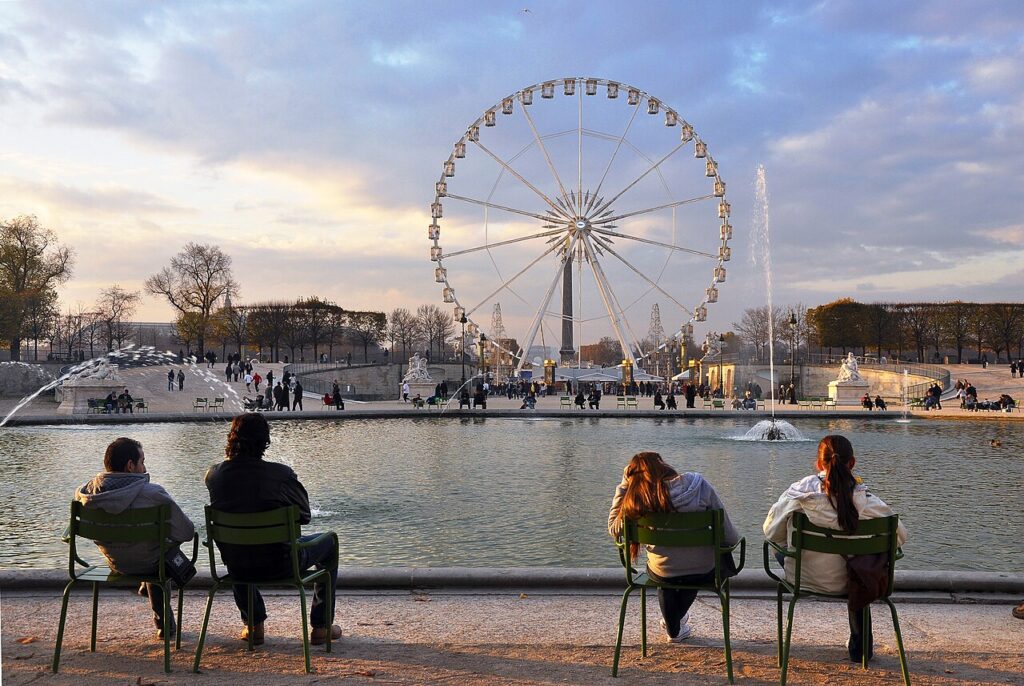
The Jardin des Tuileries stretches like a grand green carpet from the Louvre to the Place de la Concorde, offering what might be Paris‘s most regal public space. Created in 1564 for Catherine de Médicis and redesigned by André Le Nôtre in 1664, these 63 acres represent the prototype for French formal gardens—all symmetry, sculpture, and carefully controlled nature. Yet unlike Versailles, the Tuileries belongs entirely to the city, free and open from dawn until well past dusk.
This is where Parisians come to breathe between museum visits, where children sail wooden boats in octagonal fountains, and where you can sit in a green metal chair and watch the light change over some of the world’s most famous urban views.
Walking the Grand Allée
Enter from the Louvre courtyard and you’re immediately on the central pathway that runs arrow-straight toward the Concorde obelisk. Le Nôtre designed this Grand Allée to be walked slowly, with carefully orchestrated sight lines revealing sculpture, fountains, and architecture at precise intervals. The two large ponds flanking the central axis—the Grand Bassin Rond nearest the Louvre and the octagonal Grand Bassin near the Concorde end—serve as the garden‘s anchors.
In warm months, children rent miniature sailboats (€4 for 30 minutes) to navigate the octagonal basin while adults claim the surrounding chairs. The ponds double as mirrors, reflecting the chestnut trees and sky in ways that change dramatically with the seasons. Winter brings a stripped-down geometry that reveals Le Nôtre’s design bones; spring explodes with tulips and flowering chestnuts; summer means dense green shade; autumn turns the trees golden against gray Paris stone.
Don’t miss the elevated terrace that runs along the Seine side of the garden. The Terrasse du Bord de l’Eau offers unobstructed river views and passes the Musée de l’Orangerie at the Concorde end, home to Monet’s Water Lilies in two purpose-built oval rooms.
Sculpture Around Every Corner
The Tuileries functions as an open-air sculpture museum with more than 200 works scattered throughout the grounds. Maillol’s voluptuous bronze nudes populate the eastern section near the Louvre—look for his “La Rivière” reclining by the Carrousel garden. Rodin’s “Le Baiser” and “Eve” stand in the western section, while contemporary pieces rotate through temporary exhibitions.
The garden’s most photographed sculptures frame the entrance gates. At the Place de la Concorde end, Coysevox’s massive “Renommée” and “Mercure” horses rear on pedestals, perfectly positioned against the obelisk backdrop. These 17th-century originals (the ones at Versailles are copies) capture the garden’s royal heritage in white marble.
For a quieter sculpture experience, explore the garden’s perimeter paths where smaller bronzes hide among hedges and trees. The less-trafficked north side along Rue de Rivoli rewards wanderers with pieces that get overlooked in the central rush.
Where to Sit and What to Skip
The Tuileries provides more than 3,000 of Paris’s signature sage-green chairs, free to arrange as you wish. Locals know the best spots: the shaded grove between the two ponds for afternoon reading, the sunny southwest corner near the Jeu de Paume museum for morning coffee, or the elevated terrace for sunset people-watching.
Avoid the overpriced cafés inside the garden itself. Instead, grab supplies at Angelina on Rue de Rivoli (their hot chocolate in a to-go cup is worth the queue) or the small grocery at 194 Rue de Rivoli, then claim your chair. The garden allows picnics except on the lawns, which open only in summer and fill quickly with sunbathers.
The two museums bookending the Tuileries deserve visits: the Musée de l’Orangerie for Impressionism and the Jeu de Paume for photography and contemporary art. Both maintain separate admission from the Louvre and draw smaller crowds. Visit early morning or late afternoon when tour groups clear out.
Practical Information
The Tuileries opens at 7:00 a.m. daily, closing at 9:00 p.m. in summer and 7:30 p.m. in winter. Access is free, with multiple entry points: through the Louvre courtyard, from Place de la Concorde, or via gates along Rue de Rivoli. The most direct métro access is Tuileries (line 1) or Concorde (lines 1, 8, 12).
The garden provides restrooms near both main ponds (€0.50), wheelchair-accessible paths throughout, and water fountains along the central allée. Spring tulip season (mid-April through early May) and autumn color (late October) represent peak beauty, but the garden rewards visits year-round—even winter fog creates dramatic effects through the bare trees.
If you’re planning a full day exploring this corner of Paris, consider a structured tour that connects the Louvre, Tuileries, and surrounding landmarks. Otherwise, simply show up with a book, a camera, or nothing at all. The Tuileries asks only that you slow down and notice what centuries of careful design can do to 63 acres of Parisian real estate.
Want more stories about Paris’s hidden corners and enduring classics? Subscribe to the Love Paris newsletter—one short story about the city every day, straight to your inbox.
Tours & experiences in Paris


Powered by Viator. Some links are affiliate links — we may earn a small commission at no extra cost to you.