
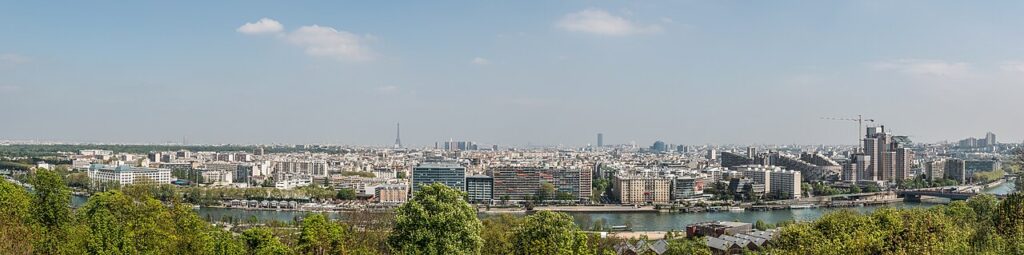
While the Bois de Vincennes claims the east, the Bois de Boulogne dominates Paris‘s western border—2,090 acres of forest, lakes, formal gardens, and winding paths that feel a world away from the city center. Originally a royal hunting ground, it was transformed by Napoleon III and Baron Haussmann in the 1850s into the romantic landscape park you see today, modeled after London’s Hyde Park but distinctly French in spirit.
This isn’t a manicured city park. It’s a genuine forest with hidden corners, secret gardens, and enough variety to fill several visits. Parisians come here to row boats, picnic beside waterfalls, cycle through tree-lined allées, or simply disappear into the woods for a few hours.
The Lakes and Lac Inférieur
The Bois has two main lakes. Lac Inférieur, the larger and more accessible of the two, sits near the center of the park and offers rowboat rentals from April through October. The island in the middle—Île de la Grande Jatte—has a café where locals nurse espressos under plane trees while ducks paddle past. On weekends, families spread blankets along the grassy banks, and the scene feels more like the countryside than Paris.
Lac Supérieur to the north is quieter, smaller, and surrounded by dense woodland. There’s no boat rental here, just benches and the occasional heron. If you want solitude, head here mid-morning on a weekday.
To reach Lac Inférieur, take Métro Line 2 to Porte Dauphine and walk ten minutes southwest through the park. The kiosk rents boats for around €15 per hour—cash helps, though they’ve started accepting cards.
Bagatelle: The Secret Rose Garden
Tucked into the northwest corner of the Bois, the Parc de Bagatelle is one of Paris’s most exquisite formal gardens and shockingly undervisited. Built in 1775 after a wager between Marie-Antoinette and the Comte d’Artois (he claimed he could construct a château and gardens in under three months—he won), Bagatelle today is famous for its rose garden, which explodes with over 10,000 roses in June.
But the garden rewards visits year-round. In spring, the iris beds bloom purple and gold. In autumn, the Japanese maples turn crimson. The small château hosts rotating art exhibitions, and peacocks strut freely across the lawns, occasionally shrieking to remind you they’re here too.
Entry costs €6, and it’s worth every centime. Bring a book, claim a bench near the water lilies, and settle in. The Orangerie café serves decent sandwiches and excellent tarts if you need fortification.
From Porte Maillot (Métro Line 1), take bus 244 to the Bagatelle entrance—it’s a short ride and drops you at the gate.
The Jardin d’Acclimatation and the Fondation Louis Vuitton
On the eastern edge of the Bois, the Jardin d’Acclimatation began life in 1860 as an imperial pleasure garden and today functions as a small amusement park for children, complete with a miniature train, pony rides, and a small farm. Adults without kids often skip it, but the gardens themselves—particularly the areas near the entrance—are lovely and free to wander if you avoid the ticketed attractions.
Just north, Frank Gehry’s Fondation Louis Vuitton rises from the trees like a glass sailboat. The contemporary art museum hosts blockbuster exhibitions (recent years have featured Monet, Basquiat, and Cindy Sherman) and the building itself is an architectural pilgrimage site. The rooftop terrace offers unexpected views back toward Paris.
Tickets run €16 and should be booked online—weekend slots sell out. Métro Line 1 to Les Sablons, then a ten-minute walk, or take the Foundation’s shuttle from Place Charles de Gaulle.
Practical Tips for Visiting
The Bois de Boulogne is safe and welcoming during daylight hours, but it has a reputation after dark—stick to daytime visits. Weekday mornings are the most peaceful; weekends bring joggers, cyclists, and families in full force, especially near the lakes.
Rent a bike from one of the Vélib’ stations near Porte Dauphine or Porte Maillot—the park has over 15 miles of dedicated cycle paths, and it’s the best way to cover ground. If you’re walking, bring comfortable shoes; distances are deceptive, and you’ll cover more ground than you think.
Pack a picnic. While there are a handful of cafés (the one on Lac Inférieur, the Bagatelle Orangerie, the restaurant at Pré Catelan), the real joy here is spreading out on the grass with cheese, bread, and wine from a neighborhood market.
In spring, the château de Bagatelle hosts a prestigious rose competition, the Concours International de Roses Nouvelles, and the gardens are at their most spectacular. In summer, the open-air Théâtre de Verdure stages concerts—jazz, classical, chanson—under the trees as the sun sets.
The Bois de Boulogne rewards slow exploration. Don’t try to see everything in one visit. Pick a lake, a garden, or a path, and let the park unfold at its own pace. That’s how Parisians do it, and they’ve been coming here for over 150 years.
Want more hidden corners and local secrets delivered to your inbox? Subscribe to the Love Paris newsletter—one short story a day, straight from the streets of the city we love.
Tours & experiences in Paris


Powered by Viator. Some links are affiliate links — we may earn a small commission at no extra cost to you.