
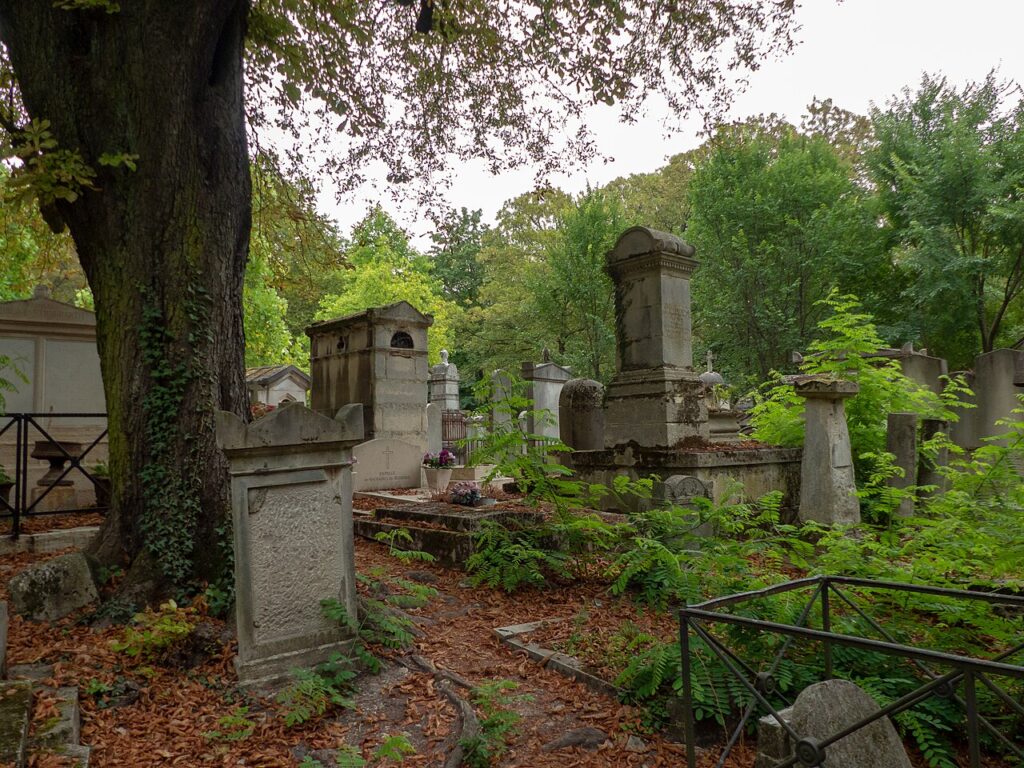
In the 20th arrondissement, far from the tourist crowds of central Paris, Père Lachaise spreads across 110 acres of hillside like a small city of the dead. But this isn’t a somber place. On any given morning, you’ll find joggers on the wide avenues, photographers hunting for the perfect light through autumn leaves, and travelers making pilgrimages to graves that have become shrines to creativity, rebellion, and romance.
Opened in 1804 and named after Louis XIV’s confessor, Père Lachaise transformed the idea of what a cemetery could be. Its winding paths, elaborate monuments, and garden-like atmosphere made it the world’s first modern cemetery—and it remains one of Paris’s most visited parks.
The Famous Residents
Oscar Wilde’s tomb, covered in lipstick kisses until a glass barrier was installed, sits near Colette’s simple marker. Jim Morrison’s grave attracts a steady stream of visitors who leave bottles, flowers, and handwritten notes. Édith Piaf rests under a modest black stone that’s always decorated with fresh flowers. Chopin’s monument features a muse weeping over a broken lyre.
But the real pleasure comes from the unexpected discoveries. You’ll stumble upon Molière’s elaborate tomb (his remains were moved here in 1817 to increase the cemetery’s prestige), Proust’s unadorned family plot, and Balzac’s bronze bust. The medieval lovers Héloïse and Abelard share a Gothic chapel—the cemetery’s oldest monument, dating to the 12th century.
In the southeastern corner, the Mur des Fédérés marks where 147 Communards were executed in 1871. It’s become a pilgrimage site for the French left, always decorated with red carnations and wreaths.
How to Visit
Enter through the main gates on Boulevard de Ménilmontant (Métro: Père Lachaise or Philippe Auguste). Free maps are available at the gatehouse, but the real joy is getting lost. The cemetery’s hilly terrain and maze of paths mean you’ll discover things no map highlights: a family mausoleum overgrown with ivy, a carved stone angel reaching toward the sky, or a simple marker for someone who died two centuries ago.
Early morning, especially on weekdays, offers the best experience. By 9 a.m. in spring or fall, you’ll have whole sections to yourself. The light filters through plane trees and chestnuts, and you can hear birds rather than tour groups. Sunset is equally magical, though the gates close at 5:30 p.m. in winter and 6 p.m. in summer, so time your visit accordingly.
Wear comfortable walking shoes—the paths are cobblestone and often uneven, and you’ll want to explore the upper sections where the views over eastern Paris are worth the climb. Bring water, especially in summer; there are no cafés inside, though you’ll find several along Boulevard de Ménilmontant.
Beyond the Famous Names
Some of the cemetery’s most beautiful art has nothing to do with fame. Division 96 contains dozens of Russian and Eastern European émigrés’ graves with Orthodox crosses and Cyrillic inscriptions. The monuments along Avenue Principale showcase every style of 19th-century funerary art, from Egyptian Revival to Art Nouveau. The Rothschild family tomb looks like a small temple, while other monuments feature life-size bronze sculptures of the deceased in their everyday clothes.
Look for the grave of Victor Noir, a journalist killed in 1870. His bronze effigy shows him lying as if he just fell, and a peculiar tradition has developed: touching a certain part of his anatomy is supposed to enhance fertility. The bronze there is noticeably shinier than the rest of the statue.
The columbarium, added in 1894, holds the ashes of thousands in small niches decorated with photos, flowers, and personal mementos. It’s a more intimate experience than the grand monuments, offering glimpses into how ordinary Parisians commemorate their loved ones.
Practical Details
Admission is free, and the cemetery is open daily except during certain holidays. Dogs are welcome on leash, and you’ll see locals walking their dogs along the quieter paths. Photography is permitted and encouraged—the play of light and shadow through the trees creates constantly changing compositions.
If you want structure, several companies offer guided tours focusing on famous residents or the cemetery’s art and architecture. But a self-guided visit rewards curiosity. Give yourself at least two hours, though you could easily spend a full morning exploring.
The surrounding neighborhood, particularly along Rue de la Roquette and Rue de Ménilmontant, has excellent bakeries and cafés where you can reflect on your visit over coffee and a croissant. The cemetery feels less like a tourist attraction and more like a park where history lives in every corner—exactly what its designers intended more than two centuries ago.
Want more insider Paris stories delivered to your inbox? Subscribe to the Love Paris newsletter and get one short story about the real Paris every day.
Tours & experiences in Paris


Powered by Viator. Some links are affiliate links — we may earn a small commission at no extra cost to you.