
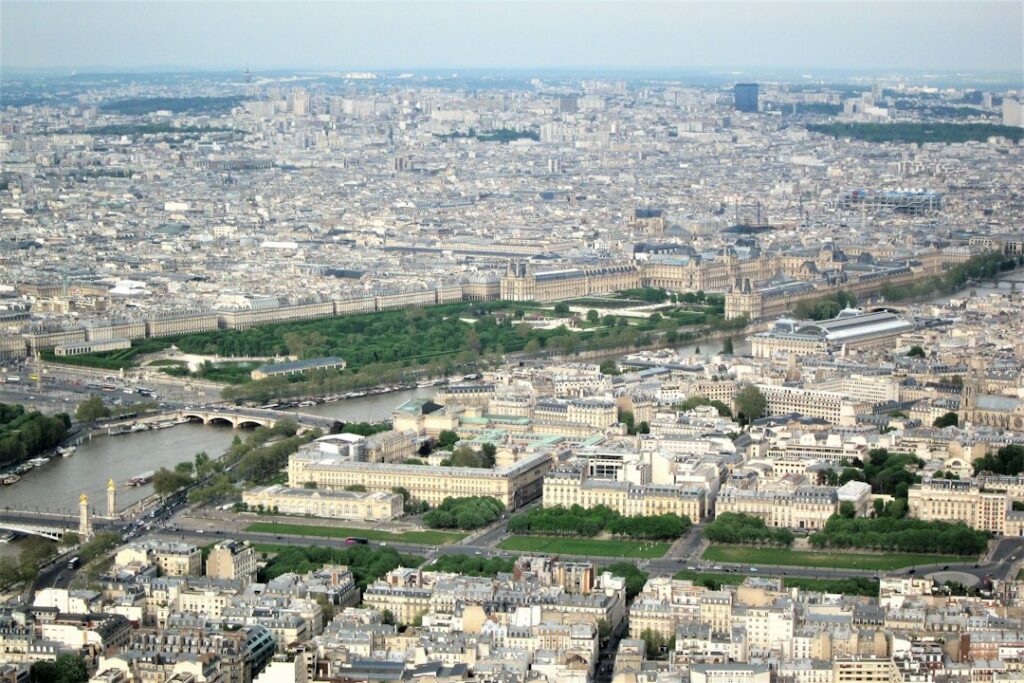
The Right Bank—everything north of the Seine—has been Paris‘s commercial heart since medieval times. While the Left Bank claimed intellectuals and artists, the Right Bank got the merchants, bankers, and shopkeepers who built the city’s economic engine. Today, that legacy lives on in grand boulevards, covered passages, and neighborhood shopping streets that feel worlds apart from the tourist-packed Champs-Élysées.
This is where Parisians have always come to buy things, from 12th-century produce at Les Halles to 19th-century silks in the Sentier district. The architecture tells the story: soaring glass-roofed galleries, Belle Époque department stores, and medieval lanes that once housed the guilds. If you want to understand how Paris shops—and why shopping here feels different from anywhere else—start on the Right Bank.
The Covered Passages: Paris’s Original Shopping Malls
Before department stores, before boutiques, Paris had its passages couverts—glass-roofed galleries that let shoppers browse in any weather. The Right Bank’s 2nd and 9th arrondissements still have a dozen of these early-19th-century marvels, and walking through them feels like stepping into a Balzac novel.
Galerie Vivienne, off Rue des Petits-Champs near the Palais Royal, is the most beautiful. Built in 1823, it has mosaic floors, neoclassical columns, and a glass canopy that turns ordinary daylight into something magical. Today it houses rare bookshops, wine merchants, and the original Legrand Filles et Fils wine shop, operating since 1880.
Passage des Panoramas, Paris’s oldest surviving passage from 1800, runs between Boulevard Montmartre and Rue Saint-Marc. It’s scruffier than Vivienne but more authentic—stamp dealers, old print shops, and excellent cheap bistros like Racines and Canard & Champagne. Go on a rainy Thursday afternoon when the tourists are at the Louvre.
To explore them all, start at Métro Bourse and work your way through Passage des Panoramas, Passage Jouffroy, and Passage Verdeau—three connected galleries that take you from Boulevard Montmartre to Rue de la Grange-Batelière. Budget two hours and stop for hot chocolate at À Priori Thé in Galerie Vivienne.
Rue de Rivoli and the Department Store Revolution
When Napoleon punched Rue de Rivoli through the Right Bank in the early 1800s, he created Paris’s first modern shopping street—straight, wide, and lined with identical arcaded buildings. The arcades meant shoppers could window-shop without getting muddy, a revelation at the time.
Today, the western stretch near Place de la Concorde is mostly tourist shops and chain stores, but the section between Hôtel de Ville and Châtelet still has character. Librairie Galignani at number 224, founded in 1520, is Paris’s oldest English-language bookshop. BHV Marais, the department store at number 52, has a legendary basement hardware department where Parisians buy everything from nails to kitchen gadgets.
The real department store magic happens north of here. Le Bon Marché on the Left Bank gets more press, but the Right Bank had the true pioneers: Printemps and Galeries Lafayette on Boulevard Haussmann. Both opened in the 1860s and 1870s, introducing radical ideas like fixed prices, free entry, and the concept that shopping could be entertainment. The stained-glass dome at Galeries Lafayette, installed in 1912, still makes you catch your breath.
Neighborhood Shopping Streets: Where Parisians Actually Buy Things
The Right Bank’s real shopping happens in the neighborhoods, on streets that have specialized in particular goods for centuries. Rue du Faubourg Saint-Antoine in the 11th has been the furniture district since the 17th century—today it’s showrooms and workshops where craftsmen still make chairs using 300-year-old techniques.
Rue Montorgueil in the 2nd, once the northern extension of the Les Halles market, is a pedestrian food street with fromageries, butchers, fishmongers, and Stohrer, Paris’s oldest pâtisserie from 1730. Go in the morning when locals are doing their marketing. The oyster stands set up outside the seafood shops on weekend mornings.
For fashion, Parisians skip the Champs-Élysées and head to the narrow streets around Place des Victoires and Rue Étienne Marcel in the 1st and 2nd. These were the old textile district, and the rag trade legacy continues in contemporary boutiques, vintage shops, and showrooms where you can sometimes buy direct from designers.
Practical Tips for Right Bank Shopping
Most shops outside the major tourist zones close Sunday and Monday. Food shops often open Sunday morning but close Monday. The covered passages keep irregular hours—some galleries lock their gates at 8 p.m., others stay open until the last business closes.
The best time to explore is weekday afternoons, when the morning delivery chaos has settled but shops haven’t closed for lunch (usually 1–3 p.m. in neighborhood areas). Saturday mornings are busy with locals doing their weekend shopping—great for atmosphere, less so for leisurely browsing.
For the covered passages, start from Métro Palais-Royal-Musée du Louvre or Bourse. For the department stores, take Métro to Havre-Caumartin or Chaussée d’Antin-La Fayette. For neighborhood shopping, use Saint-Paul (Marais), Strasbourg-Saint-Denis (Sentier), or Filles du Calvaire (upper Marais).
Most merchants still appreciate a polite “Bonjour” when you enter and “Au revoir” when you leave, even if you don’t buy anything. Small shops may prefer cash for purchases under €20.
Want more insider tips on exploring Paris beyond the guidebook? Subscribe to the Love Paris newsletter—one short story about the city every day, straight to your inbox.
Tours & experiences in Paris


Powered by Viator. Some links are affiliate links — we may earn a small commission at no extra cost to you.