
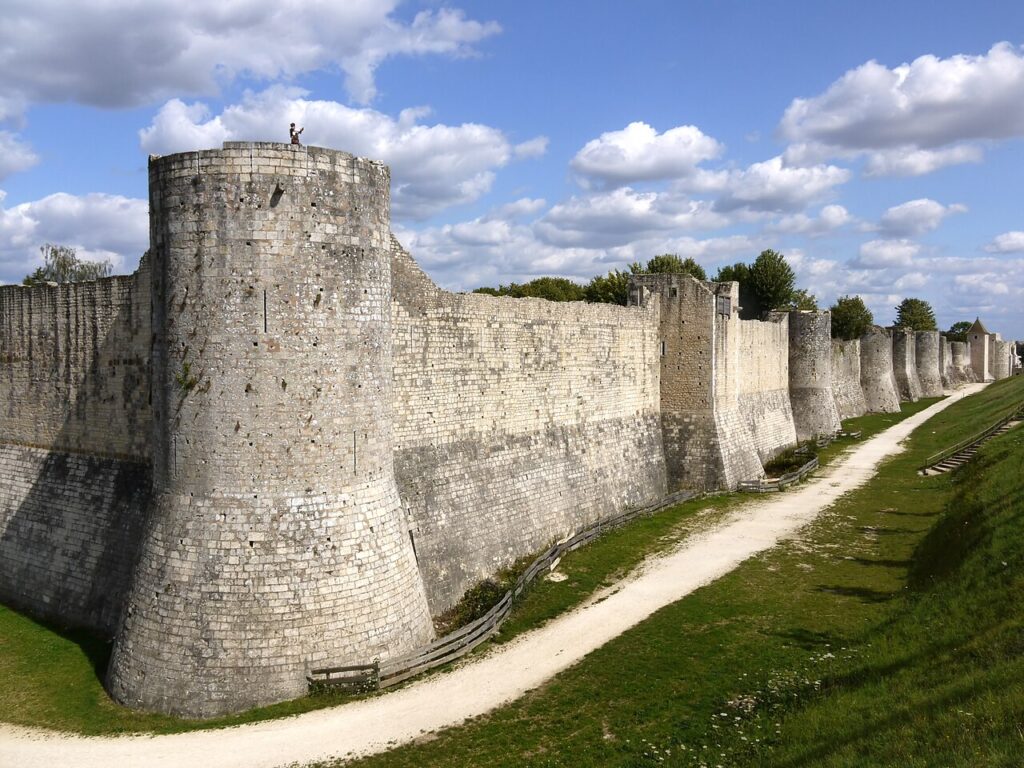
While most visitors focus on Versailles and Fontainebleau, the fortified town of Provins sits quietly an hour and a half southeast of Paris, offering one of France‘s best-preserved medieval experiences. This UNESCO World Heritage site was once a major trade hub for the Champagne fairs in the 12th and 13th centuries, and its walls, towers, and underground passages remain largely intact.
Unlike the polished châteaux that draw tour buses, Provins feels authentically rough around the edges—cobblestone streets wind between half-timbered houses, massive ramparts encircle the upper town, and knights on horseback still charge through the arena twice a day during summer shows.
Getting There and When to Visit
Trains from Gare de l’Est reach Provins in 80 to 90 minutes, with no changes required. The station sits in the lower town (Ville Basse); from there, it’s a 15-minute uphill walk or a short bus ride to the medieval upper town (Ville Haute) where all the attractions cluster.
Visit between April and October for the full experience—the falconry shows, jousting tournaments, and most attractions run on weekend schedules or close entirely in winter. June’s Medieval Festival transforms the entire town into a living history event, with period costumes, craft markets, and performances throughout the streets. Weekdays outside school holidays offer the ramparts nearly to yourself.
The Ramparts and César Tower
Start at the Tour César, the 12th-century octagonal keep that dominates the skyline. Climb its 67 steps for views across the Champagne plains—on clear days, you can see for miles. The tower served as both fortress and prison; graffiti carved by prisoners centuries ago still marks the walls.
From there, walk the ramparts themselves. Unlike many reconstructed medieval walls, Provins’s fortifications stretch for nearly a kilometer in their original form, complete with 22 towers. The Porte Saint-Jean, the main gate, features a double-arch entry and intact portcullis mechanism. Walk the wall-walk between towers for the best sense of the town’s defensive layout.
Underground Provins
Beneath the upper town, a network of medieval galleries and cellars extends for kilometers. The guided tour of the Souterrains takes you through vaulted passages that once served as storage for the Champagne fairs’ merchants. The temperature stays around 10°C year-round—bring a jacket even in summer.
These weren’t dungeons or secret passages, despite local legends. They were practical warehouse space, carved from the limestone that also built the town above. Some chambers still show tool marks from medieval quarrymen.
Shows and Living History
The Aigles des Remparts (Eagles of the Ramparts) falconry show runs twice daily in season, with eagles, vultures, and owls flying freely above the medieval setting. It’s genuinely impressive—these aren’t trained tricks but demonstrations of actual medieval hunting techniques.
At the Légende des Chevaliers (Legend of the Knights), armored riders perform jousting and swordplay in a purpose-built arena. The show skews toward families, but the horsemanship is real, and the medieval combat techniques are historically grounded. Both shows include English commentary.
The Lower Town and Rose Gardens
Most visitors never leave the Ville Haute, but the lower town rewards an hour’s exploration. The Église Saint-Ayoul, a 12th-century church, features carved capitals and original stained glass without the crowds of Paris’s famous churches.
The Roseraie de Provins (rose garden) celebrates the town’s historical connection to the Provins rose, a variety brought back from the Crusades. The garden contains over 300 rose varieties and blooms best in June. It’s a 10-minute walk from the ramparts, down quiet residential streets that give a sense of daily life in this still-functioning medieval town.
Practical Tips
Buy the combined pass (Pass Provins) at the tourist office near César Tower—it covers the tower, ramparts, underground tours, and both shows for less than buying separately. The office also has excellent free maps with walking routes marked.
Bring cash for the smaller shops and cafés; card readers aren’t universal here. The town has several crêperies and simple restaurants serving regional specialties—try the Niflettes, almond-paste pastries that have been made in Provins since medieval times.
Pack comfortable walking shoes. The cobblestones are uneven, and you’ll be climbing stairs in towers and walking unpaved sections of rampart.
Most attractions close by 6 p.m., and the last train to Paris typically leaves around 8:30 p.m. Check return schedules before you go—service isn’t as frequent as on the Versailles line.
Want more stories about the Paris you won’t find in guidebooks? Subscribe to the Love Paris newsletter and get one short story a day, delivered each morning.
Tours & experiences in Paris


Powered by Viator. Some links are affiliate links — we may earn a small commission at no extra cost to you.