
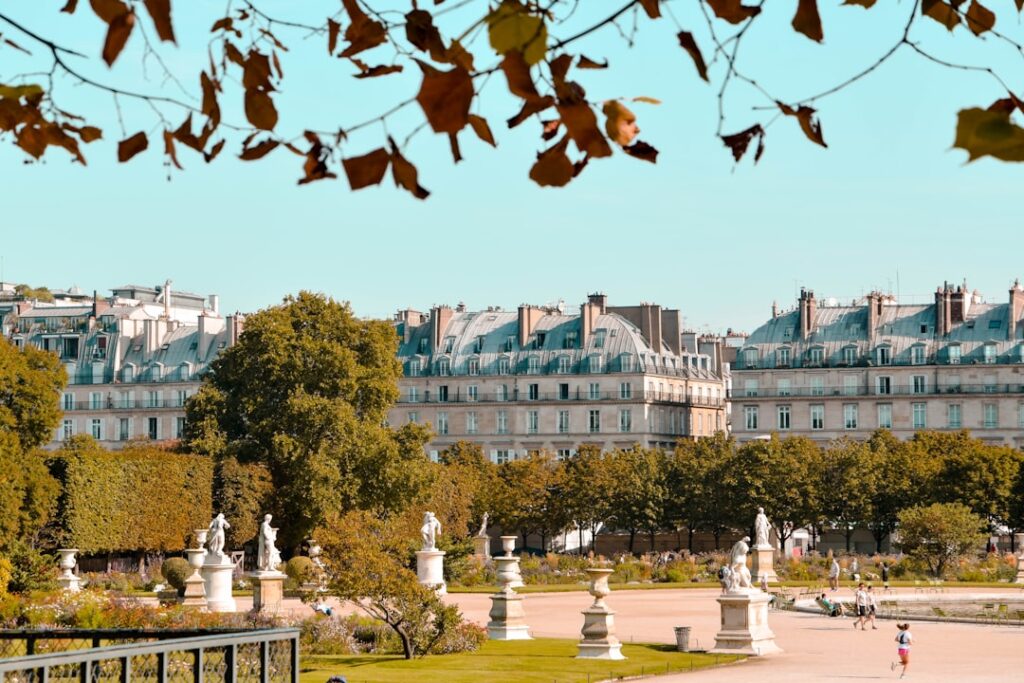
The Tuileries Garden sits at the very heart of Paris, a perfectly manicured 63-acre park that connects the Louvre to Place de la Concorde. Created in 1564 for Catherine de Médicis and later redesigned by André Le Nôtre—the landscape architect behind Versailles—these formal French gardens remain one of the city’s most beloved public spaces.
Unlike the more relaxed Luxembourg Gardens, the Tuileries maintain their royal formality: straight gravel paths, clipped hedges, geometric flowerbeds, and marble statues that create a sense of order and elegance. But don’t let the grandeur intimidate you. Parisians treat this garden as their outdoor living room, and you should too.
The Layout and What You’ll Find
The garden is divided into distinct sections, each with its own character. The Grand Carré, near the Louvre, features two large octagonal ponds where children sail wooden boats you can rent from the nearby kiosk. Metal chairs surround the ponds—grab a pair, pull them into the sun (or shade), and settle in with a book or just watch Parisian life unfold.
The central allée runs the entire length of the garden, lined with rows of chestnut trees that create a shaded tunnel in summer. This is where joggers make their morning circuits and where you’ll find the best people-watching on Sunday afternoons.
Near the Place de la Concorde end, the garden opens up to reveal sweeping views. From here, you can see the Luxor Obelisk, the Arc de Triomphe in the distance, and—if you turn around—the Louvre framed by trees. It’s one of Paris’s great urban vistas.
Art, Statues, and Seasonal Exhibitions
More than 60 sculptures dot the gardens, from classical bronze and marble pieces to works by Rodin, Maillol, and Giacometti. The Rodin sculptures cluster near the Jeu de Paume museum—look for The Kiss and several pieces from The Gates of Hell.
Twice a year, the Tuileries hosts temporary art installations as part of the FIAC contemporary art fair (usually October) and other cultural programs. Check ahead if you’re visiting in spring or fall—you might catch something special.
The garden also houses two small museums worth visiting: the Jeu de Paume, which showcases photography and video art, and the Musée de l’Orangerie at the Place de la Concorde end, home to Monet’s massive Water Lilies paintings displayed in two oval rooms designed specifically for them.
When to Visit and How to Enjoy It
The Tuileries opens at 7 a.m. (7:30 a.m. in winter) and closes at sunset, with exact times varying by season. Early morning brings joggers and tai chi practitioners. By mid-morning, the metal chairs fill with readers and coffee drinkers who’ve grabbed takeaway cups from nearby cafés on Rue de Rivoli.
Spring (April through May) is glorious when the tulips and forget-me-nots bloom in the formal beds. Summer brings a small funfair—the Fête des Tuileries—which runs from late June through August with carnival rides, game booths, and cotton candy stands. It’s touristy but charming, especially at dusk when the lights come on.
Fall offers the best light for photography, when the chestnut leaves turn golden and the sun sits low enough to create long shadows across the gravel paths. Winter is quieter, sometimes beautifully stark when frost covers the lawns, though you’ll want a warm coat.
For refreshments, there are several options. The Café des Marronniers near the Grand Bassin Rond serves decent coffee and sandwiches at outdoor tables. For something nicer, head to the Musée de l’Orangerie’s café or cross Rue de Rivoli to Angelina for their famous hot chocolate.
Getting There and Practical Tips
Multiple metro stations serve the Tuileries: Tuileries (Line 1) puts you at the middle of the garden, Concorde (Lines 1, 8, 12) at the western end, and Palais Royal-Musée du Louvre (Lines 1, 7) at the eastern entrance near the Louvre.
The garden is free to enter and always open during daylight hours. Restrooms are located near the Grand Bassin Rond and at the Place de la Concorde end—they’re free and reasonably maintained.
Bring a book, a snack from a nearby boulangerie, and embrace the Parisian art of doing nothing productively. Unlike many Paris parks, you can sit on the grass in designated areas (look for signs), though most visitors prefer the iconic metal chairs you can drag wherever you like.
Photography is best in the late afternoon when the light softens and the crowds thin. The view down the central allée toward the Louvre, framed by trees and statues, is particularly beautiful an hour before sunset.
The Tuileries proves that Paris’s most rewarding experiences often cost nothing. It’s a place to slow down, rest your museum-weary feet, and remember that sometimes the best way to see Paris is simply to sit still and let it come to you.
Want more insider guides to Paris’s neighborhoods, gardens, and hidden corners? Subscribe to the Love Paris newsletter and get one short story a day delivered straight to your inbox.
Tours & experiences in Paris


Powered by Viator. Some links are affiliate links — we may earn a small commission at no extra cost to you.