
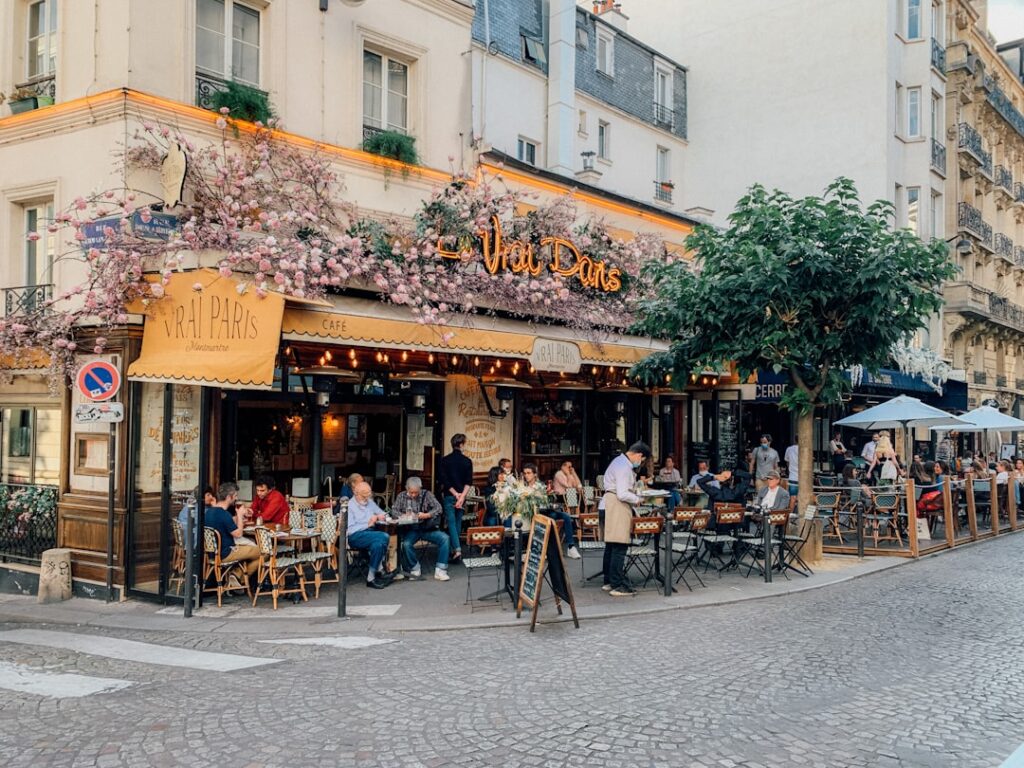
Perched on Paris’s highest hill, Montmartre retains the spirit of the bohemian village it once was—a place where Picasso painted, Renoir danced, and Toulouse-Lautrec sketched the cabaret dancers. Today, this 18th arrondissement neighborhood still feels separate from the rest of Paris, with its steep staircases, vineyard tucked between buildings, and artists setting up easels in Place du Tertre.
A morning walk through Montmartre reveals layers of history most visitors miss when they rush straight to Sacré-Cœur. The best way to experience it is on foot, starting early before the tour groups arrive.
Starting Point: Abbesses Metro and the Wall of Love
Begin at Abbesses metro station, one of only two original Art Nouveau Hector Guimard entrances remaining in Paris. The station itself sits at the deepest point in the network—take the elevator or climb 300 steps. Just outside, the small Square Jehan Rictus holds Le Mur des Je t’aime (the Wall of Love), where “I love you” appears in 250 languages on blue tiles.
From here, walk up Rue de la Vieuville to Rue des Abbesses, a charming street lined with boulangeries, wine shops, and neighborhood cafés. Stop at Café des Deux Moulins at 15 Rue Lepic—the café from the film Amélie—for a proper French breakfast.
The Hidden Vineyard and Lapin Agile
Head up Rue Lepic, the winding street where Van Gogh lived with his brother Theo at number 54. At the top, turn onto Rue Girardon to find Clos Montmartre, Paris’s only working vineyard. The 2,000 vines produce about 1,000 bottles annually during the October grape harvest festival.
Just around the corner on Rue des Saules stands Au Lapin Agile, the pink cottage cabaret that’s operated since 1860. Picasso, Modigliani, and Apollinaire all drank here. It still hosts cabaret shows most evenings, though the neighborhood is quiet on this street during the day.
Across the way, Rue Cortot leads to the Musée de Montmartre at number 12, housed in the neighborhood’s oldest building. Renoir rented a studio here, and the museum’s gardens offer one of the best views over the vineyard and rooftops below. The admission is worth it for the peaceful garden alone.
Place du Tertre and Beyond the Tourist Square
Continue uphill to Place du Tertre, the village square where artists have set up since the 19th century. Yes, it’s touristy, but arrive before 9 a.m. and you’ll see the artists setting up their easels in the quiet morning light, a scene that hasn’t changed in decades.
From the square, walk through the small streets to the north—Rue Norvins, Rue Poulbot, Rue de l’Abreuvoir—where Montmartre feels residential again. Number 6 Rue de l’Abreuvoir might be the most photographed house in Paris, a pink cottage covered in ivy with Sacré-Cœur rising behind it.
On Rue Saint-Vincent, the narrow staircase of Rue du Calvaire leads down past garden walls and quiet houses. This is Montmartre at its most village-like: cats sunning on doorsteps, residents chatting at corner cafés, laundry hanging from wrought-iron balconies.
Bateau-Lavoir and the Artistic Legacy
Descend via Rue Ravignan to Place Émile-Goudeau, where a modern reconstruction marks the site of the Bateau-Lavoir. This ramshackle building housed Picasso’s studio from 1904 to 1909—the period when he painted Les Demoiselles d’Avignon and invented Cubism alongside Georges Braque. Modigliani, Juan Gris, and Max Jacob also worked here. The original burned in 1970, but the square remains a peaceful spot to sit.
For lunch, walk down to Rue des Trois Frères where Le Bouclard at number 1 serves classic French bistro fare at neighborhood prices. Or continue to Rue Lepic where you’ll find the excellent Boulangerie Coquelicot at number 24, perfect for sandwiches and pastries.
Practical Tips for Walking Montmartre
Wear comfortable shoes—the hill is steep and the streets are cobbled. The best times to visit are early morning (before 9 a.m.) or late afternoon (after 5 p.m.) when day-trippers have left. Sundays feel particularly local, with families out for walks and the quiet cafés full of regulars reading newspapers.
The entire walk covers about three kilometers and takes two to three hours at a leisurely pace, not counting museum visits or café stops. Skip the petit train tourist shuttle—walking is the only way to discover the hidden courtyards, unexpected staircases, and quiet corners that make Montmartre special.
Avoid the restaurants directly on Place du Tertre, which cater to tourists. Instead, eat where you see Parisians: the streets radiating from Abbesses metro have excellent neighborhood spots.
Want more insider guides to Paris’s best neighborhoods? Subscribe to the Love Paris newsletter for one short story about the city each day, delivered straight to your inbox.
Tours & experiences in Paris


Powered by Viator. Some links are affiliate links — we may earn a small commission at no extra cost to you.