
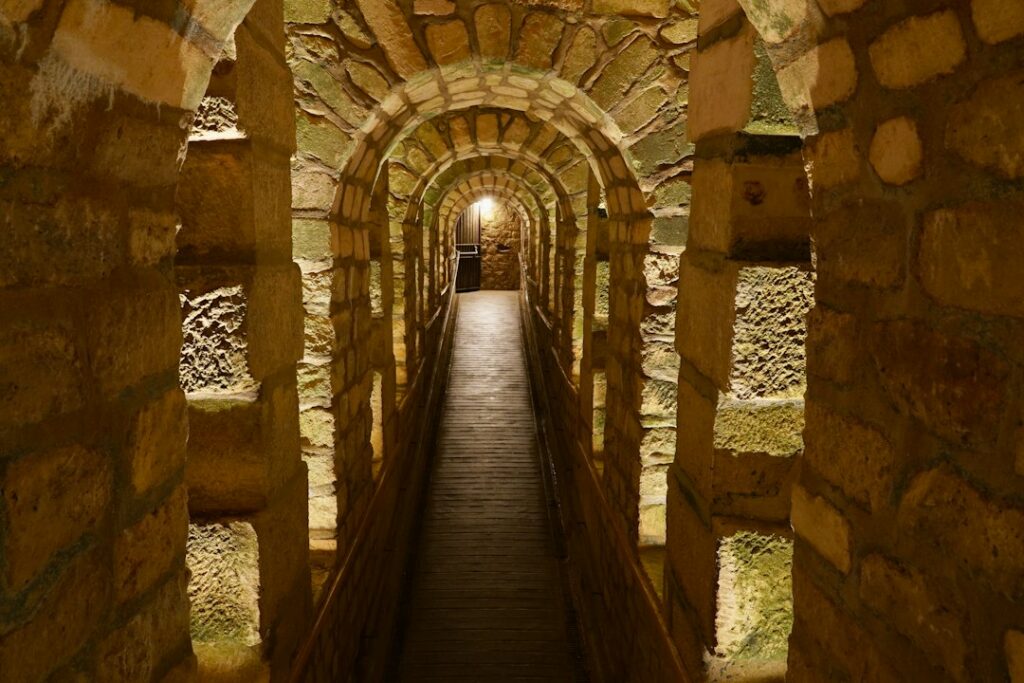
Twenty meters beneath the streets of Paris lies an empire of the dead. The Catacombs hold the remains of more than six million Parisians, their bones arranged in careful patterns along nearly a mile of underground galleries. This isn’t a morbid curiosity—it’s a profound meditation on mortality and one of the most extraordinary historical sites in the city.
The entrance at 1 Avenue du Colonel Henri Rol-Tanguy in the 14th arrondissement looks modest enough, but what waits below is anything but ordinary. Here’s how to visit Paris’s most haunting landmark and why it deserves a place on your itinerary.
The Story Behind the Bones
The Catacombs weren’t always a tourist attraction. In the late 18th century, Paris faced a public health crisis. The city’s overflowing cemeteries—particularly the Saints-Innocents cemetery near Les Halles—were contaminating groundwater and spreading disease. Between 1785 and 1787, workers began the enormous task of exhuming millions of skeletons and transferring them to the abandoned limestone quarries beneath the Left Bank.
These weren’t just dumped underground. Quarry inspector Louis-Étienne Héricart de Thury transformed the tunnels into a proper ossuary, arranging skulls and femurs into the decorative patterns you see today. He added plaques with poetry and biblical verses, turning the space into a kind of underground necropolis—a place for reflection on death and the equality it brings to all.
The bones you see include Parisians from across the centuries: medieval peasants and aristocrats, revolutionaries and royalists, possibly even figures like Robespierre and Danton, though their exact locations are unknown. The Catacombs became a democratic resting place where social distinctions dissolved into anonymity.
Planning Your Visit
The Catacombs are open Tuesday through Sunday from 9:45 a.m. to 8:30 p.m., with the last entry at 7:30 p.m. They’re closed Mondays and on May 1st. This is one of Paris’s most popular attractions, and the experience can be frustrating if you don’t plan ahead.
Only 200 visitors are allowed underground at once, which means lines regularly stretch for two hours or more, especially on weekends and during summer. Book your ticket online in advance—it’s essential. Timed-entry tickets usually go on sale several weeks ahead and sell out quickly for peak times.
The visit involves descending 131 steps down a narrow spiral staircase, walking about 1.5 kilometers through cool, damp tunnels, then climbing 112 steps back up. It takes 45 minutes to an hour. The temperature underground stays around 14°C (57°F) year-round, so bring a light jacket even in summer. Wear comfortable walking shoes—the ground is uneven and can be slippery.
Large bags and backpacks aren’t allowed, and security checks bags at the entrance. There are no bathrooms once you descend, so plan accordingly. The tunnels are not wheelchair accessible, and the experience isn’t recommended for anyone with mobility issues, claustrophobia, or respiratory problems.
What You’ll See Underground
The first part of your descent takes you through empty quarry tunnels. You’ll pass explanatory panels about the geology and history of Paris’s limestone quarries, which provided the building material for much of the city above. Then you reach the ossuary entrance, marked with the chilling inscription: “Arrête! C’est ici l’empire de la Mort” (Stop! This is the empire of Death).
Beyond that threshold, the bones begin. Femurs stacked like cordwood line the walls, punctuated by rows of skulls arranged in crosses, hearts, and barrel shapes. The artistry is striking—these arrangements turn anonymous remains into something approaching sculpture. Plaques throughout offer sobering reminders: “Happy is he who is forever faced with the hour of his death and prepares himself for the end every day.”
Notable features include the Crypt of the Passion, where bones form a heart-shaped pillar, and the Samaritan’s Fountain, a wellspring that once provided drinking water for quarry workers. Lighting is atmospheric but adequate, and multilingual information panels explain what you’re seeing.
Photography is allowed, but be respectful. These are human remains, not props.
Beyond the Official Route
What you see on the official tour represents a tiny fraction of the quarry network beneath Paris. An estimated 300 kilometers of tunnels spread beneath the city, most of them closed to the public and patrolled by specialized police. An underground subculture of cataphiles explores these illegal sections, hosting secret parties and creating art installations in the darkness.
Don’t attempt to join them. The unauthorized tunnels are dangerous—easy to get lost in, prone to collapse, and patrolled by police who will fine you if caught. Stick to the legal route. It’s impressive enough.
After you exit at 21 bis Avenue René-Coty, you’re in the quiet, residential 14th arrondissement. The nearby Denfert-Rochereau métro station (lines 4 and 6, RER B) makes it easy to continue your day. If you’re hungry, walk north toward Montparnasse, where Boulevard Raspail and Rue Daguerre offer excellent cafés and bistros.
Making the Most of Your Visit
Visit first thing in the morning or late afternoon for smaller crowds. Morning slots tend to sell out first online, so late afternoon can be your best bet for same-week availability. Weekdays are always quieter than weekends.
Consider pairing your visit with other nearby sites. The Montparnasse Cemetery is a ten-minute walk away and offers an above-ground counterpoint to the underground world you’ve just seen. The Fondation Cartier-Bresson and Fondation Henri Cartier-Bresson (for photography lovers) are also close by.
The Catacombs offer a side of Paris most visitors never see—literally beneath the surface of the city. It’s a powerful reminder that Paris isn’t just monuments and museums. It’s layers of history, including the six million anonymous Parisians resting in the darkness below.
Want more insider stories about the hidden sides of Paris? Subscribe to the Love Paris newsletter and get one short story about the city delivered to your inbox every day.
Tours & experiences in Paris


Powered by Viator. Some links are affiliate links — we may earn a small commission at no extra cost to you.