The baguette is more than bread in Paris—it’s a daily ritual, a benchmark of quality, and a point of neighborhood pride. Every year, the city’s bakers compete for the Grand Prix de la Baguette, and Parisians take their loyalty to their preferred boulangerie seriously. Here’s where to find the city’s finest examples of this iconic loaf.
What Makes a Great Baguette
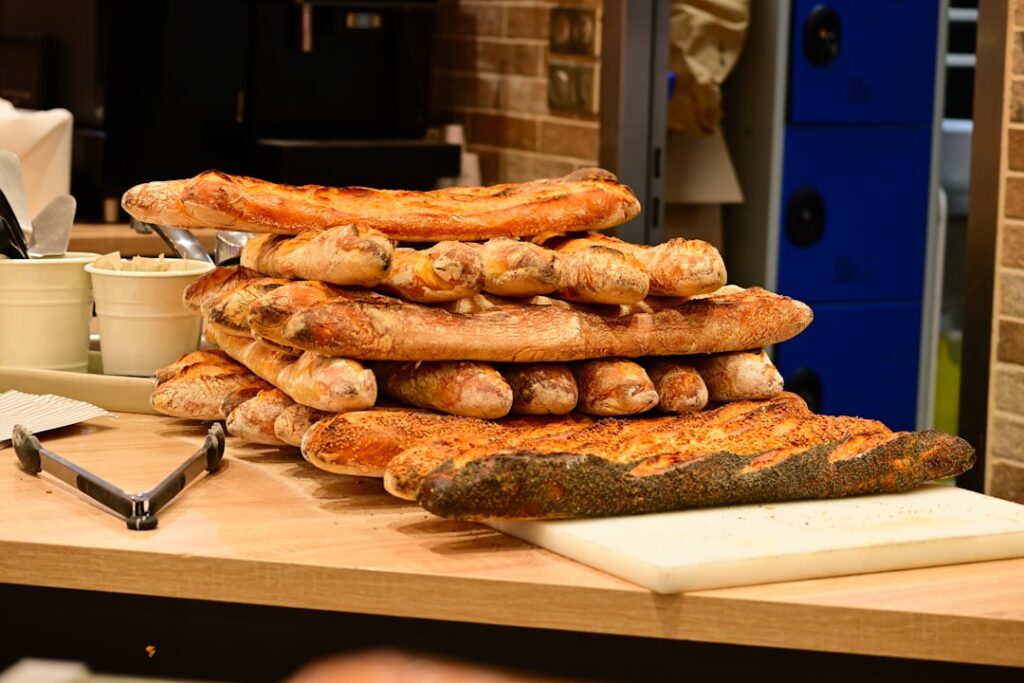
A proper Parisian baguette has a golden, crisp crust that shatters when you break it, revealing an airy interior with irregular holes. The flavor should be wheaty and slightly nutty, never bland or doughy. Traditional baguettes contain only four ingredients: flour, water, salt, and yeast. The best bakers use a slow fermentation process and bake throughout the day so you’re never more than a few hours from a warm loaf.
Look for the Boulangerie Artisanale sign, which guarantees the bread is made on-site from start to finish. Avoid chain bakeries—real Parisians can spot the difference from across the street.
Award-Winning Bakeries
Boulangerie Utopie in the 11th arrondissement (20 rue Jean-Pierre Timbaud) won the 2023 Grand Prix and continues to draw crowds for its perfectly balanced baguette tradition. The crust achieves an ideal crackle, and the interior stays fresh for hours. Arrive before 11 a.m. or after 4 p.m. when fresh batches emerge from the oven.
Le Grenier à Pain has multiple locations, but the original at 38 rue des Abbesses in Montmartre is worth the pilgrimage. Their baguette à l’ancienne uses organic flour and a long fermentation that gives the bread a deeper, more complex flavor. The bakery opens at 7 a.m., perfect for breakfast seekers.
Du Pain et des Idées in the 10th arrondissement (34 rue Yves Toudic) near Canal Saint-Martin is famous for its pain des amis, but don’t overlook their traditional baguette. The 19th-century storefront alone is worth the visit, and the bread lives up to the setting.
Neighborhood Favorites
In the Marais, Au Duc de la Chapelle (6 rue de la Verrerie) produces a baguette with an unusually dark crust and pronounced wheaty flavor. It’s a local secret that never seems to make the tourist lists, which means shorter lines.
Boulangerie Gontran Cherrier has several locations across Paris, with the original at 22 rue Caulaincourt in Montmartre. Cherrier trained at some of France’s most respected bakeries before opening his own, and his baguette tradition shows that pedigree. He also experiments with heritage grain varieties worth trying.
On the Left Bank, Poilâne (8 rue du Cherche-Midi) is world-famous for its sourdough miche, but the house also makes an exceptional baguette with a slightly thicker crust than average. This bakery has been family-run since 1932, and their wood-fired ovens give the bread a subtle smokiness.
In the 7th arrondissement, Boulangerie Secco (20 rue Jean Nicot) draws diplomats and locals alike for morning baguettes. The baker uses a stone oven and traditional shaping techniques that create the irregular, artisanal appearance you want to see.
Practical Tips
Buy your baguette as close to mealtime as possible—they’re best within four hours of baking. Most bakeries bake multiple times daily, typically early morning, late morning, and mid-afternoon. Don’t refrigerate a baguette; it will turn rubbery. If you need to keep it overnight, wrap it in a clean kitchen towel.
When you order, ask for bien cuite if you prefer a darker, crispier crust, or pas trop cuite for a lighter bake. A standard baguette costs between €1.20 and €1.50. Anything significantly cheaper likely comes from par-baked frozen dough.
The peak baguette-buying hours are 7 to 8 a.m., 12:30 to 1:30 p.m., and 6:30 to 7:30 p.m.—when Parisians pick up bread for breakfast, lunch, or dinner. Visit during these windows for the freshest bread, but expect a line at the best bakeries.
Metro tip: Most of these bakeries sit within walking distance of major metro lines. The 11th arrondissement spots are near République (lines 3, 5, 8, 9, 11), Montmartre bakeries cluster around Abbesses (line 12), and Left Bank locations are accessible via Sèvres-Babylone (lines 10, 12) or Saint-Sulpice (line 4).
Want more Paris food secrets delivered to your inbox? Subscribe to the Love Paris newsletter—one short story a day about the city’s best-kept culinary traditions and neighborhood finds.
Tours & experiences in Paris


Powered by Viator. Some links are affiliate links — we may earn a small commission at no extra cost to you.