
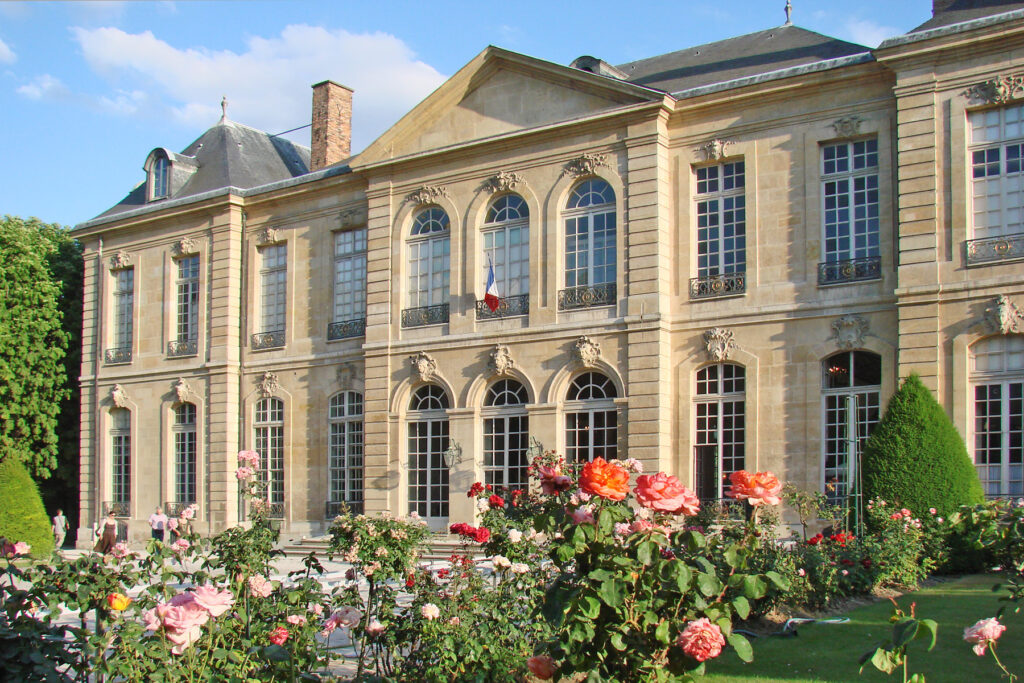
While crowds funnel into the Louvre and Musée d’Orsay, the Musée Rodin remains a quieter refuge in the 7th arrondissement. Housed in the beautiful Hôtel Biron, an 18th-century mansion where Auguste Rodin lived and worked until his death in 1917, this museum holds the world’s largest collection of the sculptor’s work—and its gardens rank among the most peaceful spots in central Paris.
The museum sits on rue de Varenne, a five-minute walk from the Invalides metro station. You’ll recognize it by the golden dome of Les Invalides rising just beyond the garden walls.
Inside the Hôtel Biron
The mansion itself is intimate and manageable, with about eighteen rooms spread across two floors. You’ll find Rodin’s most famous marble and bronze works here: The Kiss, The Hand of God, and numerous studies for his monumental commissions. The rooms are arranged roughly chronologically, showing how Rodin developed his revolutionary approach to capturing movement and emotion in stone and metal.
Don’t miss the gallery devoted to Camille Claudel, Rodin’s student, collaborator, and lover. Her sculptures—including The Waltz and The Age of Maturity—reveal an artist of equal power, and the museum has worked to give her the recognition she deserves alongside Rodin’s work.
The second floor holds smaller studies and plaster casts, along with pieces from Rodin’s personal art collection. He owned works by Van Gogh, Monet, and Renoir, and these paintings provide useful context for understanding Rodin’s place among his contemporaries.
The Gardens: Where Sculpture Meets Nature
The three-hectare garden is the real reason to visit. Unlike most Parisian museums, you can buy a garden-only ticket (€4) if you want to skip the interior—though seeing both is worth the full admission.
The Thinker sits on its pedestal facing the mansion, one of several bronze casts Rodin made of this iconic work. Behind it, The Gates of Hell rises nearly twenty feet, covered with writhing figures that Rodin worked on for 37 years without ever completing. The garden also holds Balzac, The Burghers of Calais, and Ugolino and His Sons, positioned among rose beds, linden trees, and manicured lawns.
Visit in May or June when the roses bloom, or in early autumn when the gardens are less crowded but still lush. There’s a small café with outdoor tables near the back of the garden—expensive for what you get, but the setting makes up for it. Bring a book and settle in for an hour.
Practical Details
The museum is open Tuesday through Sunday, 10 a.m. to 6:30 p.m., closed Mondays. Admission is €13 for the full museum and gardens, €4 for gardens only. It’s included in the Paris Museum Pass, which pays for itself quickly if you’re visiting multiple museums.
Get there via metro line 13 (Varenne station), line 8 (Invalides), or the RER C (Invalides). The museum is a pleasant walk from the Eiffel Tower (about twenty minutes) or from the cafés of rue Cler.
English audio guides are available and worthwhile—they provide context about Rodin’s techniques and the stories behind major works. The museum is fully accessible, with elevators and ramps throughout.
Unlike the Louvre or Orsay, you can see the Musée Rodin thoroughly in about two hours. Plan to arrive when it opens to have the gardens mostly to yourself, or come around 5 p.m. when day-trippers have left but there’s still good light for the outdoor sculptures.
Combine Your Visit
The 7th arrondissement rewards wandering. After the museum, walk south on rue de Varenne to see some of Paris’s most elegant private mansions and government buildings. The street leads to the Bon Marché department store and its spectacular food hall, La Grande Épicerie.
Alternatively, head north to the Seine and cross Pont Alexandre III, Paris’s most ornate bridge, to reach the Grand Palais and Champs-Élysées. Or walk west toward Les Invalides to see Napoleon’s tomb and the military museum.
For lunch, the rue Cler market street is a ten-minute walk away, lined with cheese shops, bakeries, and casual restaurants frequented by locals rather than tourists.
The Musée Rodin proves that smaller can be better when it comes to Paris museums. You’ll leave with a genuine understanding of one artist’s vision, not the overwhelming blur that comes from racing through a massive collection. And you’ll have spent time in one of the city’s loveliest gardens—a combination that captures what makes Paris special.
Want more insider tips on Paris’s museums, neighborhoods, and hidden corners? Subscribe to the Love Paris newsletter and get one short story a day delivered to your inbox.
Tours & experiences in Paris


Powered by Viator. Some links are affiliate links — we may earn a small commission at no extra cost to you.