
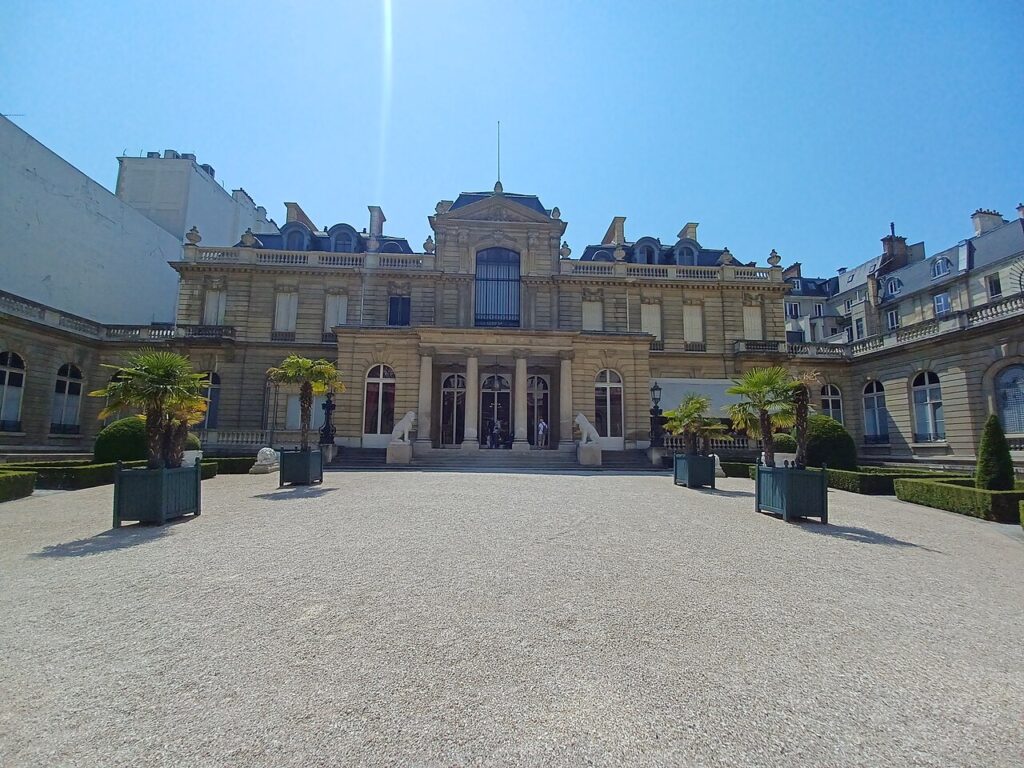
While crowds queue at the Louvre, one of Paris’s finest art collections remains tucked inside a Second Empire mansion on Boulevard Haussmann. The Musée Jacquemart-André offers something the grand museums cannot: the intimate experience of viewing masterworks exactly as a wealthy 19th-century collector displayed them, in the rooms where they lived.
Édouard André, heir to a banking fortune, and his wife Nélie Jacquemart, a society portrait painter, spent decades amassing Italian Renaissance paintings, Dutch masters, French decorative arts, and sculpture. When Nélie bequeathed their home and collection to the Institut de France in 1913, she preserved not just art but an entire way of life.
The State Apartments
Your visit begins in the formal reception rooms on the ground floor, where the couple entertained Paris’s elite. The Grand Salon retains its original furnishings—Louis XV chairs, Aubusson tapestries, and a painting by Boucher above the mantelpiece. Light floods through tall windows overlooking the courtyard garden, much as it did during the Andrés’ legendary soirées.
The Paris most visitors miss
Our free 8-page PDF guide: 25 places, from Galerie Vivienne's 1880 mosaic floor to Canal Saint-Martin's locks, each linked to its official site.
The adjacent Tapestry Room houses three enormous 18th-century tapestries that once belonged to the royal château of Marly. Stand in the center and you’re surrounded by pastoral scenes woven in silk and wool, their colors still vivid after 250 years.
But it’s the Music Room that stops most visitors. Here, beneath a ceiling painted by Tiepolo (relocated from a Venetian palace), you’ll find works by Uccello, Botticelli, and Mantegna. The juxtaposition is deliberate: Nélie arranged the collection to spark visual conversations between Italian, Flemish, and French art across centuries.
The Italian Museum
Climb the sweeping staircase to the second floor, where the Andrés created a private museum within their home. The Italian galleries showcase their passion for the Renaissance: a Donatello relief, paintings by Bellini and Carpaccio, and one of the museum’s treasures—a profile portrait by Uccello of a young man in a striking red hat.
The Florentine Gallery, with its coffered ceiling and Della Robbia sculptures, feels more like a Tuscan palazzo than a Parisian hôtel particulier. Édouard and Nélie made multiple trips to Italy, buying directly from aristocratic families selling off ancestral collections. What they brought back wasn’t just art but entire architectural elements—carved doorways, painted ceilings, marble columns—reassembled here with painstaking precision.
Don’t rush through these rooms. The labels are minimal by modern museum standards, which actually helps you see the works as the Andrés intended: not as educational specimens but as beautiful objects in a beautiful home.
The Private Apartments
The second-floor tour continues through the couple’s private quarters, where intimacy replaces grandeur. Nélie’s studio contains her easel and paints, along with society portraits she painted before her marriage. Édouard’s smoking room, lined in tooled leather, displays his collection of Dutch and Flemish masters—Rembrandt, Hals, Van Dyck.
The library holds 10,000 volumes and a Fragonard painting above the fireplace. It’s not roped off; you can walk right up to the bookcases and read the spines. This accessibility defines the museum’s appeal—you’re not kept at a distance from the art or the life that surrounded it.
Practical Details
The museum sits on Boulevard Haussmann in the 8th arrondissement, a short walk from both the Champs-Élysées and the department stores of Boulevard Haussmann. The closest métro stations are Miromesnil (lines 9 and 13) and Saint-Philippe-du-Roule (line 9).
Because the museum occupies a private mansion, group sizes are limited and spaces can feel crowded during peak hours. Weekday mornings offer the most breathing room. An audioguide is included with admission and is genuinely worth using—it reveals details you’d otherwise miss, from hidden symbols in paintings to the provenance of individual pieces.
The mansion’s original dining room now serves as a café, where you can have coffee or a light lunch beneath more Tiepolo frescoes. It’s one of the more elegant museum cafés in Paris, though it fills quickly around midday.
Check the official website before you visit to confirm current visiting conditions and any temporary exhibitions that might affect your route through the house. The museum occasionally closes certain rooms for conservation work.
If you love the intimacy of historic house museums, pair your visit with the Musée Marmottan Monet in the 16th arrondissement or the Musée Cognacq-Jay in the Marais—both offer similar experiences of viewing art in a domestic setting rather than institutional galleries.
Tours & experiences in Paris


Powered by Viator. Some links are affiliate links — we may earn a small commission at no extra cost to you.