
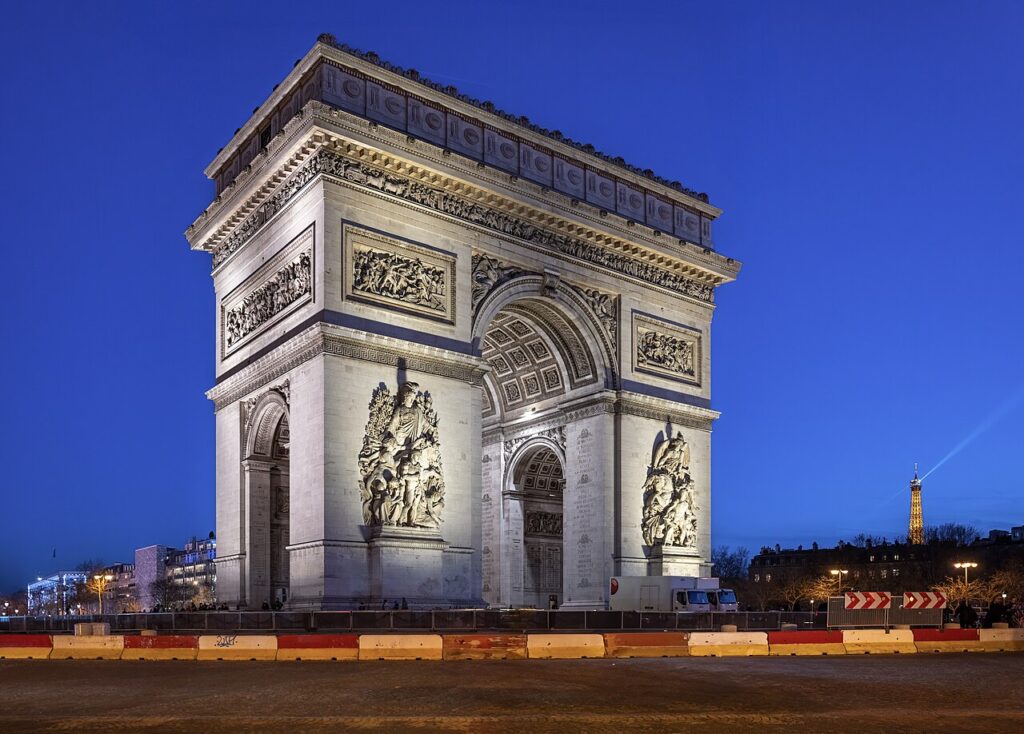
The Arc de Triomphe stands at the center of Place Charles de Gaulle, where twelve avenues converge in a chaotic ballet of Parisian traffic. Napoleon commissioned this triumphal arch in 1806 to honor his Grande Armée, though he never saw it completed. Today, it’s one of Paris’s most recognizable monuments and offers some of the city’s best panoramic views.
Unlike the Eiffel Tower, the Arc de Triomphe rewards visitors with a unique perspective: you’re standing at the exact center of the Étoile (the star), looking down the Champs-Élysées toward the Louvre in one direction and out toward La Défense in the other. It’s worth the climb.
Getting There and Inside
Never, ever attempt to cross the roundabout at street level. Twelve avenues of unregulated traffic make Place Charles de Gaulle one of Europe’s most dangerous intersections. Instead, use the underground pedestrian tunnel. The entrance is on the right side of the Champs-Élysées as you face the Arc, near the Métro station Charles de Gaulle-Étoile.
The monument itself is free to enter if you have the Paris Museum Pass, which covers the climb to the top. Otherwise, tickets are €13 for adults, free for EU residents under 26. Lines can stretch long during summer afternoons, so arrive early—the Arc opens at 10 a.m. most days. If you’re visiting between April and September, evening visits around 8 or 9 p.m. offer softer light and smaller crowds.
There’s no elevator. You’ll climb 284 steps on a narrow spiral staircase. It’s manageable for most visitors, with a small museum gallery halfway up where you can catch your breath.
What You’ll See
The Arc de Triomphe tells the story of Napoleonic France through massive relief sculptures. On the side facing the Champs-Élysées, look for François Rude’s La Marseillaise (officially called The Departure of the Volunteers of 1792), depicting French citizens rallying to defend the Republic. The names of 128 battles and 558 generals are inscribed on the inner walls—those who died in battle are underlined.
At the base of the Arc, beneath the monument’s vault, lies the Tomb of the Unknown Soldier from World War I. The eternal flame is rekindled every evening at 6:30 p.m. in a simple ceremony that’s open to the public. It’s a moment of quiet dignity amid the surrounding chaos of traffic and tourists.
The small museum on the upper level explains the Arc’s construction and Napoleon’s vision. You’ll see how the monument evolved, was completed long after Napoleon’s death in 1836, and became a symbol for French national celebrations and commemorations, from Victor Hugo’s funeral procession to the Liberation of Paris in 1944.
The Rooftop Terrace
The observation deck at the top delivers 360-degree views that help you understand Paris’s layout. The city unfolds in a near-perfect geometric pattern: the twelve avenues radiating outward, the green corridor of the Champs-Élysées leading to the Tuileries and the Louvre, Montmartre and Sacré-Cœur rising to the north, and the business district of La Défense stretching west.
Bring your camera. From here, you can photograph the Eiffel Tower without hordes of tourists in the frame. The golden dome of Les Invalides gleams to the south. On clear days, you can trace the Seine as it curves through the city.
The terrace isn’t huge, so it gets crowded mid-day. Early morning visits—right when it opens—give you the space to linger and appreciate the view. Late evening in summer means you can watch the Eiffel Tower’s hourly light show from this perfect vantage point.
Practical Tips
The Arc de Triomphe sits in a wealthy, tourist-heavy area, so nearby cafés charge accordingly. If you want coffee or a meal, walk a few blocks away from the Étoile—head up Avenue de Wagram or Avenue de la Grande Armée for better value and fewer crowds.
If you’re doing a full day of monument-hopping, the Paris Museum Pass makes sense. It includes the Arc de Triomphe, Sainte-Chapelle, the Louvre, Versailles, and dozens of other sites, plus it lets you skip most ticket lines. For first-time visitors covering major monuments in a few days, it pays for itself.
The Métro stop Charles de Gaulle-Étoile serves six different lines (1, 2, 6, and RER A), making the Arc one of the most accessible monuments in Paris. If you’re staying in the Marais, Saint-Germain, or the Latin Quarter, you’re twenty minutes away at most.
Photography inside the monument is allowed, though tripods aren’t. The spiral staircase is atmospheric but tight—you’ll be squeezing past people coming down as you climb up.
Want more insider tips like these delivered to your inbox? Subscribe to the Love Paris newsletter—one short story about the city every day.
Tours & experiences in Paris


Powered by Viator. Some links are affiliate links — we may earn a small commission at no extra cost to you.