
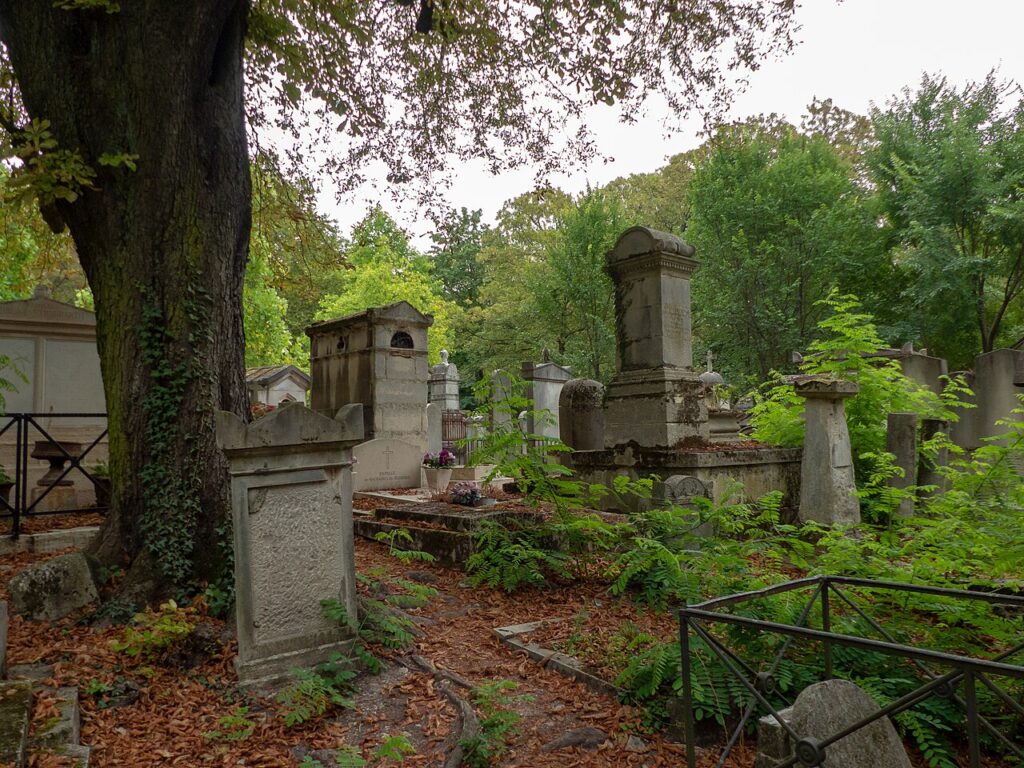
Père Lachaise Cemetery sprawls across 110 acres in the 20th arrondissement, where rows of chestnut trees shade weathered gravestones and elaborate mausoleums. This isn’t a somber place—it’s one of Paris’s most peaceful gardens, where locals jog along tree-lined avenues and visitors discover sculpture, architecture, and stories at every turn.
Since opening in 1804, Père Lachaise has become the world’s most visited cemetery, attracting more than three million people each year. They come to pay respects to Jim Morrison and Oscar Wilde, but they stay for the unexpected beauty: art nouveau chapels, sleeping stone angels, and quiet corners that feel a world away from the city below.
Finding the Famous and the Forgotten
The cemetery’s most visited grave belongs to Jim Morrison, lead singer of The Doors, who died in Paris in 1971. His simple flat stone in Division 6 is usually surrounded by flowers, handwritten notes, and fellow music lovers. Security guards keep a close watch—the site has seen its share of vandalism over the decades.
Oscar Wilde’s tomb, designed by Jacob Epstein, sits in Division 89 behind a glass barrier installed after decades of lipstick kisses damaged the stone. The modernist winged figure still draws admirers who leave flowers and notes for the Irish wit who spent his final years in Paris.
Édith Piaf rests in Division 97, her black granite tomb often decorated with fresh roses. Nearby, you’ll find Frédéric Chopin (Division 11), Marcel Proust (Division 85), and Gertrude Stein with Alice B. Toklas (Division 94). The cemetery office near the main entrance on Boulevard de Ménilmontant provides free maps marking notable graves.
Architecture Worth the Climb
Père Lachaise sits on a hillside, and the climb rewards you with Gothic Revival chapels, Egyptian obelisks, and elaborate family mausoleums that showcase two centuries of funerary art. The Monuments aux Morts in Division 97 commemorates those who died in World War I, while the Mur des Fédérés in Division 76 marks where Communard rebels were executed in 1871.
Some of the most beautiful architecture appears on lesser-known tombs. The Casimir Perier monument features bronze doors you can peer through to see the family crypt. The Famille Greffulhe tomb displays exquisite art nouveau metalwork. The chapels scattered throughout—some dating to the early 1800s—mix neoclassical symmetry with Romantic excess.
Don’t miss the columbarium near the main entrance, where rows of niches hold cremation urns in a surprisingly intimate space. Isadora Duncan, Maria Callas, and Max Ophüls rest here.
When to Visit and How to Get There
Père Lachaise opens daily at 8:00 a.m. (8:30 a.m. on Saturdays, 9:00 a.m. on Sundays) and closes between 5:30 p.m. and 6:00 p.m. depending on season. Entry is free.
The cemetery has five entrances, but most visitors use the main gate on Boulevard de Ménilmontant, accessible via Métro lines 2 (Père Lachaise or Philippe Auguste stations) or line 3 (Gambetta station). The Gambetta entrance at the cemetery’s highest point lets you walk downhill—easier on the legs.
Spring brings cherry blossoms and lilacs. Autumn turns the chestnut trees golden. Winter mornings, when mist settles between the tombs, create an atmospheric mood. Weekday mornings before 10:00 a.m. offer the quietest experience, though you’ll always share the paths with joggers and locals taking shortcuts through the grounds.
Wear comfortable walking shoes—the cobblestone paths and hills make this genuine exercise. Bring water, especially in summer, as the cemetery has only one small café near the main entrance.
Beyond the Famous Names
Père Lachaise rewards wandering. Follow the small paths between divisions to discover anonymous graves overgrown with ivy, benches tucked under ancient trees, and sculptures that range from serene to unsettling. The old Jewish section in Division 7 contains some of the cemetery’s oldest graves, many with Hebrew inscriptions weathered by two centuries.
Bird watchers bring binoculars—the cemetery is home to more than 40 bird species, including tawny owls that nest in the older mausoleums. In spring, you might spot hedgehogs rustling through fallen leaves.
The cemetery’s official app provides audio guides and themed walking routes, though many visitors prefer to explore without a plan, letting the paths lead where they will. That’s when you stumble upon a stone angel with a heartbreaking expression, or a tomb decorated with fresh flowers for someone who died 150 years ago.
Ready to discover more of Paris’s hidden corners and local favorites? Subscribe to the Love Paris newsletter and get one short story about the city delivered to your inbox every day.
Tours & experiences in Paris


Powered by Viator. Some links are affiliate links — we may earn a small commission at no extra cost to you.