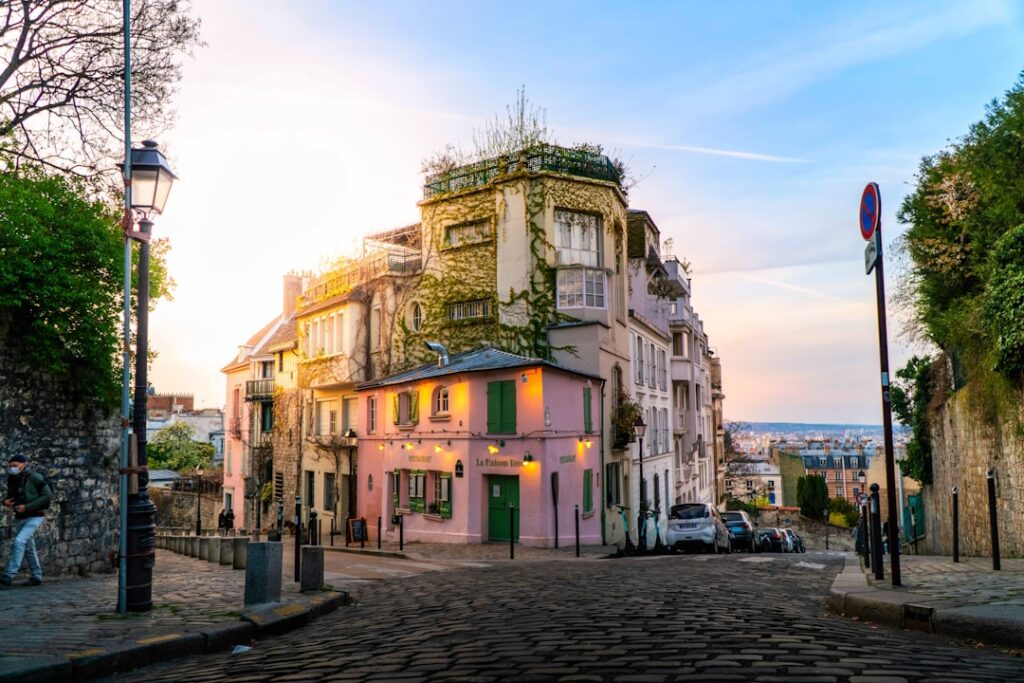
While tourists flock to Montmartre and the Marais, Belleville remains Paris as Parisians live it—a hillside neighborhood in the 19th and 20th arrondissements where street art covers entire buildings, markets spill onto sidewalks with produce from five continents, and locals gather in bistros that haven’t changed their zinc bars in decades. This is where Édith Piaf was born, where artists can still afford studios, and where you’ll find some of the best views in Paris without the crowds.
The Heart of Belleville: Rue de Belleville and Beyond
Rue de Belleville cuts through the neighborhood like a spine, climbing from the Belleville métro station up toward the Parc de Belleville. This main artery pulses with life, especially on Tuesday and Friday mornings when the Belleville market sets up between Boulevard de Belleville and Rue du Faubourg du Temple. You’ll find North African spice vendors next to Chinese fishmongers, Vietnamese herb stalls beside Senegalese fabric sellers—a reflection of the neighborhood’s deeply multicultural character.
Start your exploration at the Belleville métro (lines 2 and 11). Walk uphill along Rue de Belleville, stopping at Aux Folies, a classic corner café at number 8 where locals have been taking their morning coffee since 1918. The zinc bar, mosaic floor, and Art Nouveau details remain untouched. Continue uphill and you’ll pass Chinese bakeries selling custard buns, Tunisian grocers with bins of dates and preserved lemons, and the occasional traditional French boulangerie holding its ground.
Turn onto Rue Denoyez, a narrow pedestrian street that’s become Belleville’s open-air gallery. Every surface—walls, doors, shutters, even the ground—is covered in street art that changes constantly. The bar Aux Folies Belleville (not to be confused with Aux Folies) anchors the street, hosting live music most nights and serving cheap beer to artists and students on its graffiti-covered terrace.
Parc de Belleville: Paris’s Best View You’ve Never Heard Of
At the top of the hill, Parc de Belleville offers what many argue is the finest panoramic view of Paris. From the upper terrace at 108 meters above sea level, you can see from Montmartre to the Eiffel Tower, across the entire Right Bank. Unlike the view from Sacré-Cœur, you’ll likely share this one with neighborhood families and joggers rather than tour groups.
The park itself cascades down the hillside in terraces, with fountains, vine-covered pergolas, and the Maison de l’Air (a small free museum about air quality and atmospheric science—quirky and worth ten minutes). Come at sunset with a bottle of wine from one of the natural wine shops on Rue des Panoyaux, and you’ll understand why artists and writers have been drawn to Belleville for generations.
The best entrance is from Rue Piat, which leads you to the top terrace. If you’re coming from Rue de Belleville, you’ll enter lower down and climb up through the gardens.
Eating and Drinking Like a Local
Belleville’s dining scene reflects its working-class roots and immigrant communities. You won’t find Michelin stars, but you will eat extraordinarily well for half what you’d pay in Saint-Germain.
For Chinese food, head to Rue de Belleville’s lower section near the Belleville métro. Raviolis Chinois du Nord-Est (number 16) serves hand-pulled noodles and soup dumplings at shared tables—cash only, minimal French, maximum flavor. Le Président (number 123) does exceptional Sichuan dishes in a no-frills dining room.
Le Baratin on Rue Jouye-Rouve is a neighborhood institution—a tiny bistro where chef Raquel Carena cooks seasonal French food with a personal touch. Reserve ahead; locals book this place solid. For natural wine and small plates, Aux Deux Amis on Rue Oberkampf (technically in the 11th but on Belleville’s border) pours excellent wines by the glass and serves charcuterie, cheese, and whatever the chef felt like making that day.
Boulangerie Etienne on Rue de Ménilmontant bakes some of Paris’s best baguettes—they’ve won awards—and their almond croissants on weekends are worth the line. Get there before 10 a.m. or they’ll be sold out.
Practical Tips for Visiting Belleville
Take the métro to Belleville (lines 2, 11), Pyrénées (line 11), or Jourdain (line 11) depending on which part of the neighborhood you want to explore. All three put you within easy walking distance of the main sights.
Come on a Tuesday or Friday morning for the market, which runs roughly 7 a.m. to 2:30 p.m. Arrive before noon for the best selection. Wednesday and Saturday mornings, a smaller market sets up at Place de la Réunion in the southern part of Belleville.
The neighborhood is safe, but it’s a working neighborhood, not a polished tourist district. Keep normal city awareness, especially at night. The streets can be steep—wear comfortable shoes.
Belleville is best explored slowly, on foot, with time to wander side streets and duck into shops. Give yourself a half day minimum. Combine it with nearby Père Lachaise cemetery (a 15-minute walk from Parc de Belleville) for a full day in the 20th arrondissement.
This is Paris without pretense—real, multicultural, and evolving. While gentrification edges in (notice the organic grocery stores and specialty coffee shops), Belleville retains its soul as a neighborhood where people actually live, work, and gather. It’s Paris as it feels, not just as it looks.
Want more hidden corners and neighborhood secrets delivered to your inbox? Subscribe to the Love Paris newsletter and get one short Paris story every day—the city beyond the guidebooks, one discovery at a time.
Tours & experiences in Paris


Powered by Viator. Some links are affiliate links — we may earn a small commission at no extra cost to you.