
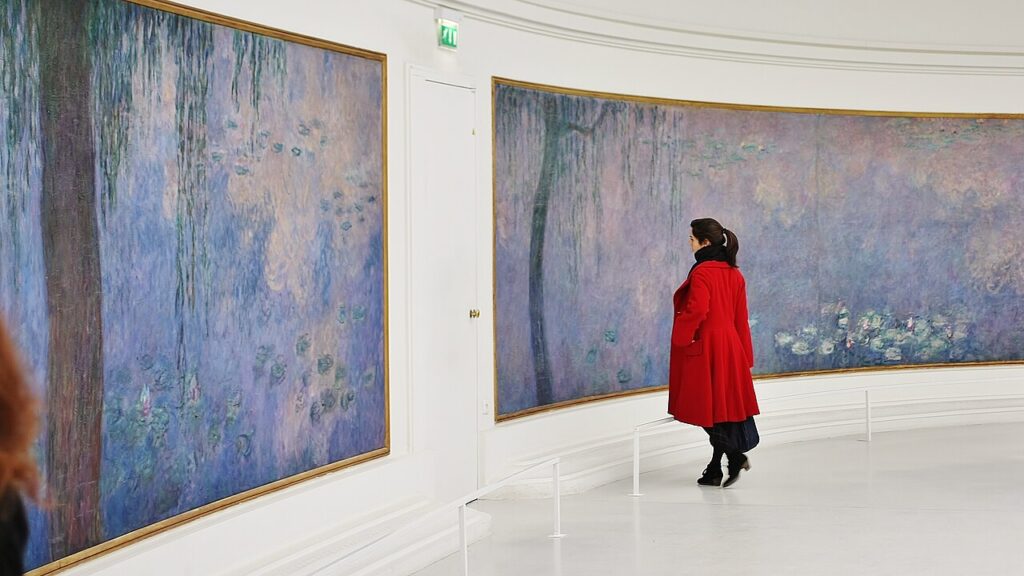
While the Louvre and Musée d’Orsay draw enormous crowds, the Musée de l’Orangerie remains one of Paris’s most rewarding and undervisited museums. Located at the western end of the Tuileries Garden overlooking Place de la Concorde, this intimate gallery offers something rare in Paris: the chance to stand alone in front of masterpieces.
The museum’s crown jewels are Claude Monet‘s monumental Water Lilies (Les Nymphéas), eight enormous curved panels that wrap around two oval rooms on the upper floor. But the treasures don’t stop there. Downstairs, the Jean Walter and Paul Guillaume collection holds exceptional works by Cézanne, Renoir, Matisse, Picasso, and Modigliani that many visitors never even know exist.
Monet’s Water Lilies: An Immersive Experience
Monet designed these enormous canvases specifically for the Orangerie, donating them to the French state the day after the Armistice in 1918. He spent the final years of his life perfecting them at his Giverny garden, working nearly blind to complete his vision of an endless watery horizon.
The two oval rooms are intentionally spare and flooded with natural light from skylights above. There are benches in the center of each room—sit down, stay awhile, and let your eyes adjust. The paintings shift as clouds pass overhead and the light changes. Morning visits offer the softest illumination, while late afternoon brings warmer tones that make the lilies glow.
Unlike the Louvre or Orsay, you can often have these rooms nearly to yourself, especially on weekday mornings. The quiet is part of the experience. Monet wanted viewers to feel surrounded by water, to lose themselves in the reflections and colors. Give yourself at least 20 minutes in these rooms—they reveal more the longer you look.
The Hidden Collection Downstairs
Most visitors leave after seeing the Water Lilies, missing the extraordinary collection on the lower level. The Jean Walter and Paul Guillaume collection features 144 works spanning Impressionism to the 1930s, displayed in beautifully lit galleries that feel more like a private home than a major museum.
Here you’ll find Cézanne’s Apples and Biscuits, Renoir’s luminous portraits of women, Modigliani’s elongated figures, and Rousseau’s dreamlike jungle scenes. There’s a wonderful concentration of Soutine’s expressionist landscapes and still lifes, as well as significant works by Matisse, Picasso during his classical period, and Marie Laurencin’s pastel portraits.
The intimate scale makes it easy to spend time with individual paintings. The Renoirs in particular benefit from close viewing—you can see every brushstroke in his portraits of bathers and dancers. Don’t rush. This collection deserves at least 45 minutes.
Planning Your Visit
The Orangerie is open Wednesday through Monday from 9:00 a.m. to 6:00 p.m., closed Tuesdays. It’s located at the Place de la Concorde end of the Tuileries, accessible via the Concorde métro station (lines 1, 8, and 12). The entrance is clearly marked on the terrace overlooking the garden.
Tickets cost €12.50 and can be purchased online in advance, which I strongly recommend to skip the line. The museum is included in the Paris Museum Pass, making it an excellent addition to a multi-day itinerary. Audio guides are available in English for €5 and provide helpful context for both Monet’s process and the downstairs collection.
The best time to visit is Wednesday or Thursday morning right when doors open at 9:00 a.m. You’ll have the Water Lilies rooms almost entirely to yourself. Avoid weekends and the first Sunday of each month, when admission is free and crowds swell significantly.
The museum is compact—you can see everything comfortably in 90 minutes to two hours. There’s a small bookshop with excellent art books and prints, and clean restrooms on the lower level. No café, but you’re steps from Angelina on Rue de Rivoli if you want hot chocolate afterward, or dozens of cafés in the Tuileries during warm weather.
Making the Most of Your Visit
Combine the Orangerie with a walk through the Tuileries Garden—it’s one of the most pleasant museum approaches in Paris. You can also easily pair it with the nearby Jeu de Paume, a photography and contemporary art museum in the opposite corner of the Tuileries, or walk along the Seine to the Orsay.
Photography is permitted without flash, and the Water Lilies rooms are particularly photogenic in morning light. But do put your phone away for at least part of your visit. These paintings reward sustained attention in a way that’s increasingly rare in our distracted age.
If you’re planning to visit Giverny to see Monet’s gardens, come to the Orangerie first or after. Seeing where the water lilies were painted and where they ended up creates a powerful artistic journey that spans the final decades of Monet’s life.
Want more insider tips on Paris’s museums, neighborhoods, and hidden corners? Subscribe to the Love Paris newsletter and get one short story about the city delivered to your inbox each day.
Tours & experiences in Paris


Powered by Viator. Some links are affiliate links — we may earn a small commission at no extra cost to you.