
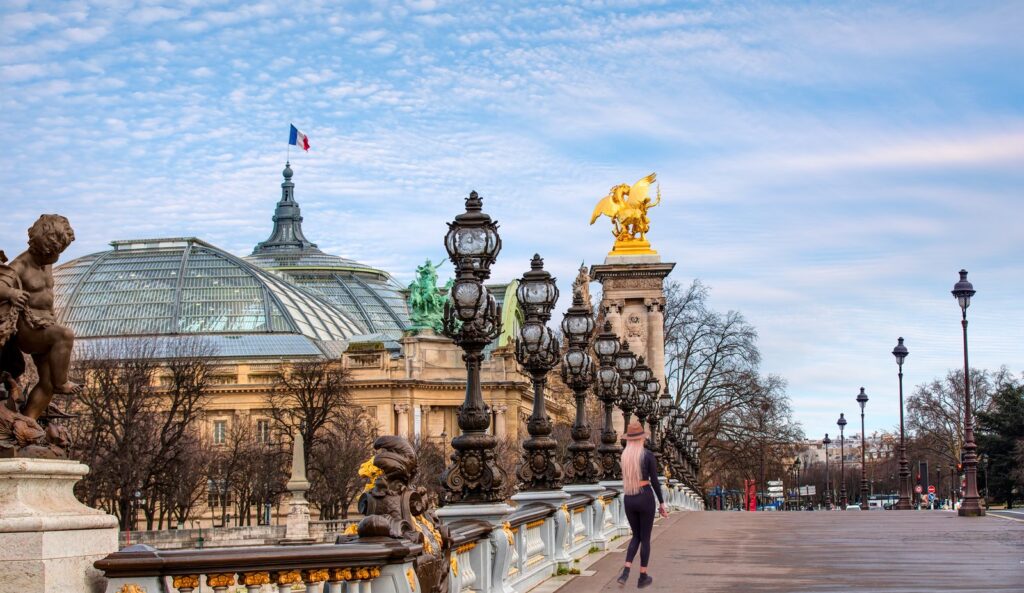
The Grand Palais rises along Avenue Winston Churchill like a crystalline palace, its magnificent glass dome visible from across the Seine. Built for the 1900 Exposition Universelle, this monument to the Belle Époque combines the elegance of classical French architecture with the daring innovation of iron-and-glass construction. Today it hosts some of Paris’s most important art exhibitions and cultural events beneath what remains one of the largest glass roofs in Europe.
The building itself is the spectacle—70,000 square feet of glass flooding the Grand Nave with natural light, supported by Art Nouveau ironwork that seems to defy gravity. Whether you’re visiting for a blockbuster exhibition or simply to admire the architecture, the Grand Palais offers a perspective on Paris that few monuments can match.
The Grand Nave and Its Architecture
The heart of the Grand Palais is its Grand Nave, a cathedral-like space stretching 787 feet long and rising 148 feet at its highest point. The glass-and-steel vault filters daylight through pale blue glass panels, creating an atmosphere that shifts with the weather and time of day. Engineers used 8,500 tons of steel to create this structure, a technical marvel that put Paris at the forefront of modern construction.
The Paris most visitors miss
Our free 8-page PDF guide: 25 places, from Galerie Vivienne's 1880 mosaic floor to Canal Saint-Martin's locks, each linked to its official site.
Walk the perimeter to appreciate the architectural details: ornate friezes depicting the arts and sciences, mosaic-covered pillars, and the iconic bronze quadrigas that crown each corner of the building. The stone façades facing Avenue Winston Churchill and the Champs-Élysées feature classical columns and sculptural groups representing French painting, sculpture, and architecture.
Access the building through the main entrance on Avenue du Général Eisenhower. Metro Champs-Élysées-Clémenceau (lines 1 and 13) brings you within a two-minute walk. The nave itself is only open during exhibitions and events, so check the official Grand Palais website before you visit to see what’s on and when you can enter.
Major Exhibitions and Cultural Events
The Grand Palais has become synonymous with large-scale art exhibitions that draw crowds from across Europe. The Galeries Nationales, managed by the Réunion des Musées Nationaux, presents two or three major shows each year—retrospectives of masters like Monet, Picasso, or Velázquez, or thematic exhibitions exploring artistic movements and periods.
These blockbuster shows require advance booking, often weeks ahead for weekend slots. Weekday mornings, especially Tuesday and Wednesday, see lighter crowds. Late-evening openings on certain days let you experience the nave under artificial lighting, a completely different atmosphere from the sun-drenched daytime visits.
The building also hosts Paris Photo each November, one of the world’s leading photography fairs, and the Saut Hermès equestrian competition in March, when show jumpers compete beneath the glass dome in an unforgettable setting. FIAC, the contemporary art fair, occupied the space for years before moving to the Grand Palais Éphémère near the Eiffel Tower during renovation work.
The Palais de la Découverte
The west wing of the Grand Palais is home to the Palais de la Découverte, Paris’s science museum, founded in 1937. Its activities moved out when the Grand Palais renovation began in 2020, and the building is not open to visitors yet: in February 2026 the French government said the works could not be handed over on the original timetable and gave 2027 as the target for reopening (official answer, Assemblée nationale). Checked October 2026.
Visiting Practicalities
The Grand Palais sits at the intersection of several major tourist routes. You can combine it with a walk through the Champs-Élysées gardens, cross the Pont Alexandre III to reach the Invalides and Rodin Museum, or follow Avenue Winston Churchill down to the Place de la Concorde and the Tuileries.
The Grand Palais reopened in June 2025 after its renovation. Opening hours depend on what is on, so check the official Grand Palais website before you travel.
Spring and autumn bring the most comfortable conditions for visiting—the glass roof can turn the nave into a greenhouse during summer heat waves, and winter temperatures inside can be surprisingly cool. Dress in layers and wear comfortable shoes; you’ll be standing and walking for extended periods during major exhibitions.
The café inside the building offers a convenient stop for coffee and light meals, though the surrounding neighborhood—particularly along Avenue Franklin D. Roosevelt and Avenue Montaigne—provides plenty of alternatives if you’re looking for something more substantial before or after your visit.
Tours & experiences in Paris


Powered by Viator. Some links are affiliate links — we may earn a small commission at no extra cost to you.