
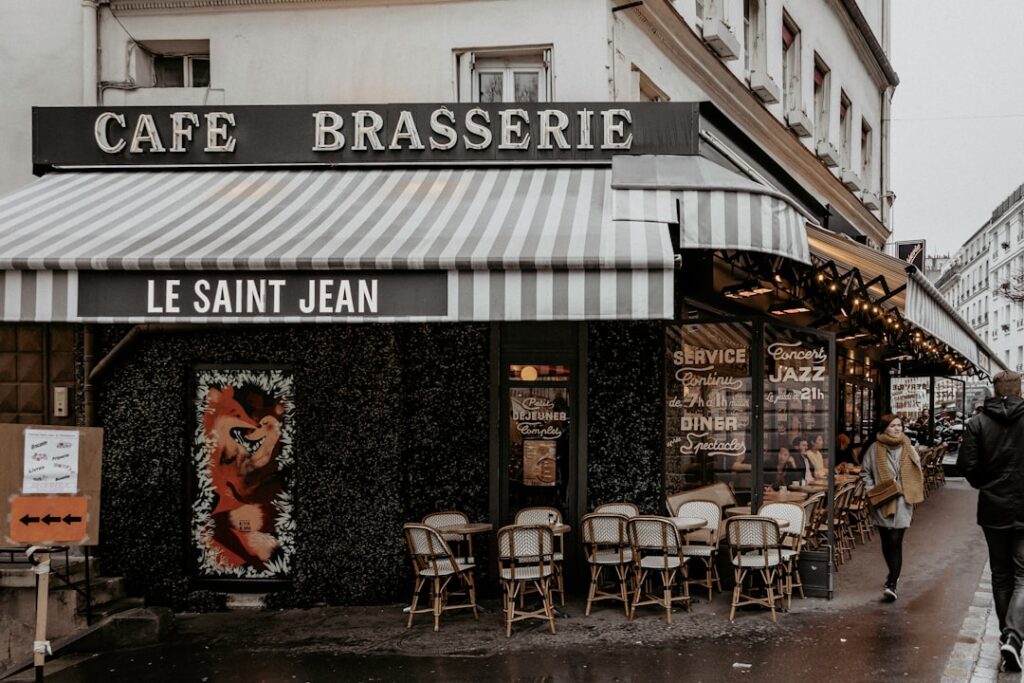
Saint-Germain-des-Prés occupies a special place in the Paris imagination. This Left Bank neighborhood, centered around the ancient church that gives it its name, was ground zero for existentialism, jazz, and the postwar literary scene. Today it remains one of the city’s most sophisticated quarters, where historic cafés stand alongside art galleries, rare bookshops, and some of Paris’s finest boutiques.
Walking these streets, you’re tracing the footsteps of Hemingway, Fitzgerald, Sartre, de Beauvoir, Camus, and countless others who made Saint-Germain synonymous with intellectual Paris. But this isn’t a museum neighborhood—it’s vibrantly alive, blending its storied past with contemporary culture.
The Literary Cafés: Where Ideas Were Born
Start at Café de Flore on Boulevard Saint-Germain, the most famous of the neighborhood’s literary haunts. Sartre and de Beauvoir held court here daily during the 1940s, writing at their regular table on the second floor. The Art Deco interior hasn’t changed much since then. Order a café crème, claim a red banquette, and watch the neighborhood go by.
Directly across the street, Les Deux Magots draws its own devoted following. Named for the two Chinese figurines inside, this café was Hemingway’s preferred spot and hosted everyone from Picasso to Verlaine. The hot chocolate here is legendary—thick, dark, and served in porcelain pots.
A few blocks away on Rue de l’Abbaye, Café de la Mairie offers a quieter alternative. This corner café faces the lovely Place Saint-Sulpice and its baroque church. It’s where locals actually drink, with reasonable prices and tables that spill onto the square in warm weather.
Bookshops and Hidden Literary Corners
Saint-Germain remains Paris’s premier book district. Librairie La Hune on Boulevard Saint-Germain specializes in art, architecture, and photography books, staying open until midnight for dedicated bibliophiles. Around the corner on Rue Bonaparte, browse the academic titles at Librairie Compagnie, a three-story temple to French literature and philosophy.
Don’t miss Rue de l’Échaudé and Rue Cardinale, two remarkably preserved 17th-century streets that escaped Haussmann’s renovations. These narrow lanes, lined with ivy-covered buildings and antique shops, feel frozen in time. Rue Cardinale dead-ends at a passageway leading to Cour de Rohan, a series of three interconnected medieval courtyards that few visitors discover.
The Church and the Market
Église Saint-Germain-des-Prés, the neighborhood’s namesake, is Paris’s oldest church, dating to the 6th century. The Romanesque bell tower survived the Revolution, and the interior preserves medieval columns and 19th-century frescoes. It’s free to enter, quiet, and deeply atmospheric—a thousand years of Paris history in one space.
On Sunday mornings, Marché Saint-Germain fills the covered market hall on Rue Lobineau. Locals shop for cheese, charcuterie, flowers, and produce, then stop for oysters and white wine at the seafood counter. The market building itself, rebuilt in the 1990s, also houses boutiques and a small grocery for weekday provisions.
Getting There and Making the Most of Your Visit
The Saint-Germain-des-Prés métro station (Line 4) puts you in the heart of the neighborhood. You can also arrive via Mabillon (Line 10) or Saint-Sulpice (Line 4). The area is best explored on foot—everything mentioned here falls within a comfortable twenty-minute walk.
Come in the late afternoon when galleries open after lunch, then stay for apéritif at one of the boulevard cafés. Weekday mornings are quieter if you want to browse bookshops without crowds. The neighborhood is beautiful year-round, though spring and fall bring the most pleasant weather for lingering at outdoor tables.
For the best pastries, stop at Pierre Hermé on Rue Bonaparte for macarons, or Gérard Mulot on Rue de Seine for classic French tarts and croissants. Both are neighborhood institutions.
Saint-Germain-des-Prés rewards slow exploration. This is a neighborhood for wandering without strict itineraries, for discovering courtyards and passages, for spending an hour over coffee with a book. The writers who made it famous understood that the best Paris is experienced at a walking pace, with time to notice the details that make each street corner its own small world.
Want more Paris stories like this? Subscribe to the Love Paris newsletter and get one short story about Paris delivered to your inbox every day—the neighborhoods, cafés, hidden corners, and insider tips that make this city unforgettable.
Tours & experiences in Paris


Powered by Viator. Some links are affiliate links — we may earn a small commission at no extra cost to you.