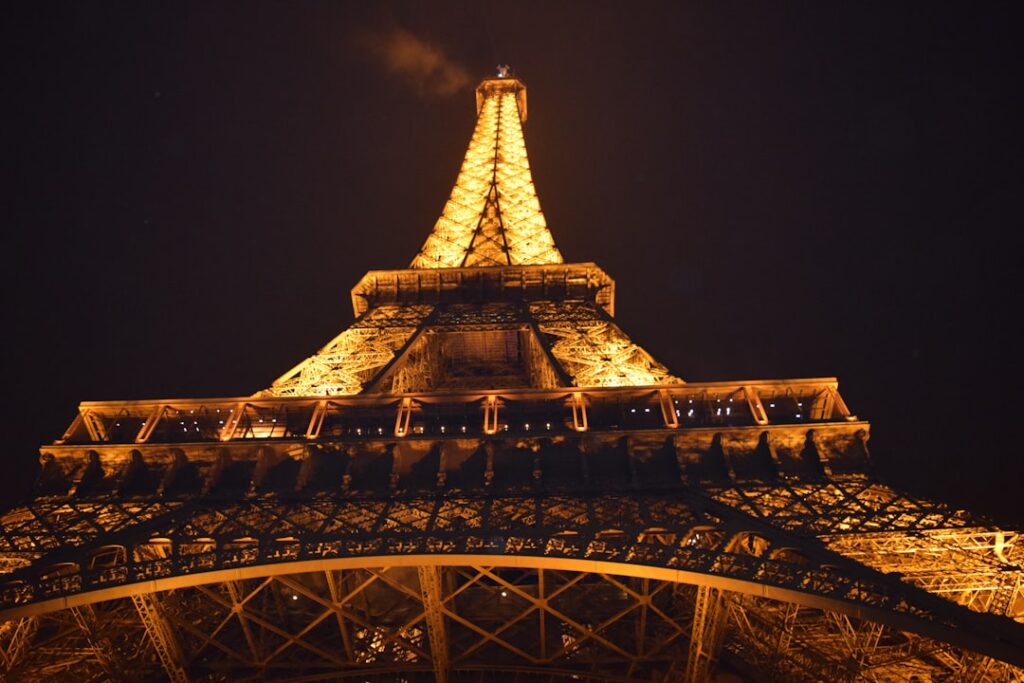
Every evening, the Eiffel Tower transforms into a glittering beacon of light, sparkling for five minutes at the top of every hour until 1 a.m. (2 a.m. in summer). It’s one of Paris’s most enchanting free shows, and yet many visitors miss it entirely or settle for a rushed glimpse. Here’s how to experience the spectacle properly.
Understanding the Light Show Schedule
The Eiffel Tower’s golden illumination switches on at sunset year-round, creating a warm glow visible across the city. The famous sparkle—20,000 bulbs flashing in a champagne-like cascade—begins at nightfall and repeats every hour on the hour for five minutes.
In winter, the first sparkle might occur as early as 6 p.m., while summer visitors should wait until after 10 p.m. for true darkness. The final show begins at 1 a.m. most nights, extended to 2 a.m. during peak summer months from mid-June through early September. Plan to arrive at your viewing spot at least ten minutes before the hour to settle in.
The tower’s beacon—two powerful beams sweeping across the Paris skyline—operates simultaneously with the sparkle, visible for up to 80 kilometers on clear nights.
The Best Viewing Spots
The Trocadéro esplanade offers the classic frontal view, but it’s packed with tourists and street vendors. For a better experience, walk down the Trocadéro stairs to the lower gardens between the two wings of the Palais de Chaillot. You’ll escape most of the crowds while keeping the perfect symmetrical view.
The Champ de Mars, directly beneath the tower, provides a dramatic upward perspective. Spread a blanket on the lawn (legal until the park closes around 12:30 a.m.) and watch the lights cascade above you. The park’s central pathway offers an unobstructed sightline, particularly beautiful when framed by the rows of trees.
Pont de Bir-Hakeim, the two-level bridge from the 15th arrondissement, gives you the tower framed by the bridge’s iron architecture—a favorite spot for photographers. Arrive early; it fills up fast.
For a Seine-level view, book an evening river cruise departing around sunset. You’ll catch the sparkle from the water, with Notre-Dame and the Louvre as bonus illuminations. Many cruises time their route to pass the tower right at the top of the hour.
Going Up the Tower After Dark
Visiting the Eiffel Tower itself at night offers an entirely different experience than daytime crowds. The city spreads below you in a sea of golden lights, with major monuments—the Arc de Triomphe, Sacré-Cœur, Notre-Dame—spotlit against the darkness.
Book your tickets online weeks in advance, specifying an evening time slot. The last elevator to the summit departs at 10:45 p.m. (11:45 p.m. in summer). Tickets for the second floor run about €18.80 for adults, summit access €29.40. Lines are shorter after 8 p.m., but the experience is priceless.
You cannot see the sparkle from the tower itself—you’re inside it—so plan your visit for shortly after an hourly show, then descend in time to watch the next one from ground level.
Insider Tips for the Perfect Evening
Bring a bottle of wine and cheese for a Champ de Mars picnic—perfectly legal and quintessentially Parisian. The small Franprix supermarket on Avenue de la Bourdonnais stocks everything you need.
Photography note: the sparkle itself is copyrighted for commercial use, but personal photos are fine. Use a tripod or steady surface for the best shots, setting your camera to a longer exposure to capture the golden glow with the sparkle overlaid.
Skip the immediate area restaurants, where quality plummets and prices soar. Walk ten minutes to Rue Cler, a charming market street with excellent bistros like Café du Marché or L’Éclair, where locals actually eat.
The tower sparkles year-round, in nearly all weather. Rain often means fewer crowds and dramatic clouds backlit by the beacon. Winter offers earlier darkness and the possibility of seeing the iron lattice dusted with snow between sparkles.
Take the Métro Line 6 (elevated between Passy and Bir-Hakeim stations) for a bonus view during your commute. Time it right, and you’ll catch the sparkle while crossing the Seine.
Whether you’re watching from Trocadéro’s gardens, the Champ de Mars lawn, or the tower’s second floor, the nightly sparkle never gets old. It’s the moment when Paris earns its nickname, the City of Light, fresh every single evening.
Want more Paris insider tips delivered to your inbox? Subscribe to the Love Paris newsletter and get one short story about the city you love every day.
Tours & experiences in Paris


Powered by Viator. Some links are affiliate links — we may earn a small commission at no extra cost to you.