
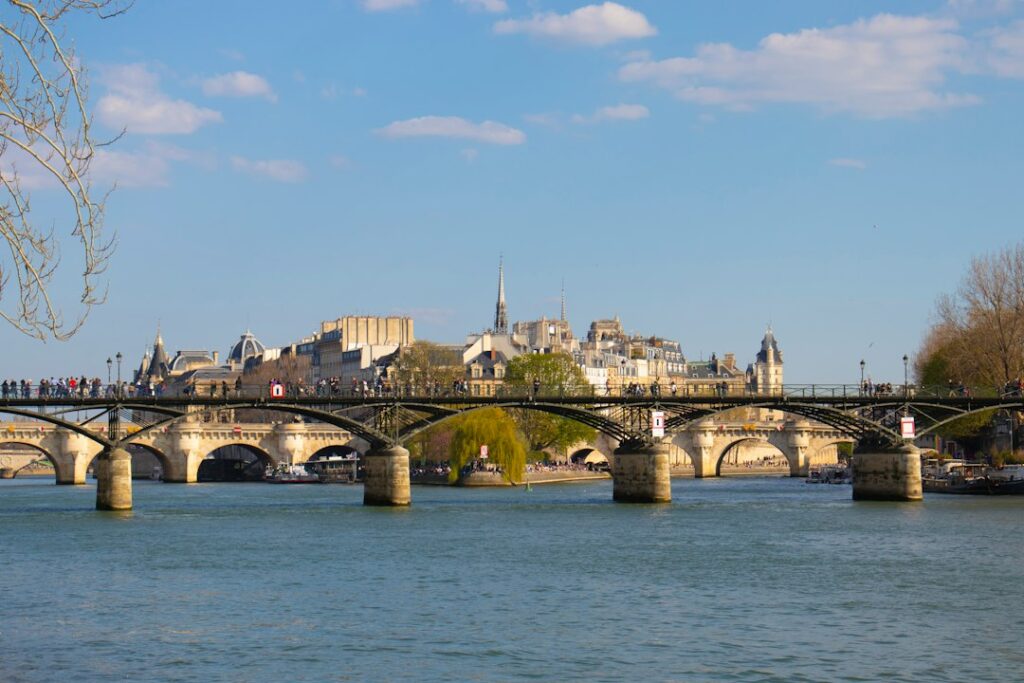
Paris began on two small islands in the middle of the Seine. Today, Île de la Cité and Île Saint-Louis remain among the city’s most enchanting destinations—compact, walkable, and packed with history. You can explore both in three hours, or spend an entire day wandering their narrow streets, crossing their bridges, and discovering why Parisians have cherished these islands for more than two millennia.
Connected by a single footbridge and just steps from the Latin Quarter and the Marais, these islands feel like a world apart from the wider city. One cradles Notre-Dame and the Palais de Justice; the other offers tree-lined quays, artisanal ice cream, and some of the most coveted addresses in Paris.
Île de la Cité: The Historic Heart
Île de la Cité is where Paris was born. The Parisii tribe settled here in the 3rd century BCE, and the island has been the city’s spiritual and administrative center ever since. Start at the western tip, Square du Vert-Galant, a triangular park at river level named for Henri IV. It’s one of the best picnic spots in Paris, with views of the Pont Neuf (ironically, the city’s oldest standing bridge) and both banks of the Seine.
Walk east along Quai de l’Horloge to see the Conciergerie, the former royal palace turned Revolutionary prison where Marie Antoinette spent her final days. The building’s Gothic towers and medieval halls are open to visitors daily. Just beyond it, Sainte-Chapelle rises like a jewel box—its 15 stained-glass windows flood the upper chapel with colored light on sunny days. Arrive right when it opens at 9 a.m. to avoid crowds.
Notre-Dame anchors the island’s eastern end. Though the cathedral remains under restoration following the 2019 fire, the square in front still draws visitors, and you can walk the perimeter to appreciate the flying buttresses and read the information panels documenting the reconstruction. The forecourt also marks Point Zéro, the bronze star embedded in the pavement from which all distances in France are measured.
Île Saint-Louis: Paris’s Most Elegant Village
Cross Pont Saint-Louis, the pedestrian bridge linking the two islands, and you step into a different world. Île Saint-Louis was farmland until the 17th century, when it was developed with elegant hôtels particuliers (private mansions) and townhouses. Many still stand, their cream-colored facades lining Rue Saint-Louis-en-l’Île, the island’s single main street.
This is one of the most atmospheric walks in Paris. Start at the western tip near Pont Louis-Philippe, where a small park offers views of the Marais and Hôtel de Ville. Stroll east along Rue Saint-Louis-en-l’Île, stopping at Berthillon (31 Rue Saint-Louis-en-l’Île) for what many consider the city’s finest ice cream—flavors like salted caramel, wild strawberry, and Armagnac prune have drawn lines since 1954. The shop closes in August, but several nearby cafés serve Berthillon year-round.
Wander the narrow side streets—Rue Poulletier, Rue Le Regrattier, Rue de Bretonvilliers—where 17th-century buildings lean slightly toward each other and window boxes spill geraniums in summer. The island’s perimeter quays are perfect for an evening walk, especially Quai de Bourbon on the north side, where you can watch the sunset behind the Panthéon.
Where to Eat and Drink
Both islands offer everything from casual cafés to Michelin-starred dining. On Île de la Cité, Le Caveau du Palais (19 Place Dauphine) serves classic bistro fare on one of Paris’s prettiest squares. Place Dauphine itself, a triangular pocket of calm behind the Palais de Justice, is ideal for a late lunch under the trees.
Île Saint-Louis has a higher concentration of restaurants, many with Seine-side terraces. Brasserie de l’Île Saint-Louis (55 Quai de Bourbon) offers Alsatian specialties and outdoor seating overlooking the water. For a splurge, Le Sergent Recruteur (41 Rue Saint-Louis-en-l’Île) serves inventive French cuisine in a 17th-century space with exposed beams.
Don’t miss Café Saint-Régis (6 Rue Jean du Bellay), a corner café with red awnings where locals read Le Monde over morning coffee. It’s been here since 1950 and still feels entirely untouched by tourism, despite being steps from Notre-Dame.
Practical Tips for Visiting
Both islands are easily reached by métro. Cité station (Line 4) deposits you in the center of Île de la Cité, while Pont Marie (Line 7) brings you to the western end of Île Saint-Louis. You can also arrive on foot via any of the nine bridges connecting the islands to the rest of Paris—Pont de l’Archevêché, on the south side of Île de la Cité, offers classic views of Notre-Dame’s apse and flying buttresses.
Visit early morning or late afternoon to see the islands at their best. By 10 a.m., tour groups descend on Sainte-Chapelle and the square in front of Notre-Dame. After 6 p.m., when most day-trippers have left, the quays and side streets regain their quiet, residential character. Sunset from Quai d’Orléans, on the southern edge of Île Saint-Louis, is particularly beautiful.
Bring comfortable shoes—the islands are small, but the cobblestones and uneven pavement reward slow exploration. And if you’re planning to visit Sainte-Chapelle or the Conciergerie, buy tickets online in advance to skip the often-lengthy security lines.
These two islands, where Paris began and where it still reveals its most intimate face, reward visitors who take their time. Wander slowly, pause on the bridges, and let the rhythm of the Seine set your pace.
Want more stories about the hidden corners and timeless classics of Paris? Subscribe to the Love Paris newsletter and get one short story a day, delivered straight to your inbox.
Tours & experiences in Paris


Powered by Viator. Some links are affiliate links — we may earn a small commission at no extra cost to you.